
Sky This Week is brought to you in part by Celestron.
Friday, April 24
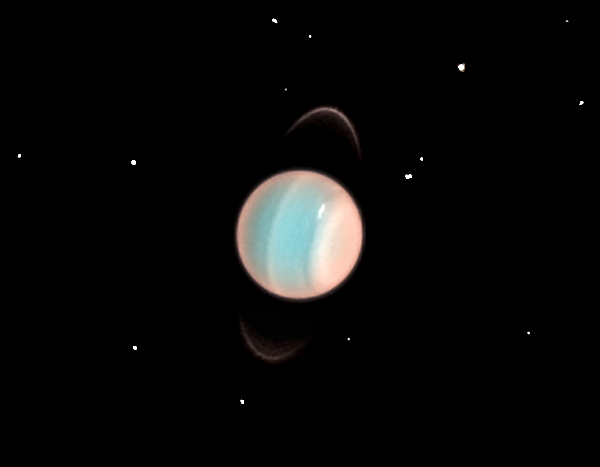
Venus passes 0.8° due north of Uranus at 1 A.M. EDT. After their close conjunction yesterday, the two remain within 1.5° of each other in the evening sky tonight, offering a second chance to spot them in a single field of view with your telescope.
Look west an hour after sunset, and you’ll spot a bright point of light just to the left of the slowly appearing Pleiades star cluster. That light is magnitude –3.9 Venus, your guidepost to finding much fainter Uranus. Center Venus in binoculars or a telescope, and look about 1.5° southwest. You should spot a much fainter (magnitude 5.8), bluish-gray disk that looks much like a dim, “flat” star. This is Uranus.
Compare the two planets’ disks — it hardly seems like a comparison! Blazing Venus stretches 11” across and appears 90 percent lit, an obvious gibbous phase. Uranus is only 3” wide and fully lit, appearing like a tiny, circular point.
Sunrise: 6:09 A.M.
Sunset: 7:48 P.M.
Moonrise: 12:45 P.M.
Moonset: 2:45 A.M.
Moon Phase: Waxing gibbous (61%)
Times for sunrise, sunset, moonrise, and moonset are given in local time from 40° N 90° W. The Moon’s illumination is given at 10 P.M. local time from the same location.
Saturday, April 25
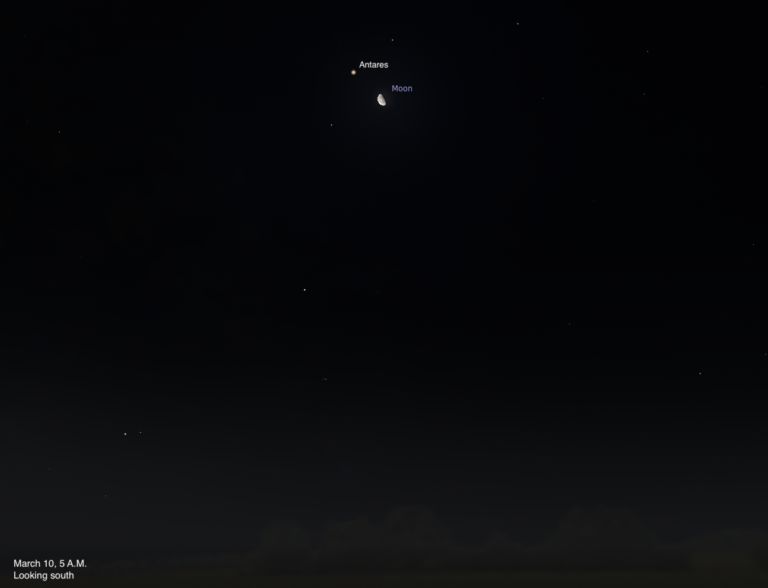
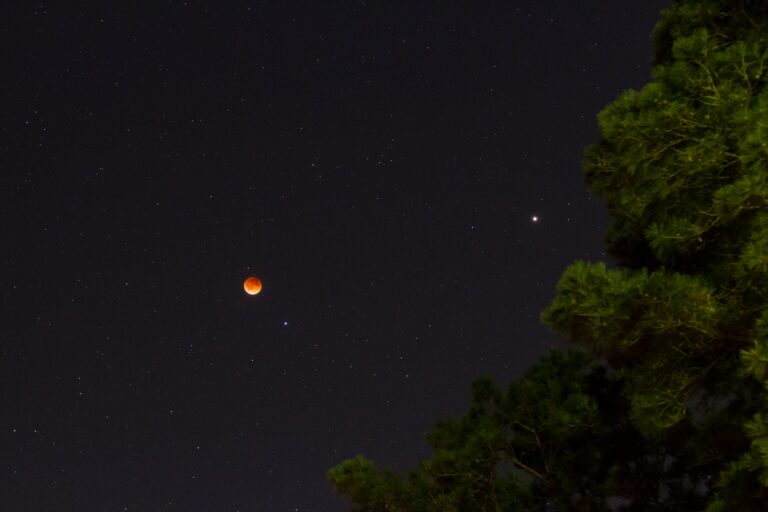
The Moon passes 0.2° north of Regulus at 9 P.M. EDT. Before this, our satellite occults (passes in front of) the bright star in Leo the Lion for some locations in South, Central, and North America — including portions of the eastern U.S.
Observers along the U.S. East Coast, particularly in southern states, see this occur in darkness, while others in the eastern portion of the Central time zone can catch a twilight occultation before night fully falls. From Orlando, Florida, the occultation begins at 8:28 P.M. EDT and ends at 9:51 P.M. EDT. From Kansas City, Missouri, the occultation starts at 6:58 P.M. CDT and ends at 8:12 P.M. CDT. For the times of disappearance and reappearance from many major cities, visit the International Occultation Timing Association’s webpage for the event here. The star’s disappearance at the dark leading limb of the Moon will be easier to catch than its reappearance at the bright trailing edge.
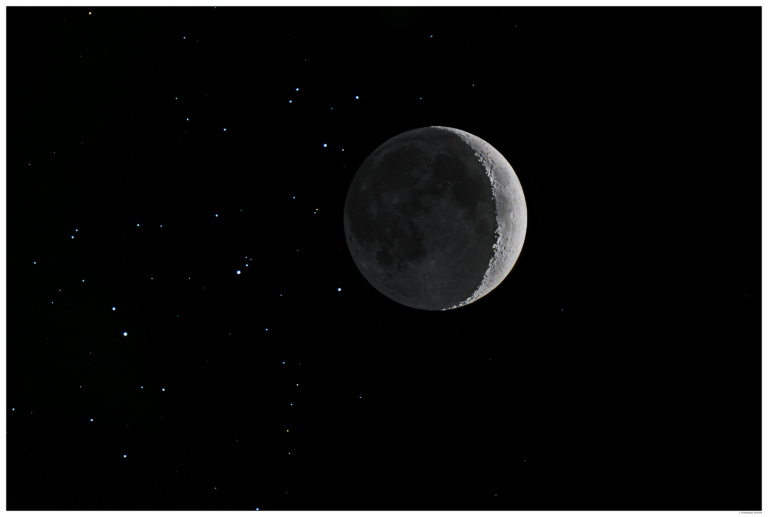
Regardless of whether you see Regulus slip behind the Moon, you can still observe the pair together, a lovely sight in the evening sky. They hang high in the south about an hour after sunset, the Moon’s waxing gibbous face glowing brightly. Regulus is a bright star and should be visible even with the Moon nearby. Shining at magnitude 1.4, it is actually a multiple-star system. It can be easily split into two, although in truth this system houses four stars in total.
The pair will remain visible overnight and into the early hours of the morning, setting around 3:40 A.M. local daylight time on the 26th.
Sunrise: 6:08 A.M.
Sunset: 7:49 P.M.
Moonrise: 1:56 P.M.
Moonset: 3:16 A.M.
Moon Phase: Waxing gibbous (71%)
Sunday, April 26
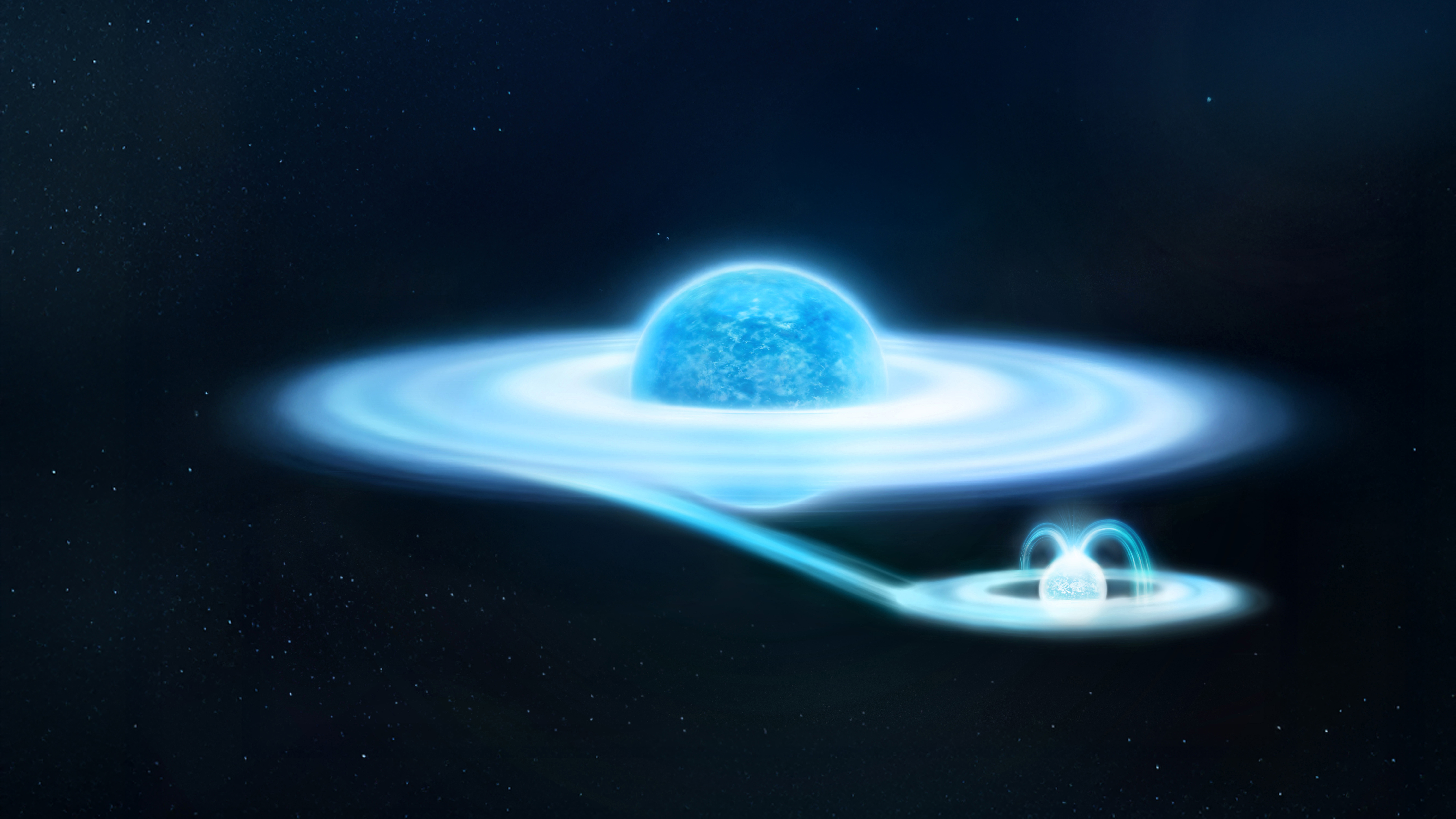
Let’s look north this evening to examine a strange star: Gamma (γ) Cassiopeiae, which sits at the central peak of the famous W in Cassiopeia the Queen.
Shining at magnitude 2.2, although it is quite bright, this sun has no official name bestowed by the International Astronomical Union. Sitting some 549 light-years away, Gamma Cas is a massive B-type star some five times hotter than our own Sun. But it has an additional distinction as the first known Be-type star, a rapidly rotating star that is flinging away its own atmosphere to form a disk of glowing hydrogen. Emission (light) from this hydrogen is what earns Be stars the “e” in their name.
But there’s an additional mystery here. Astronomers have known for several decades that Gamma Cas emits copious X-rays some 40 times more intense than stars with similar masses. But it wasn’t until recently that they were able to determine why. A paper published this spring in Astronomy & Astrophysics used extremely high-precision observations of the light coming from the star to unravel the truth. Gamma Cas has long been known to have a much lower-mass companion. The new observations show that the X-rays are not coming from Gamma Cas itself, but from this companion, a magnetic white dwarf. As material from Gamma Cas’ hydrogen disk flows toward the white dwarf, it forms a disk around this object as well. Some of the material from that disk follows magnetic field lines to its poles, where it glows so hotly that it produces the X-rays we see.
Sunrise: 6:06 A.M.
Sunset: 7:50 P.M.
Moonrise: 3:03 P.M.
Moonset: 3:42 A.M.
Moon Phase: Waxing gibbous (80%)
Monday, April 27
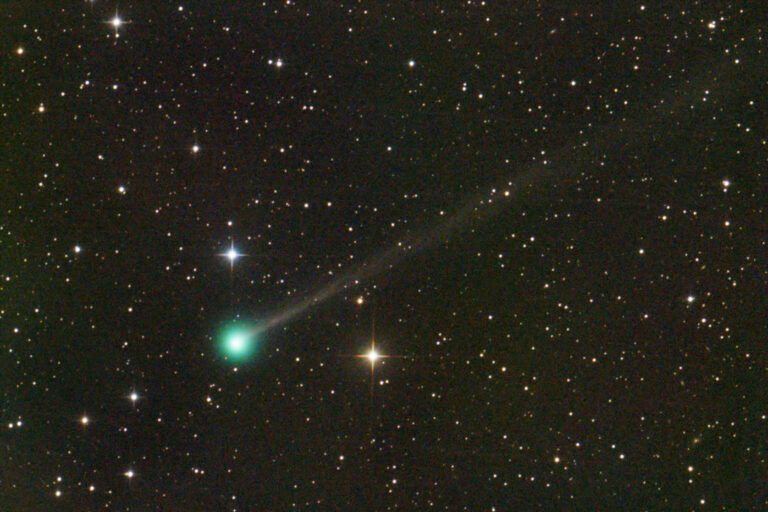
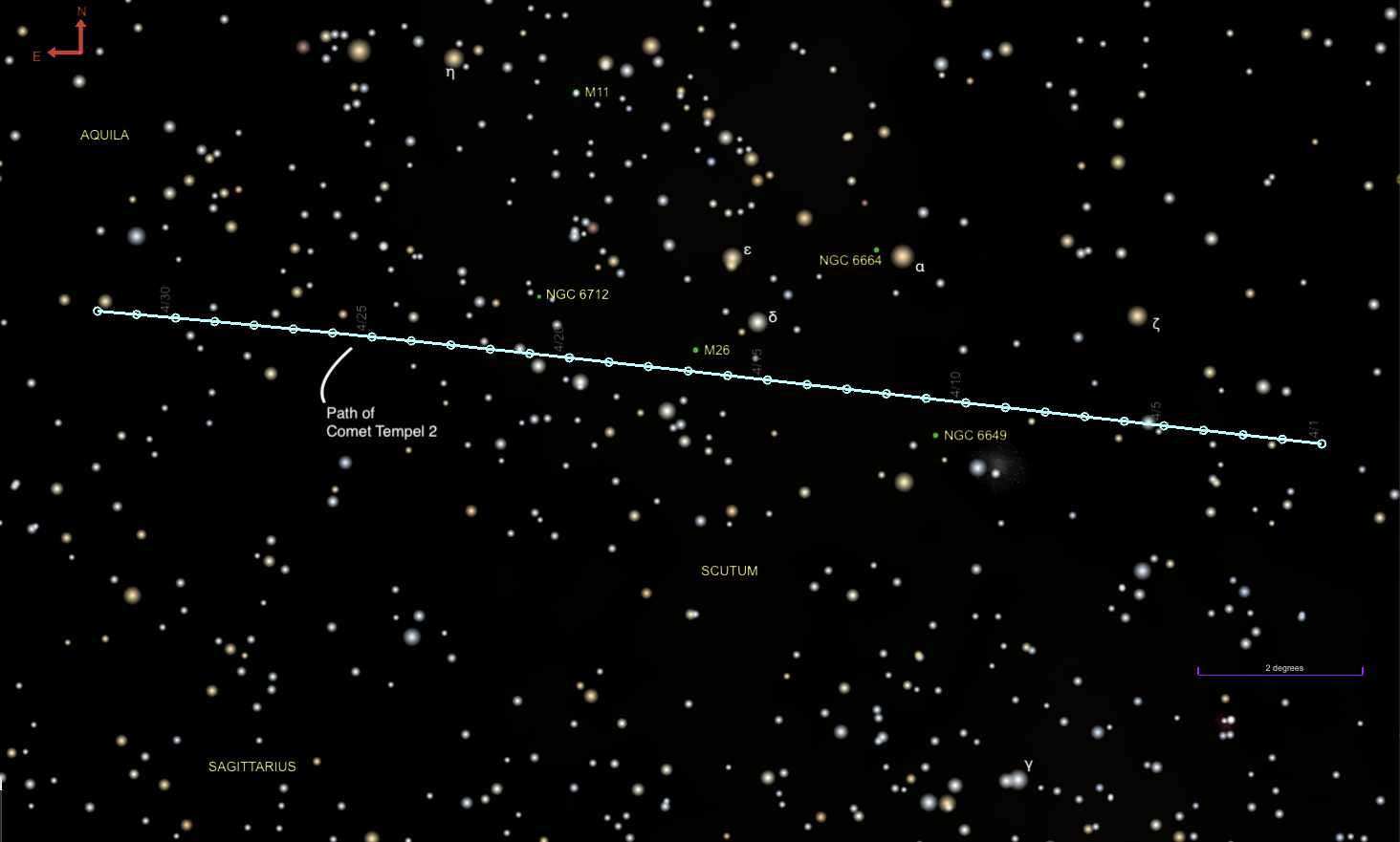
Comet 10P/Tempel, also called Tempel 2, is continuing to brighten in the early-morning sky. Rising around midnight and visible until the sky streaks with dawn, two hours before sunrise you’ll find the comet some 35° high in the southeast, near the tail feathers of Aquila the Eagle and not far from globular cluster NGC 6712.
Recently recorded around magnitude 11, Tempel 2 is located just over 4° south of Lambda (λ) Aquilae this morning. The comet is also only 3° from NGC 6712, which lies to Tempel 2’s west. Binoculars may show both fuzzballs in a single field of view, while a telescope will allow you to zoom in on one at a time.
At magnitude 8.2, NGC 6712 will be brighter. It spans roughly 7’ and is a somewhat diffuse cluster with a concentrated core that fizzles into separate stars as you reach the outskirts. Compare its shape, size, and brightness profile to that of the comet. Which one is larger? Which one is brighter in the center, and how do their appearances differ?
Sunrise: 6:05 A.M.
Sunset: 7:51 P.M.
Moonrise: 4:08 P.M.
Moonset: 4:04 A.M.
Moon Phase: Waxing gibbous (88%)
Tuesday, April 28
Jupiter’s large moon Ganymede began passing behind the planet in an occultation late last night. It then travels through the gas giant’s long, dark shadow to finally pop back into view for observers in the western half of the U.S., particularly along the Pacific Coast.
Jupiter is largely visible in the evening and sets around 1:30 A.M. local daylight time. So, you can still catch it this morning in the hour between about midnight and 1 A.M., sinking toward the western horizon in Gemini the Twins. It is the brightest point of light here, outshining even than the constellation’s alpha and beta stars, Castor and Pollux, respectively.
Turn a telescope on the planet and watch as long as you can as it descends into the thicker atmosphere near the horizon. You’ll see two moons to the west — these are Io, which is closer to the planet, and Callisto, which is farther west. East of the planet is Europa. Ganymede is also here, but it is hidden within the dark shadow Jupiter casts into space. The planet will set for most of the U.S. without Ganymede visible, but lucky observers in the far west can catch it reappearing from eclipse at 12:19 A.M. PDT. By then it will be far from the eastern limb, nearly a full arcminute away.
Meanwhile, Europa has begun to transit the planet, crossing the eastern limb around 12:30 A.M. MDT, visible in that time zone as well. Its shadow will follow, but not until after Jupiter sets even for those along the West Coast.
Sunrise: 6:04 A.M.
Sunset: 7:52 P.M.
Moonrise: 5:11 P.M.
Moonset: 4:25 A.M.
Moon Phase: Waxing gibbous (94%)
Wednesday, April 29
Let’s return to Jupiter this evening to spot the gas giant just a Full Moon’s width from the magnitude 3.5 star Wasat, also cataloged as Delta (δ) Geminorum.
As the sky grows dark this evening after sunset Gemini is still relatively high in the west, with Jupiter the brightest light within its boundaries. Jupiter is located just to the upper right of Wasat, and both are visible together in a telescope eyepiece or within a binocular field of view.
By the time East Coast observers can observe the planet easily with a telescope, only three of its Galilean moons are visible: Io to the west, and Callisto (closer) and Ganymede to the east. Europa is now passing behind the planet in an occultation similar to Ganymede’s journey last night, which won’t end until shortly after 12:15 A.M. MDT on April 30, when Europa finally pops out of the planet’s shadow to Jupiter’s east. Observers in the Mountain and Pacific time zones can catch the reappearance.
Before then, though, Callisto overtakes Ganymede to the far east of the planet. Visible to those in the western two-thirds of the U.S., Callisto passes due north of Ganymede around 12:15 A.M. CDT on April 30, after which the two moons exchange places and Callisto lies farther from Jupiter than Ganymede.
Sunrise: 6:02 A.M.
Sunset: 7:53 P.M.
Moonrise: 6:14 P.M.
Moonset: 4:46 A.M.
Moon Phase: Waxing gibbous (97%)
Thursday, April 30
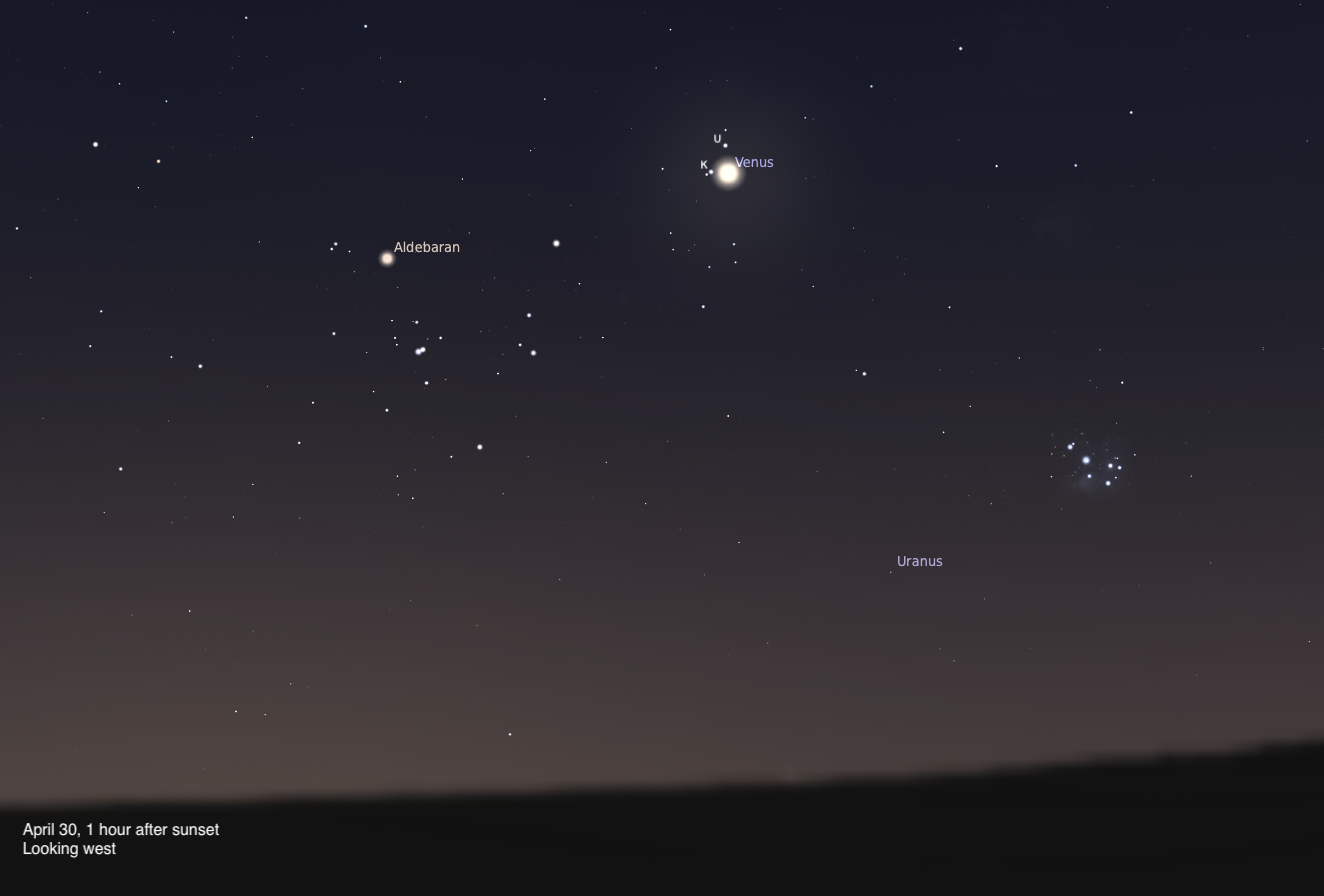
Venus ends the month of April near a pair of 4th-magnitude stars in Taurus the Bull: Kappa (κ) and Upsilon (υ) Tauri. The bright planet now lies to the upper right of 1st-magnitude Aldebaran, the Bull’s eye, and to the upper left of the Pleiades open cluster.
Venus is slightly closer to Kappa, standing just 20’ to this star’s northwest (right). Upsilon sits above Venus, just over 0.5° to the planet’s northeast. You’ll be able to view all three together in a telescope, as well as fainter field stars in the area not as readily visible to the naked eye. Venus is now slightly larger than earlier in the week, spanning 12”, but has also waned a bit, now 88 percent lit.
You can also catch fainter Uranus as the sky darkens, although it’s no longer close to Venus (as the latter moves quickly and has pulled away). Look for the ice giant in binoculars or a telescope about 4.2° south of the Pleiades, to the cluster’s lower left.
Sunrise: 6:01 A.M.
Sunset: 7:54 P.M.
Moonrise: 7:18 P.M.
Moonset: 5:09 A.M.
Moon Phase: Full
Friday, May 1
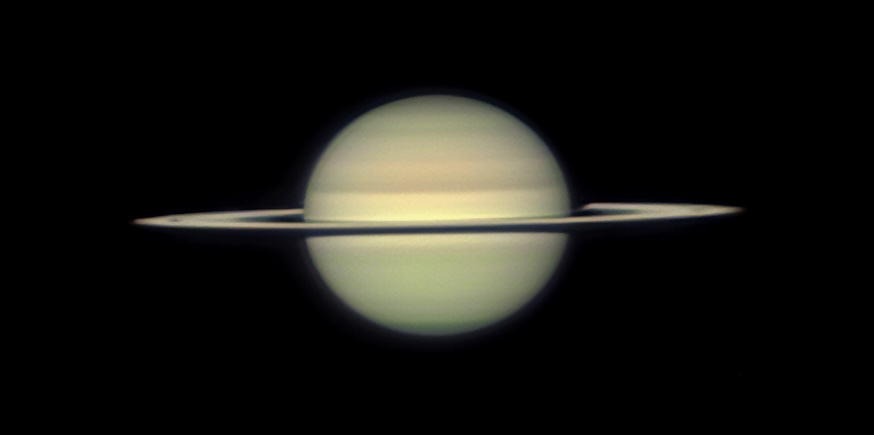
Saturn, rising early in the morning, has now become a bit easier to spot in the predawn sky. About 45 minutes before sunrise, it has reached an altitude of nearly 4° above the eastern horizon, glowing at magnitude 0.9.
Located in Cetus, you’ll find Saturn hanging below the Great Square of Pegasus, whose four bright stars will be some of the last to wink out of the sky as twilight brightens. A telescope will show the planet’s rings, although the image might appear “muddy” or blurry, as objects near the horizon are seen through a thicker column of air than when they are high in the sky.
Mars lies 7.6° east of Saturn, to the ringed planet’s lower left, but it is much lower (just under 2° high) and, at magnitude 1.2, a bit harder to spot. You can still catch it with binoculars or a small scope, although make sure you put away any optics at least several minutes before local sunrise.
Neptune, roughly the same distance but to Saturn’s west, is likely too faint to see in the brightening sky.
The Moon officially reaches Full phase at 1:23 P.M. EDT, so observers this evening can enjoy the Full May Flower Moon. It is also the first Full Moon of two that occur in the month of May; the second Full Moon on May 31 will bring us the year’s first and only Blue Moon.
Sunrise: 6:00 A.M.
Sunset: 7:55 P.M.
Moonrise: 8:21 P.M.
Moonset: 5:34 A.M.
Moon Phase: Full