Home > Features > News
News
Perseid meteors light up the weekend
August's falling stars flare despite a bright Moon.
Michael Bakich
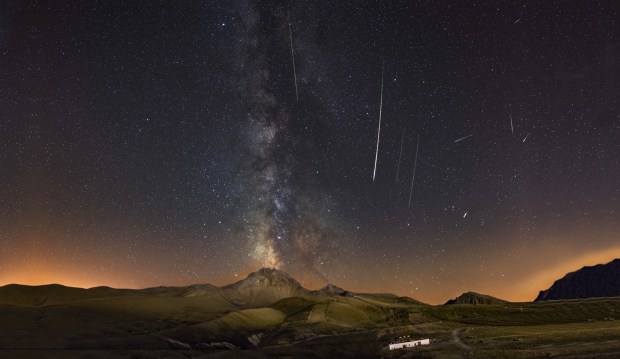
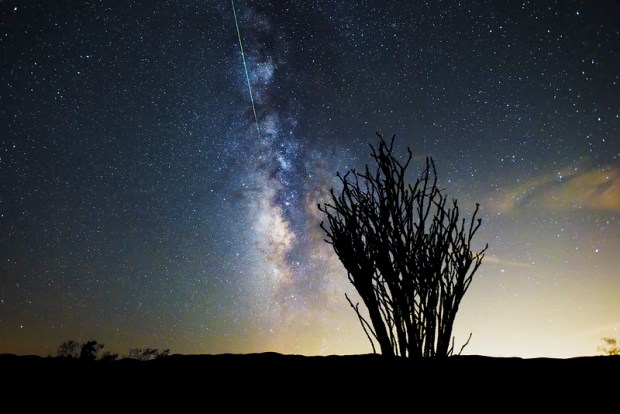
The annual Perseid meteor shower is typically one of the year's best. In 2006, this shower occurs with the Moon shining brightly. But while the number of visible meteors may be down a bit from previous years, viewers can still see the bright ones easily. The Perseid meteor shower is characterized by bright, fast meteors, many of which leave smoke trails visible for several seconds.

The Perseids will reach their activity peak around 6 P.M. EDT on Saturday, August 12th. This is a real plus for getting friends and family out to the show.
How to watch the Perseids
2006 Perseid meteor shower
All Perseid meteors originate from a point near the top of the constellation Perseus. To see the maximum number of meteors, look roughly 30° away from the radiant. Astronomy: Roen Kelly [View Larger Image]
August 12 isn't the only date to observe Perseid meteors. This year, the shower will be active between about July 30 and August 25. Of course, fewer meteors will be visible further away from the August 12 peak.

Viewers need a clear, dark sky to see more than just a few Perseids. "Dark" means at least 40 miles (64 kilometers) from the lights of a large city. No telescope is required — in fact, the eyes alone work best.

Early in the evening August 12, set up a lawn chair, preferably one that reclines. Face east, and look a third to half of the way up in the sky. After the Moon rises, face away from the Moon, and look generally overhead. When the Moon's disk enters the field of view (around 2 A.M. local time), turn your chair back to the east, and concentrate on an area of sky about halfway up. Glancing around won't hurt, either.

Important items to remember when watching for shooting stars include bug spray, cookies, fruit, and a non-alcoholic beverage. Alcohol interferes with the eye's dark-adaption as well as the visual perception of events.

How many Perseids will people see? This year, even with a bright Moon in the sky, expect to count between 20 and 30 meteors per hour.
Three reasons... To subscribe to Astronomy magazine today! (1) Save 39%. (2) Get full access to our online Astronomy Plus features. (3) Receive a FREE gift.
E-mail Address: Password:
Remember me?

Forgot your password » | Login help »

Not a member? Register » | Why join? »

Newsletter Signup

Receive news, sky-event information, observing tips, and more from Astronomy's free weekly e-mail newsletter.

Privacy Policy

Cosmology's Greatest Discoveries