July 2026 digital issue Now available to subscribers!
Learn more
Skip to content
Astronomy Magazine logo
  • Login / Register
  • Logout
  • Shop
  • Subscribe

  • News
  • Science
    • Solar System
    • Exoplanets
    • Stars
    • Milky Way
    • Galaxies
    • Exotic Objects
    • Cosmology
  • Observing
    • In The Sky
    • Upcoming Events
    • The Sun
    • The Moon
    • Planets
    • Comets
    • Deep-Sky Objects
    • Observing Basics
    • Telescopes and Equipment
    • Astrophotography
    • Gear Guide
    • This Week in Astronomy
  • Space Exploration
    • What’s Launching This Week
    • Human Spaceflight
    • Robotic Spaceflight
  • The Magazine
  • Ask Astro
  • Star Products
  • News
  • Science
    • Solar System
    • Exoplanets
    • Stars
    • Milky Way
    • Galaxies
    • Exotic Objects
    • Cosmology
  • Observing
    • In The Sky
    • Upcoming Events
    • The Sun
    • The Moon
    • Planets
    • Comets
    • Deep-Sky Objects
    • Observing Basics
    • Telescopes and Equipment
    • Astrophotography
    • Gear Guide
    • This Week in Astronomy
  • Space Exploration
    • What’s Launching This Week
    • Human Spaceflight
    • Robotic Spaceflight
  • The Magazine
  • Ask Astro
  • Star Products
  • Login / Register
  • Logout
  • Shop
  • Subscribe

Picture of the Day

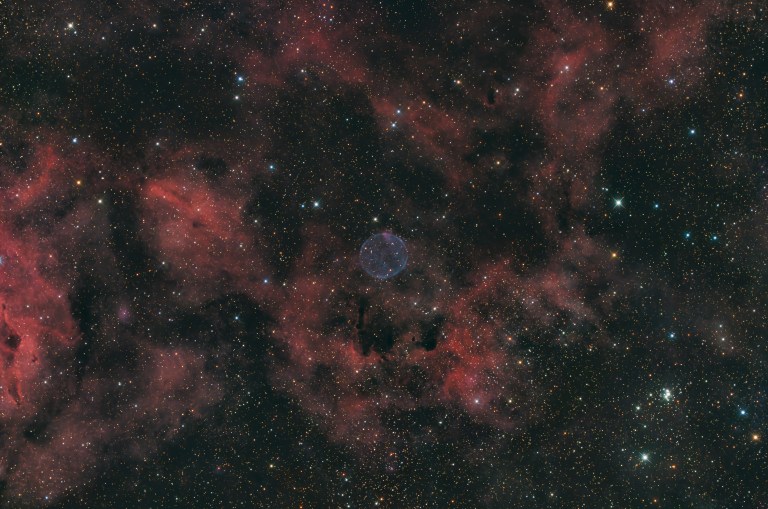
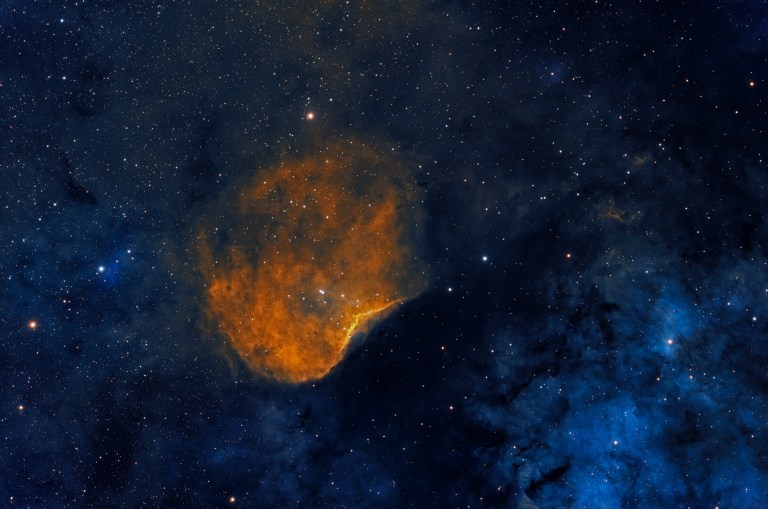
A faint blue-green cloud shaped like a squid stretches across the center of the frame, with two tapering lobes reaching left and right from a brighter, knotted middle. It floats against a much larger backdrop of deep red gas that fills the image in wispy, billowing curtains. Scattered white and pale-blue stars dot the scene.

Waiting in the wings

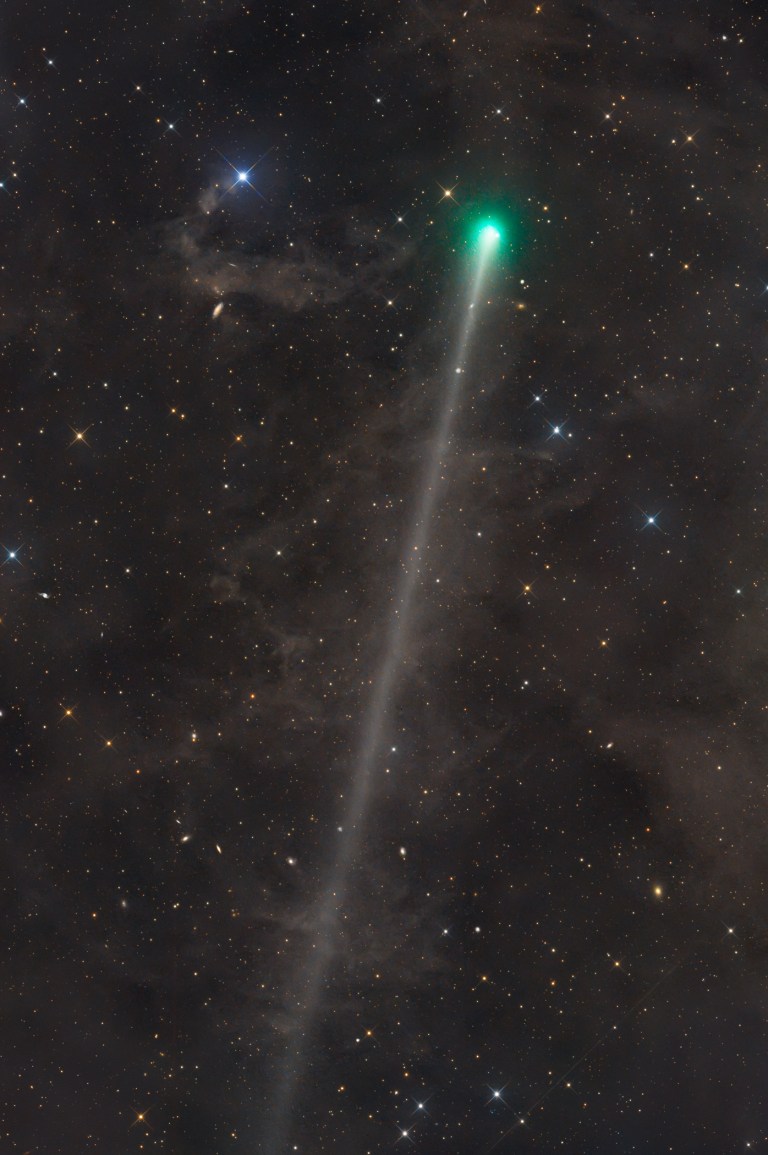
Wide-field view of deep space showing a bright teal comet near the center with a small, sharp core surrounded by a soft, round green glow. A thin, faint horizontal line crosses directly through the comet. A bright blue star with crisp four-pointed spikes shines above and to the left, set against a dense background of tiny white and reddish stars scattered over mottled brownish-grey dust clouds.

Comet Tempel 2’s dust trail

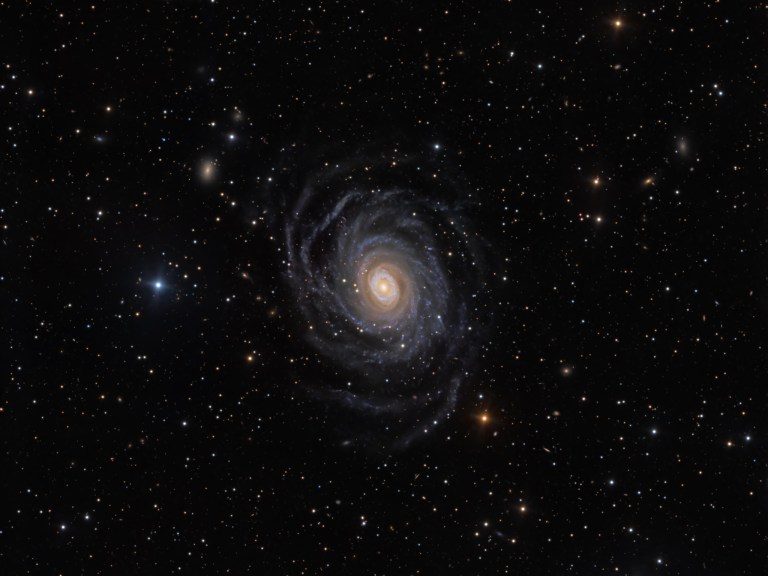
Virgo vertigo

Wide-field view of a rich starfield showing a bright, dense globular star cluster near the upper right and a complex blue nebula with dark dust lanes in the lower left. The globular cluster appears as a tight, glowing ball of countless tiny white stars fading smoothly into the surrounding field. The lower-left nebula is made of bright blue patches around a few standout stars, crossed by thick, irregular dark clouds that block the stars behind them, while the rest of the frame is sprinkled with stars of different brightness and color, including a few very bright stars with sharp diffraction spikes.

A glob and a stellar nursery

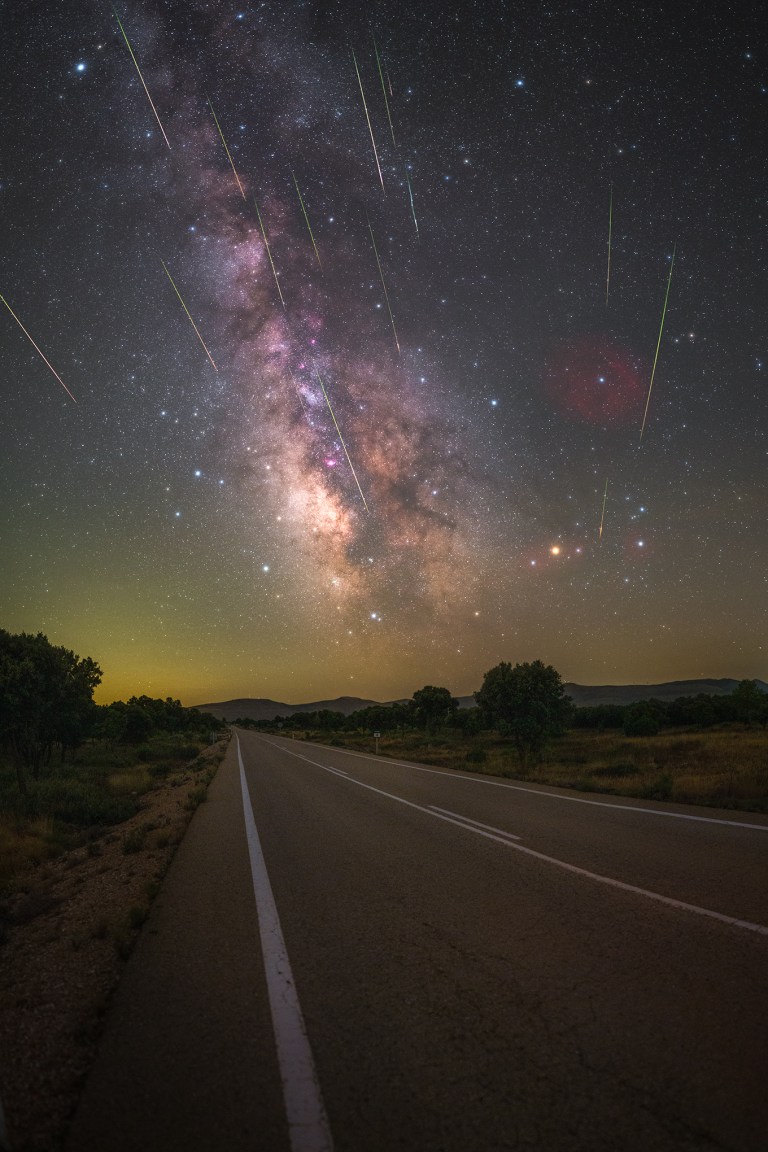
A wide, long-exposure view of the night sky shows the Milky Way stretching in a hazy, mottled band across the lower half of the frame, with creamy star clouds broken by dark dust lanes. A single bright meteor streaks diagonally from upper left to lower right as a sharp blue-white line that is brightest near its middle and fades at both ends. The background is filled with countless small stars of varying brightness, along with a few larger bluish stars that glow more strongly near the top and bottom of the image.

A June Epsilon Cygnid

Prominent filaments

A dense, glowing nebula fills the frame, with tangled clouds of gas and dust in red, orange, green, and blue tones. Near the upper center, a bright bluish-white core and surrounding emerald and lime-green wisps stand out, while darker, finger-like dust lanes and jagged edges cut into the glowing regions. The scene is packed with stars of various sizes and colors scattered across the entire image against a darker, starry background.

The Eagle’s lair

A circular, flower-like nebula fills the frame, with a bright, hollow center of soft blue and purple gas surrounded by thick, textured clouds in golden-orange and deep red. Dark, finger-like dust lanes cut into the glowing gas along the inner edges, especially on the right and bottom. A small cluster of bright stars sits near the middle of the cavity, while countless fainter stars and very subtle, reddish wisps of gas dot the darker background around the nebula.

Budding stars

A wide starfield fills the frame, with a bright, textured orange cloud of glowing gas in the lower right that resembles a jellyfish. Its center is dense and fibrous and its lower edge frayed into wisps. Fainter strands of orange gas arc upward from it into a larger, hazy cloud that stretches across the top half of the image, fading from murky yellow-green on the upper left into soft blue on the upper right and cut through by dark, jagged dust lanes. Small white stars are scattered over the black background, with a couple of brighter yellow-white stars standing out near the left edge and below the main jellyfish-shaped cloud.

Sky nettle

Tall white sea cliffs drop into dark, blurred water at night, with and rolling grassy hills fading into the distance on the left. Above, a dense arch of the Milky Way stretches above a colorful sky on the horizon — cool blue and teal on the left, with orange light pollution at right. The Milky Way forms bright white star clouds set against a darker sky above packed with sharp stars.

Milky Way over Beachy Head

A pair of colliding galaxies sits in the lower-left of the frame, with two bright, close-together cores and long, thin arcs of bluish-white stars and gas sweeping outward in opposite directions against a dark purple-black sky. To the right, a round, face-on spiral galaxy with a bright center and faint, tightly wound arms appears above a smaller, fuzzy companion, all set in a dense background of tiny white stars scattered across the field.

A galactic collision

A bright, textured cloud of glowing gas fills most of the frame, forming a rounded shape that loosely suggests a monkey’s head against a dark background. The center is brighter and more structured, with a blue interior puncuated with darker knots and ridges. The outer regions are redder and fade into soft, wispy edges. A sparse scattering of small, sharp stars is visible across the nebula and the darker surrounding sky.

A tribute to Punch

1 2 3 … 42 Older posts
Astronomy Magazine

Astronomy magazine: 50 years and counting

The world's best-selling astronomy magazine offers you the most exciting, visually stunning, and timely coverage of the heavens above. Each issue includes expert science reporting, vivid color photography, complete sky coverage, spot-on observing tips, informative telescope reviews, and much more! All this in a user-friendly style that's perfect for astronomers at any level.

Count me in

Astronomy Newsletter

Get newsletters, updates and special offers via email from Astronomy.com!

Please enter a valid email address.
Astronomy Magazine logo
  • Facebook
  • LinkedIn
  • YouTube
  • Instagram
  • Twitter
  • About Us
  • Contact Us
  • Subscribe
  • Customer Service
  • Advertising
  • Terms of Use
  • Privacy Policy
  • Do Not Sell

@ 2025 Firecrown Media. All Rights Reserved.

More Sites from Firecrown Media Publisher logo
Scroll to Top

Sign In

New User? Create an Account

Why Sign In? Subscribers can access their digital magazine issues, and registered users can participate in our Community forums and galleries.

Please enter your email.
Please enter your password.

Lost your password?

Manage My AccountCustomer Support