Celestial navigation
Find your way by watching the stars and "following the drinking gourd."
Nalini Chandra and John Percy
| Halfway between the celestial poles is the celestial equator, a projection of Earth's equator onto the sky. The stars on the celestial equator rise due east and set due west. Delta Orionis, the northern-most star in Orion's Belt, lies almost directly on the celestial equator. Early navigators learned to use the rising and setting stars to find their way. Stars were particularly important to Pacific Islanders as they traveled from one island to the next. Surrounded by the Pacific's waters, there was no land to serve as a reference point. Over time, the observations and records of these star patterns provided a method for navigation that was passed on from one generation to the next. |
The 7 brightest stars of Ursa Major the Great Bear are better known as the Big Dipper. John Chumack [View Larger Image] From more northerly latitudes, there are many more stars that never set. Whether or not a star is circumpolar depends on your latitude. For example, if you were standing on the North Pole, all the stars in your sky would be circumpolar. They would move horizontally, circling around the celestial pole overhead. For latitudes between the North Pole and the equator, the North Celestial Pole is tilted away from your zenith, the point directly above you. In fact, the angle of Polaris above the horizon is approximately equal to your latitude. Learning to identify Polaris in the sky, and hence the direction north, can be a short but useful lesson in celestial navigation. Polaris's reputation as a "quide star" can easily be presented in the story of "The Drinking Gourd." To African slaves in North America, Polaris became a symbol of freedom, as well as a guide star. Children were taught to identify Polaris by finding the Big Dipper. Slaves passed the travel instructions from plantation to plantation by singing the song, "Follow the Drinking Gourd." The Big Dipper was the drinking gourd or spoon-shaped utensil with a curved handle that slaves drank water with. |
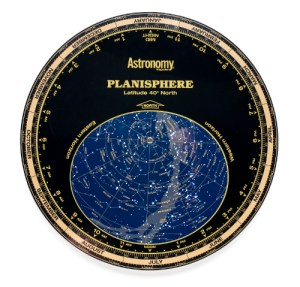
Additional online observing tools from Astronomy magazine
|