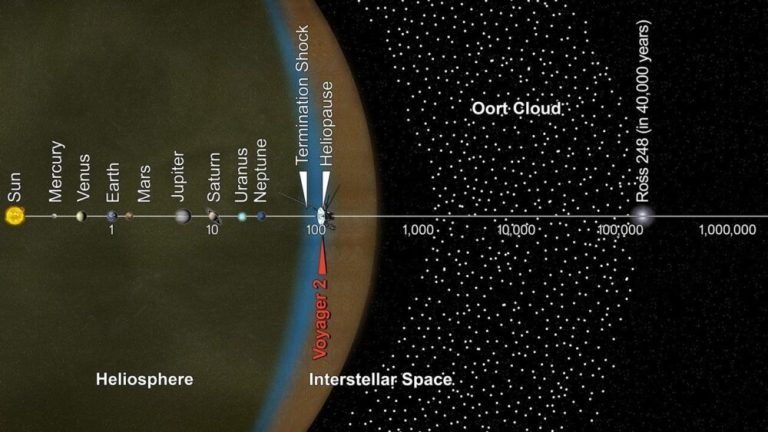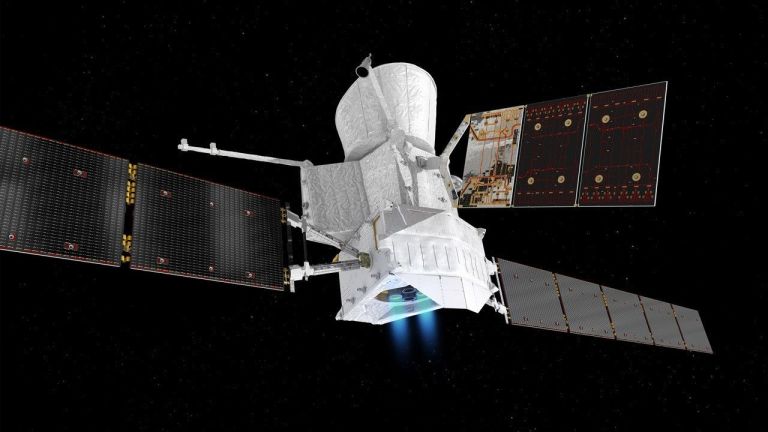
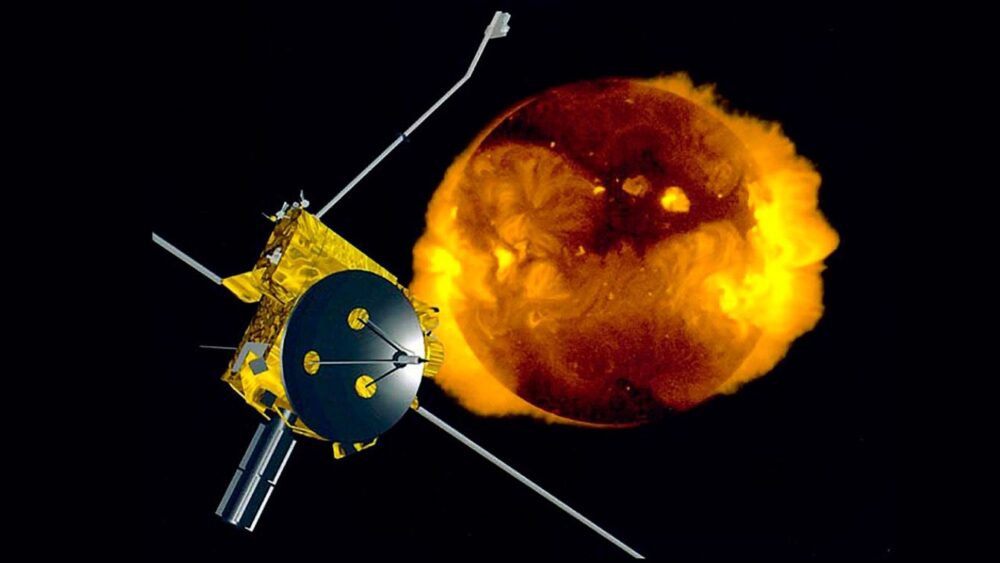
A joint NASA-ESA mission, the Ulysses solar probe launched Oct. 6, 1990, from the Space Shuttle Discovery. The mission was tasked with studying the solar wind, mapping the heliosphere, and becoming the first craft to study and chart the solar poles in detail. Equipped with a magnetometer, ion composition gauge, and instruments to measure radio waves, plasma waves, solar particles, gravitational waves, cosmic dust, gamma rays, X-rays, and more, Ulysses made nearly three complete orbits of the Sun over 18-plus years. Its heliocentric orbit was uniquely designed to take it over the Sun’s poles, and on Sept. 13, 1994, the probe made its closes approach to the solar south pole. When the mission concluded on June 30, 2009, Ulysses had created the first 3D map of the heliosphere, charted the speed and behavior of the solar wind, and uncovered new details about the Sun’s poles and magnetic field.
Elisa Neckar is senior production editor of Astronomy magazine, and the editor of the Today in the History of Astronomy feature on Astronomy.com.