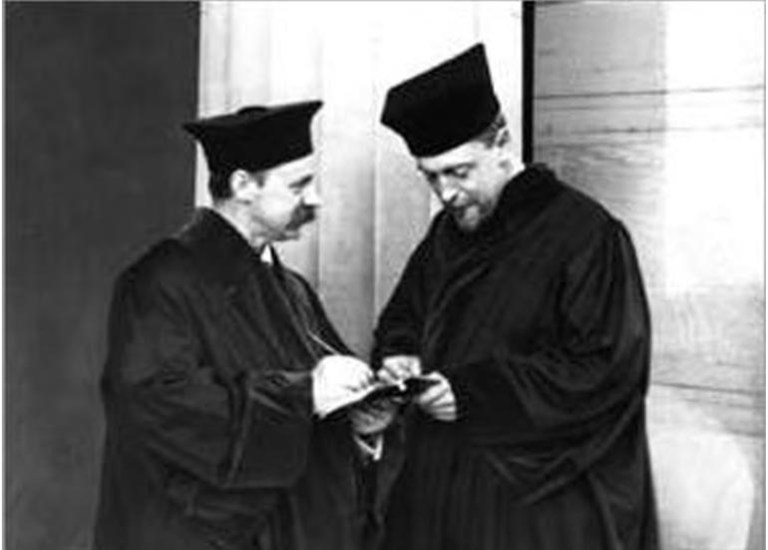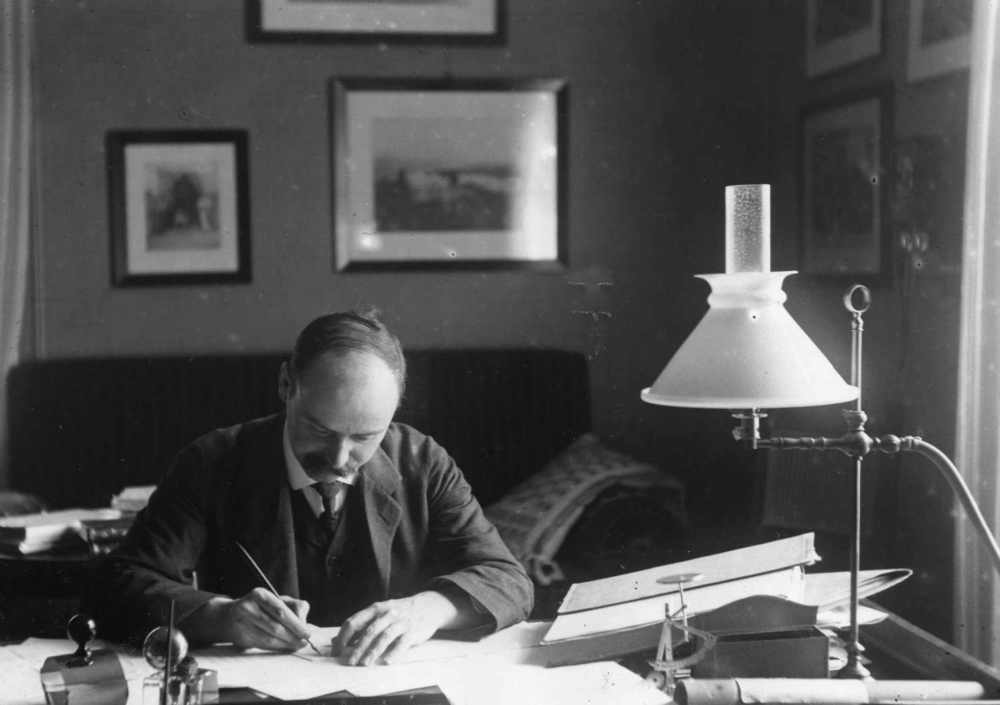
Karl Schwarzschild was born Oct. 9, 1873 – just one day after his famous collaborator Ejnar Hertzsprung – and grew up in a Jewish family in Germany. Schwarzschild was considered a child prodigy, publishing a paper on celestial mechanics by age 16. He studied astronomy at the University of Strasbourg, then went on to receive his doctorate from the University of Munich in 1896. After working at the Kuffner Observatory from 1896-1899, Schwarzschild became director at Gottingen Observatory and then Potsdam Observatory, where he recruited and collaborated with Hertzsprung.
While serving with the World War I German army from 1914-1916, Schwarzschild offered the first solution to Albert Einstein’s equations of general relativity. His development of the Schwarzschild radius, part of that solution, laid the foundation for our understanding of black holes. Unfortunately, while at the Russian front, Schwarzschild began to suffer from a rare autoimmune disease. He was invalided home to Potsdam, and he died of pemphigus only two months later, at age 42.
Elisa Neckar is senior production editor of Astronomy magazine, and the editor of the Today in the History of Astronomy feature on Astronomy.com.