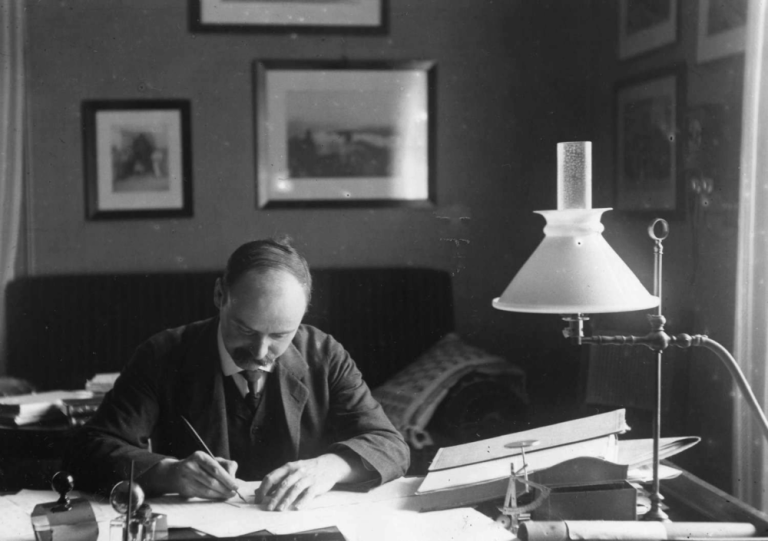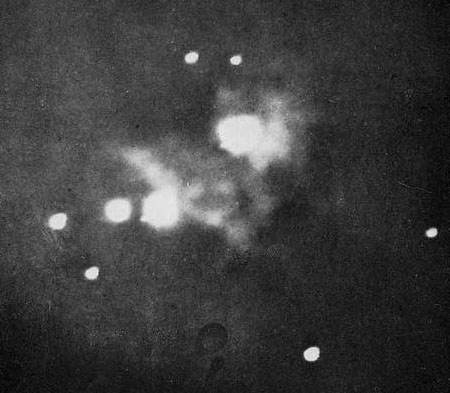
On Sept. 30, 1880, in a pioneering moment for astrophotography, amateur astronomer Henry Draper and his wife, Anna, captured the first image of the Orion Nebula. Though a medical doctor by trade, Henry was a key contributor to the development of stellar photography and spectroscopy. He and Anna obtained the first photo of a star’s spectrum, capturing a spectrogram of Vega in August 1872 that showed four hydrogen lines. He also made advances in telescope engineering, and researched the presence of oxygen in the Sun. Anna assisted and collaborated with Henry in their home observatory, helping capture photo of stellar spectra, logging observations, and preparing glass plates. For the Orion Nebula shot, the Drapers used an 11-inch refractor from Alvin Clark & Sons and captured an exposure of 50 minutes. Though the fuzzy September 1880 shot wasn’t perfect, Henry continued to refine the photographic process and telescopic equipment afterwards; in March of 1882, the Drapers produced an exquisitely detailed shot of the Orion Nebula with an exposure of 137 minutes.
Elisa Neckar is senior production editor of Astronomy magazine, and the editor of the Today in the History of Astronomy feature on Astronomy.com.