Born in London on March 19, 1799, William Rutter Dawes first pursued a career in medicine, then became a clergyman. A longtime amateur astronomer, he established a private observatory at his parish in Lancashire and from there measured over 200 double stars. When his first wife passed away and his health declined, he took a position at George Bishop’s Observatory in Regent’s Park, London, in 1839.
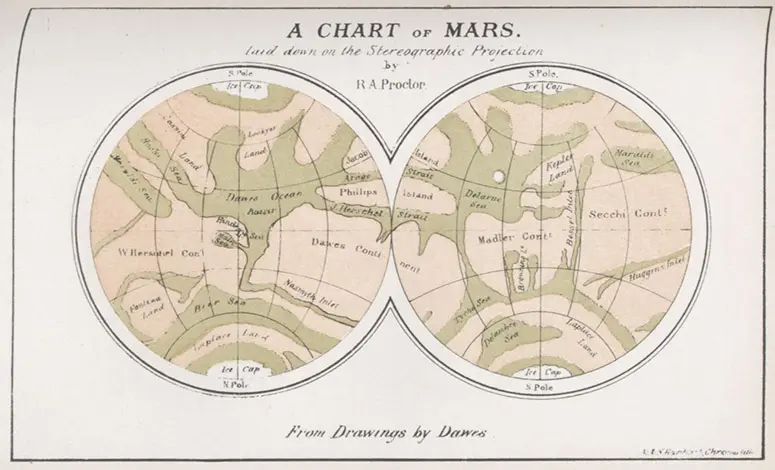
Dawes’ career from that point became a veritable who’s who of 19th century astronomy: After remarrying, he moved to Kent, where John Herschel became a supporter and frequent correspondent. A great enthusiast for Alvan Clark’s lenses, Dawes invited Clark for a visit in 1859, and would go on to so highly and widely recommend his lenses that Clark’s customer base exploded. Having turned from double stars to planetary observations, Dawes produced illustrations of Mars that were so well done that Richard Proctor used them to create one of the earliest martian maps, seen in his book Other Worlds Than Ours (1870). And near the end of his life, Dawes met and mentored William Huggins, counseling him on the contributions amateur astronomers could make and selling Huggins his 8-inch Clark lens.
Dawes died in 1868 at age 68, having earned a reputation for being exceptionally sharp-eyed thanks to his double star measurements (some still in use today), and his observations of Mars’ surface, Jupiter’s Red Spot, and Saturn’s innermost ring. He also discovered the formula for the maximum resolving power of a scope, known today as the Dawes limit. A fellow of the Royal Astronomical Society since 1830, he received their Gold Medal in 1855. A lunar crater was named in his honor in 1935.