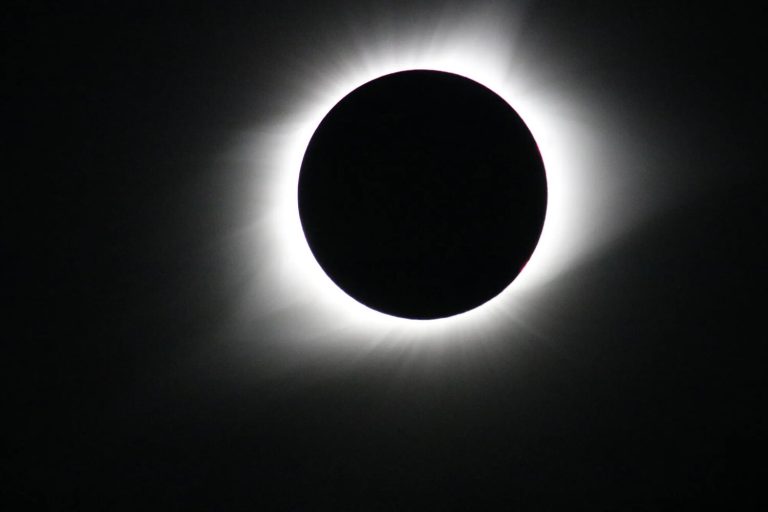
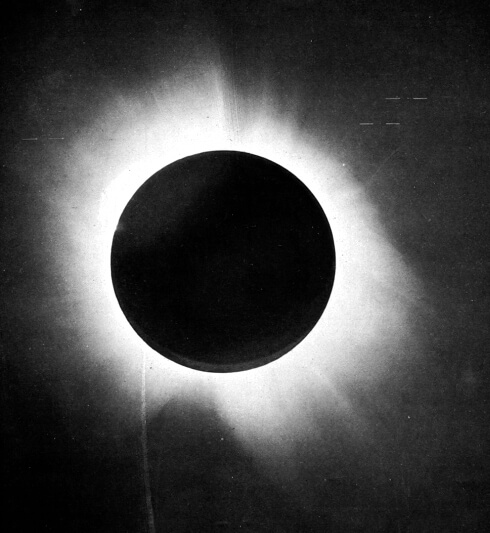
One of the most important eclipses in history happened in 1919. This particular eclipse cut a path across South America and the Atlantic Ocean, and landed on the west coast of Africa. Waiting on the island of Principe, in the Gulf of Guinea off the west coast of Africa, was a team of astronomers armed with telescopes and cameras and led by English physicist Sir Arthur Eddington.
Amid World War I, Albert Einstein had published his groundbreaking paper on general relativity. One prediction made by the theory was the bending of light in a strong gravitational field, called gravitational lensing. In 1917, the astronomer royal of England, Sir Frank Watson, realized that a total solar eclipse would set up the perfect experiment to test relativity. The upcoming eclipse of May 29, 1919, was the best candidate — if only the war would end in time.
Luckily, the war ended in November 1918. During totality of the eclipse, the Sun would be in the constellation Taurus, near the stars of the famous Hyades cluster. So in February 1919, Eddington took photographs of the Hyades and made exact measurements of each star’s position. And in May, Eddington camped on Principe.
The day was clear. During the eclipse, astronomers worked frantically to photograph the stars nearest to the Sun. With his valuable exposures in hand, Eddington sailed home to England and measured the star images on the glass plates. Precise measurements of these stars, especially Kappa Tauri, showed a defiant deflection from its true position, proving one component of relativity — gravitational lensing — to be true. Overnight, Einstein became a world celebrity, and relativity became a fact of life in the 20th century.