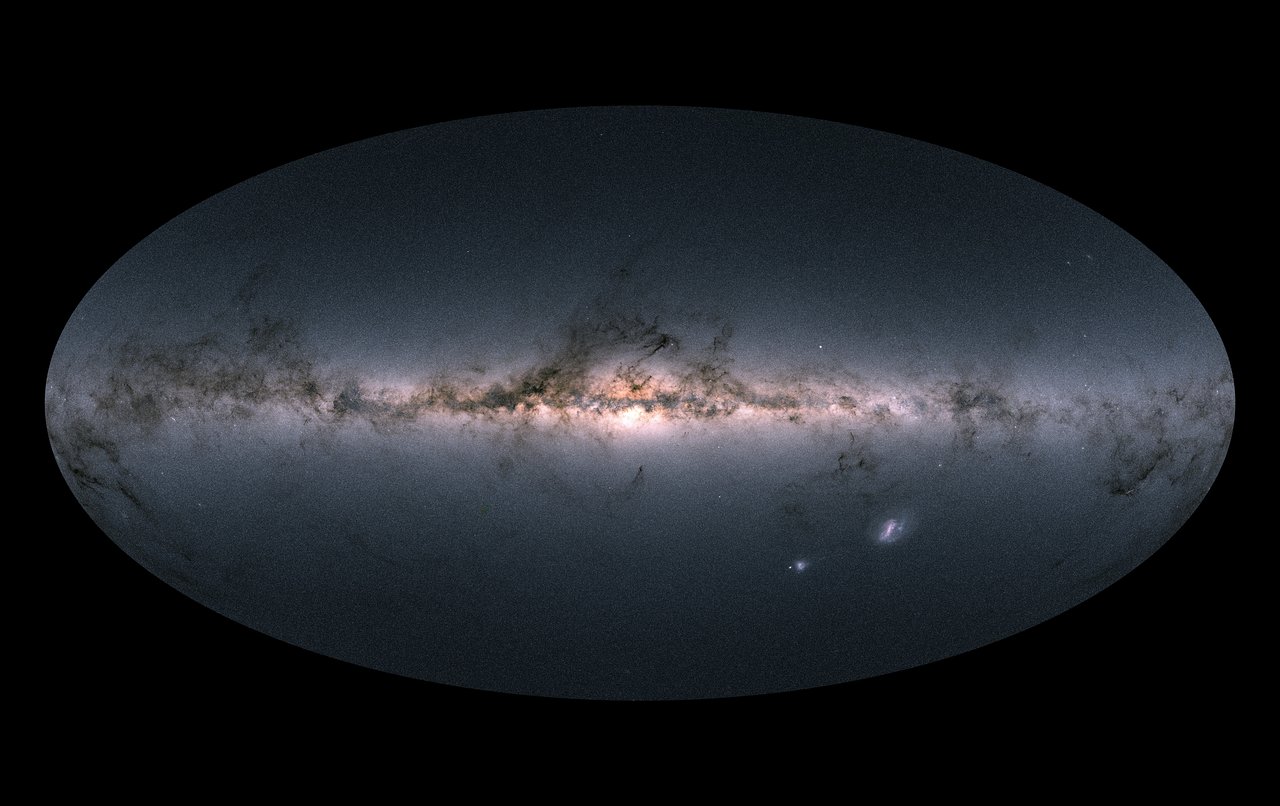
On Jan. 15, 2025, the Gaia spacecraft took its last image. Then the craft ran a final round of engineering tests, fired its thrusters to leave Earth behind, and slipped into an orbit around the Sun, finally turning off on March 27.
After more than a decade in operation, 3 trillion observations, and 2 billion stars observed, Gaia earned its retirement. Launched by the European Space Agency (ESA) in 2013, Gaia’s goal was “to map a billion stars,” and it succeeded. Compiling the map of where these stars are and how they move paints a picture of our entire galaxy — even the dark matter, whose gravitational influence subtly tugs on the stars.
Along the way, Gaia found brown dwarfs, exoplanets, and quasars. Peering down to 20th magnitude, Gaia also spied stars in the Milky Way’s satellite galaxies, the small stellar cities that orbit just outside our own, to reveal how they interact with our galaxy now and in the distant past.
Though Gaia’s observations are complete, scientists are still analyzing the hundreds of terabytes of information sent from space. And the Gaia data are being released to the public in stages, as is common for most large, long-lasting surveys. But the data are already proving wildly useful, informing the science of exoplanets, black holes, and more.