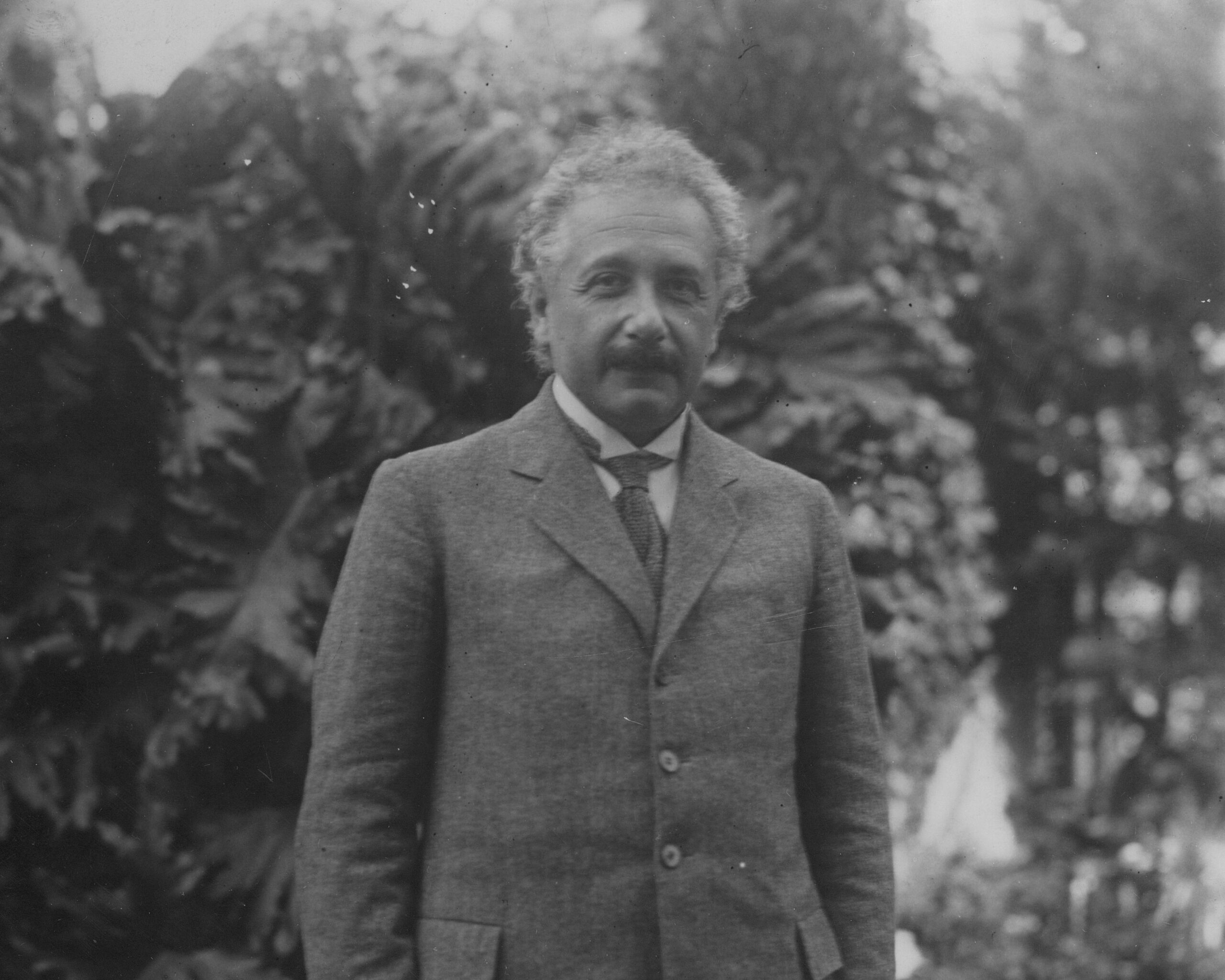
On March 14, 1879, Albert Einstein was born in Germany. Early in his life, he demonstrated passion for music and science; in 1896, he began studying physics and mathematics at the Swiss Federal Polytechnic School in Zurich. When his degree was completed, he was unable to find a position as a teacher, and instead began working at the Swiss Patent Office in 1901. In 1905, Einstein had what’s called his “Annus Mirabilis,” or Miracle Year, publishing four groundbreaking papers: his special theory of relativity, the photoelectric effect, an analysis of the Brownian motion, and his E-mc^2 formula.
By 1908, his groundbreaking research had helped him transition to academia, and he took positions in Berne, then Zurich, then Prague, then Zurich again, before being appointed the director of the Kaiser Wilhelm Physical Institute at the University of Berlin. He published his general theory of relativity in 1916, and in 1921 won the Nobel Prize in physics. In the early 1930s, Einstein accepted a position at the Institute for Advanced Study in Princeton, New Jersey, allowing him to escape the rise of fascism in Germany. He formally retired in 1945, but continued his work until his death in 1955.