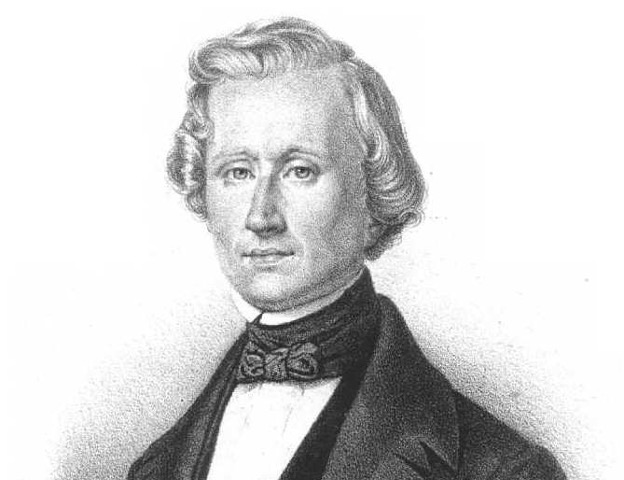
French astronomer Urbain Le Verrier was a tutor and an assistant at the Paris Observatory when the director, François Arago, asked him to investigate irregularities in Uranus’ orbit. Using extensive, careful calculations and his understanding of Newtonian physics, Le Verrier concluded the orbit was being gravitationally affected by an unknown planet. In June 1846, he published his predicted position for the new world.
When his French peers showed little interest in his conclusions, Le Verrier sent his predictions to Johann Galle at Berlin Observatory. On Sept. 23, 1846, the day he received Le Verrier’s letter, Galle found Neptune just one degree away from where Le Verrier said it would be. It was the first planet discovered through math, rather than observation. English astronomer John Couch Adams had independently predicted Neptune’s existence at approximately the same time as Le Verrier, in around the same place. The follow-up on his prediction was mired in communications breakdowns, though, and Le Verrier was considered the discoverer of the new planet, Neptune – leading to nationalistic furor from Britain. Today, Adams and Le Verrier are often both credited with finding Neptune.