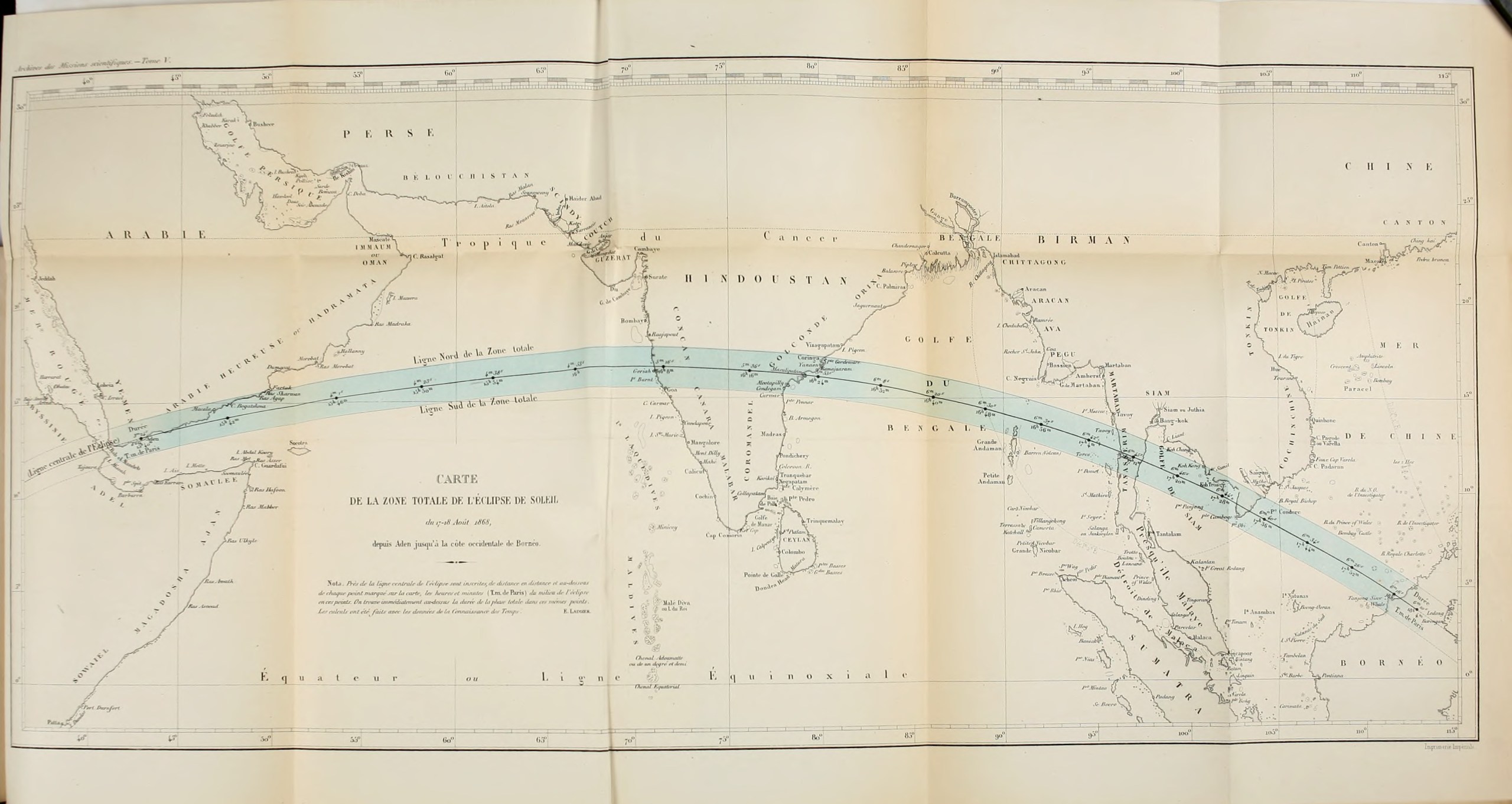
This 1868 map plots the path of the Aug. 18 eclipse. Credit: Internet Archive Book Images, via Wikimedia Commons
During the total solar eclipse of Aug. 18, 1868, two astronomers, Pierre Jules César Janssen of France and J. Norman Lockyer of England, each independently discovered a new line in the Sun’s spectrum. Lockyer thought it showed an undiscovered element, which he named helium. (In Greek mythology, Helios was the Sun god.) Although scientists would later show that helium is the second most abundant in the cosmos, it wasn’t found on Earth for another 27 years.
Michael E. Bakich is a contributing editor for Astronomy magazine. With degrees in astronomy and planetarium education, he has led many eclipse tours, published several books on observing, and logged thousands of hours at the eyepiece.