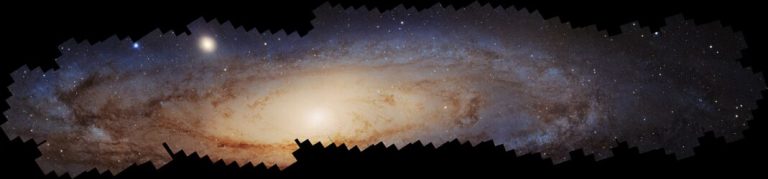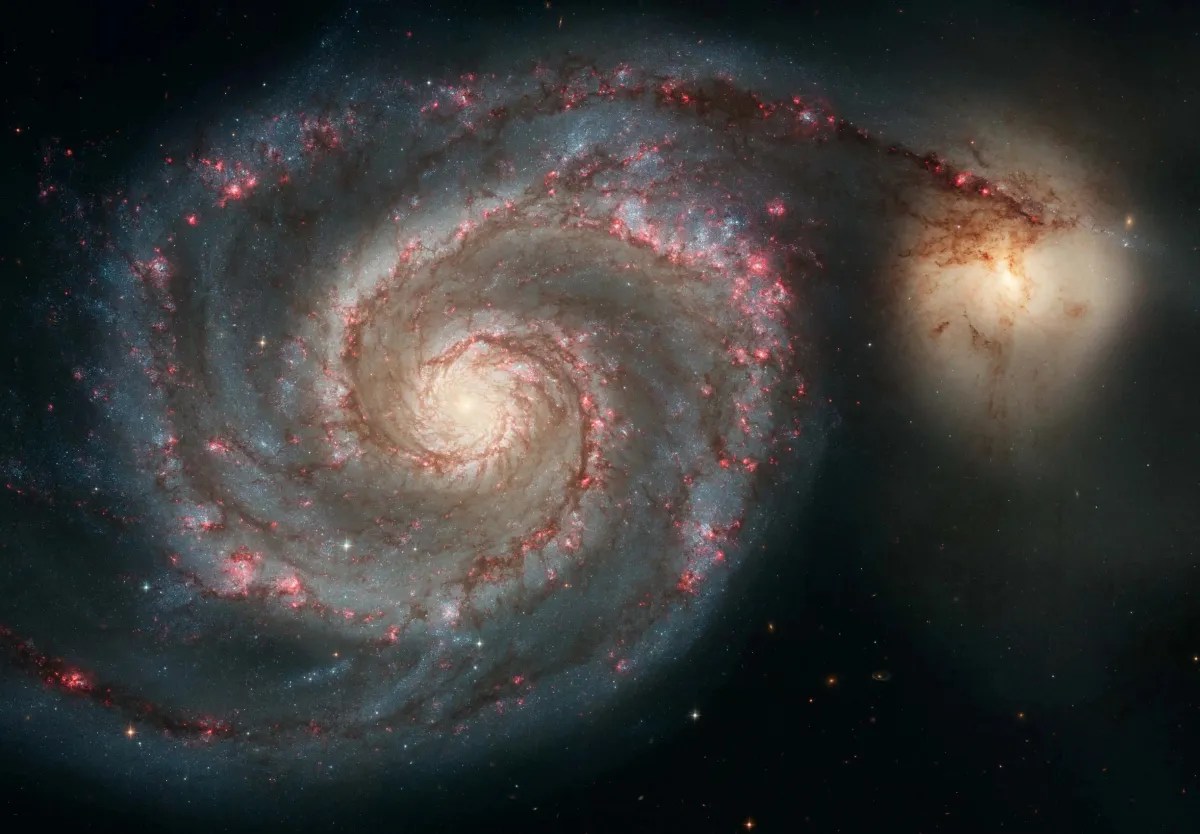
On Oct. 13, 1773, Charles Messier spotted the Whirlpool Galaxy (M51) for the first time. Writing of it a few months later, he described the object as a “very faint nebula without any stars”; it would become the 51st entry in his famous catalog of non-comets. In 1781, Messier’s friend and fellow astronomer Pierre Mechain observed that the object appeared to be a double galaxy with two nuclei (seeing M51’s companion NGC 5195).
Messier didn’t realize it, but he’d been the first to discover a spiral galaxy. It wasn’t until 1845 that the galaxy’s spiral nature was detected: Using his 72-inch reflector, William Parsons, Earl of Rosse, observed a pinwheel-like structure to M51, and labeled M51 a “spiral nebula.” Astronomers of the day theorized they were seeing a solar system in mid-formation, and the true nature of “spiral nebulae” — including the importance of the spiral arms for star formation — wouldn’t be discovered until the early 20th century. Today, M51 is recognized as a classic example of a spiral galaxy, situated about 27 million light-years away in Canes Venatici.
Elisa Neckar is senior production editor of Astronomy magazine, and the editor of the Today in the History of Astronomy feature on Astronomy.com.