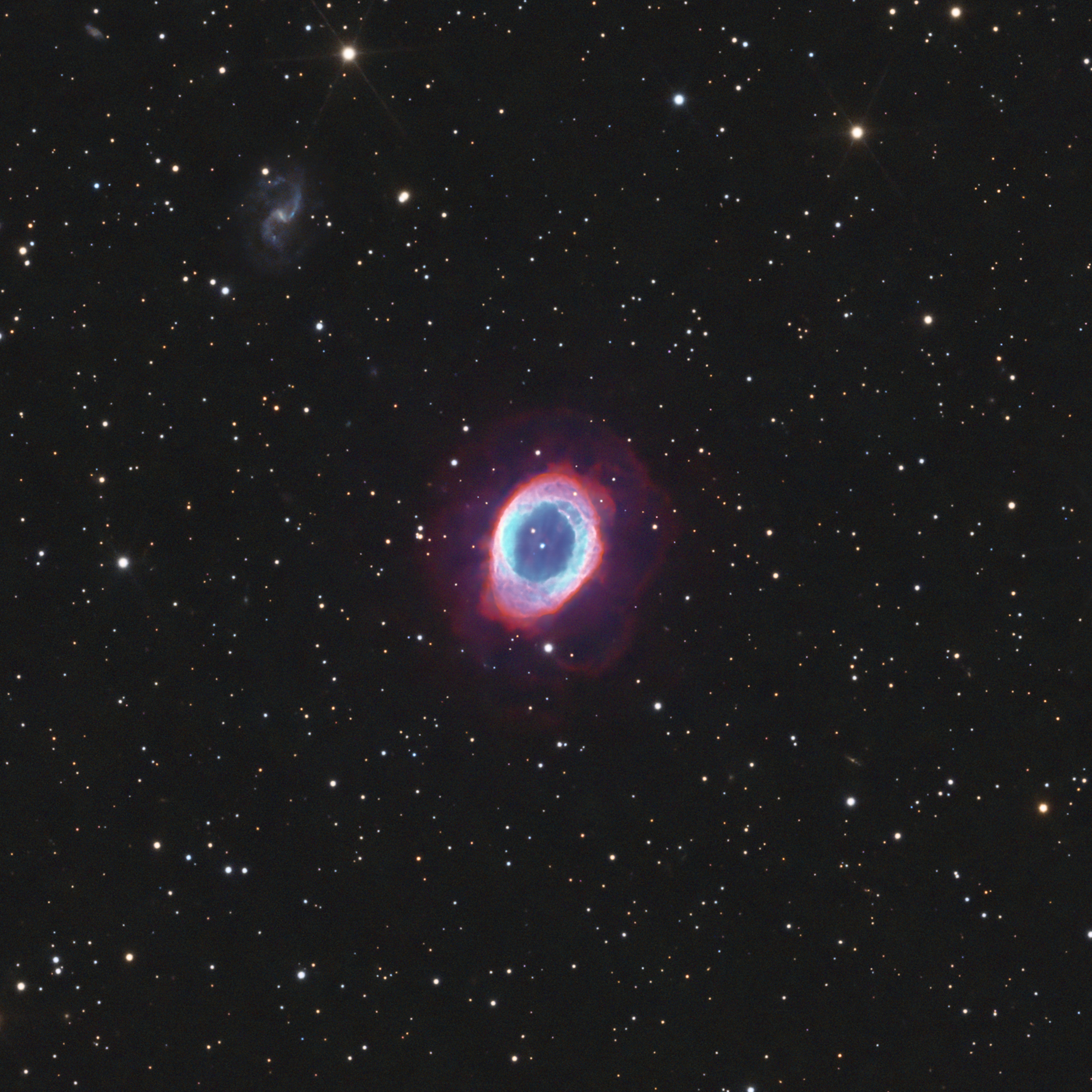
This week, Astronomy magazine Editor Emeritus Dave Eicher invites you to find the Ring Nebula in the constellation Lyra — a glowing shell of gas that offers a glimpse of our solar system’s distant future. When a Sun-like star exhausts its hydrogen, it blows off an illuminated cloud of gas that lingers for tens of thousands of years. Spot it with a low-power telescope, and you’ll be looking at the eventual fate of our own Sun. Clear skies!
Come full circle with the Ring Nebula — video transcript
Hi, I’m Dave Eicher, editor emeritus of Astronomy Magazine. Welcome to This Week in Astronomy, brought to you by Celestron, the world’s leading manufacturer of telescopes.
You know, this time I want to talk about a really cool object that gives us a glimpse of our distant future — well, not our individual distant futures, but the future of our solar system. The sky contains several hundred good examples of what astronomers call a planetary nebula, named by William Herschel due to their telescopic resemblance to planets in the eyepieces of relatively small telescopes. They’re really very different.
When a star similar in mass to our Sun exhausts its hydrogen, it enters a strange state and eventually dies. It blows off an envelope of gas that the collapsed central star gets rid of as it turns into a very dense remnant in the center of this nebula. It illuminates the gas, though, creating this glowing cloud that looks like a disk or other strange shapes in our sky. These nebulae are visible for several tens of thousands of years before the material dissipates into what astronomers call the interstellar medium.
RELATED: JWST sees the Ring Nebula in a new light
One of the great planetary nebulae in our sky is in the small, bright constellation Lyra, and it’s the Ring Nebula. It’s a really nice, of course, ring-shaped nebula that is bright enough and has a high enough surface brightness to appear—parts of it appear—reasonably bright. It’s bright so that you can see it well in small scopes away from city lights. It appears like a ghostly ring of light surrounding the very faint central remnant of the star that has ended its life. These are solar-type stars, solar-mass stars more or less.
So when you see the ring in Lyra, you’re looking at our eventual future in our solar system. Something like six billion years or so from now, our sun will run out of its normal hydrogen-burning material and will evolve into a planetary nebula phase briefly before it becomes a very dense, lonely remnant.
So look at the Ring Nebula in our sky in the bright constellation Lyra. You can see it very faintly in larger binoculars, but a good low-power telescope field will show it pretty well, and you’ll be looking at the fate of our solar system that is only about six billion years to come.
Thanks. I’ll see you next time.
David Eicher is one of the most widely recognized astronomy enthusiasts in the world. He has been with Astronomy magazine for 36 years, was the magazine’s chief editor from 2002 to 2025, and is currently the magazine’s Editor Emeritus. He has written 15 books on astronomy and 9 books on U.S. history.