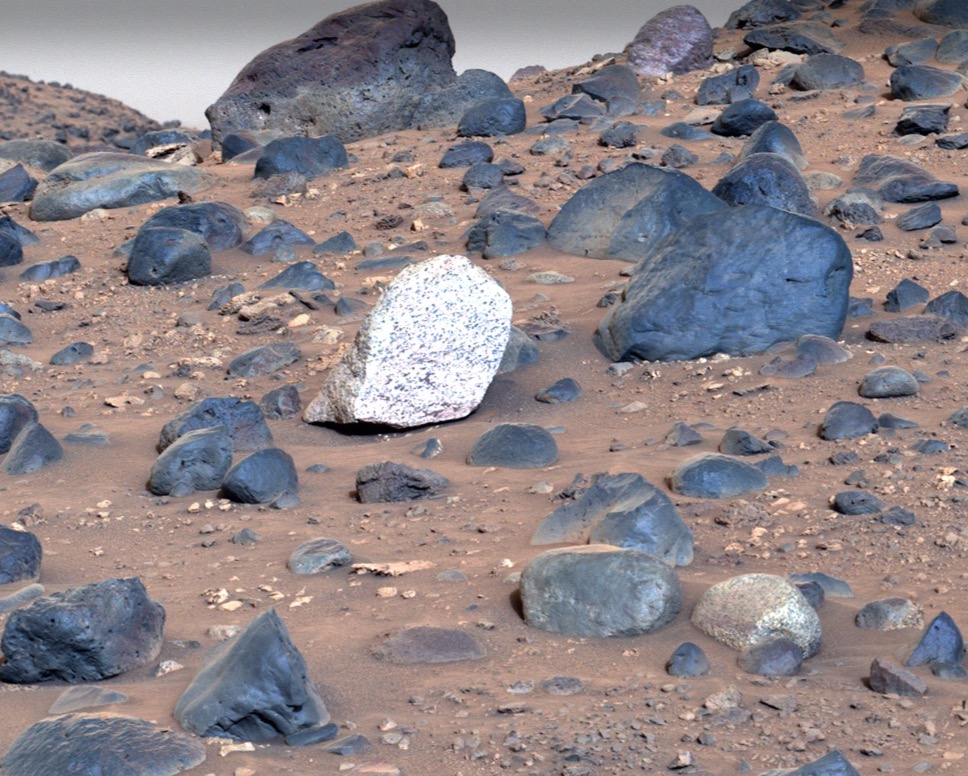
NASA’s Perseverance rover, which has been on Mars since February 2021, recently found a light-colored boulder on the surface of Mount Washburn, a hill inside Jezero Crater. Measuring 18 by 14 inches (45 by 35 centimeters), the rock is now named “Atoko Point,” because it resembles, in color, a similarly named cliff within Arizona’s Grand Canyon.
But while the earthbound feature is made of limestone, a sedimentary rock, Atoko Point on the Red Planet is composed of pyroxene and feldspar, components of igneous and metamorphic rocks. Researchers have offered two ideas about this one-of-a-kind discovery. Either the rock formed elsewhere and was transported to Jezero Crater long ago by a martian river, or it formed underground and eventually made its way to the surface.
The science team in charge of Perseverance’s exploits was looking forward to studying the wide variety of rocks on Mount Washburn. Co-lead Brad Garczynski of Western Washington University says they represent a “grab bag of geologic gifts,” but that Atoko Point was the one that stood out.
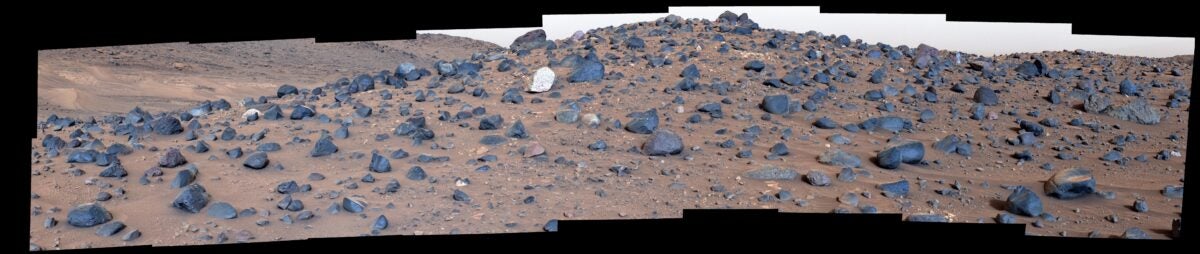
When I first saw the image of Atoko Point, I thought it resembled the light-colored interiors of several meteorites in my collection. For example, the interior of Camel Donga, which fell on the Nullarbor Plain in Western Australia, looks eerily similar. And, indeed, its main minerals are pyroxene and plagioclase, a type of feldspar, the same constituents that make up Atoko Point. Camel Donga is classified as a eucrite, a type of meteorite that is a piece of the asteroid 4 Vesta.