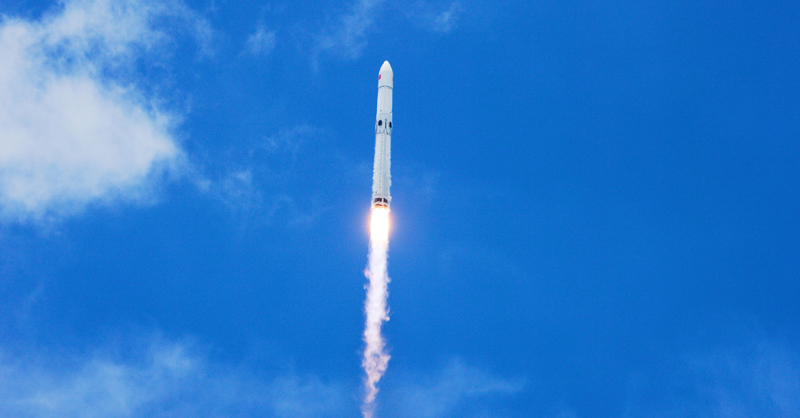
On July 10, China netted a new accomplishment in its spacefaring history. The China Aerospace Science and Technology Corporation (CASC) successfully recovered the booster of an orbital rocket only minutes after launch — a first for the nation as it races to close the gap between SpaceX’s decade-long head start in booster reuse and its own.
The Long March 10B lifted off from the Wenchang Commercial Space Launch Site on Hainan Island. About 10 minutes later, its booster descended toward the South China Sea, where the ship Linghangzhe was waiting. Hooks on the booster’s exterior snagged a gridlike net of cables stretched across the vessel’s deck, leaving the smoking booster suspended in mid air. The rocket’s upper stage continued on, delivering an undisclosed payload cataloged as CX-26 to low-Earth orbit (LEO). The China National Space Administration (CNSA) called the launch a “complete success” and “the world’s first successful sea-based net-based recovery of a carrier rocket” in a press release.
Catching up to SpaceX
This accomplishment is a long time coming. China has spent the past year and a half racing to catch up with SpaceX, whose reusable Falcon 9 has flown nearly 700 times. Two earlier attempts came up short. LandSpace’s Zhuque-3 reached orbit in December but its booster crashed after experiencing “abnormal combustion” during recovery. A Long March 12A booster lost control on descent that same month. Last Friday’s success is the first time China has stuck the landing.
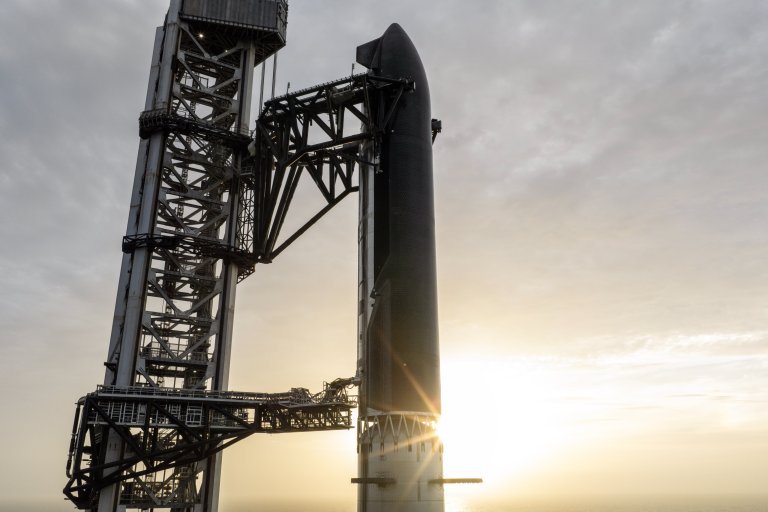
China’s success with the Long March 10B puts three distinct methods of booster recovery on the table. Legs are the most proven of the three: SpaceX first landed a Falcon 9 booster this way on Dec. 21, 2015, and Blue Origin has followed the same approach twice — first with its suborbital New Shepard on Nov. 23, 2015, and again with its orbital New Glenn, which stuck a landing for the first time on Nov. 13, 2025. SpaceX debuted a second method in 2024, catching its far larger Starship booster with mechanical arms mounted on the launch tower itself on Oct. 13 that year. Now, China’s net system is the third.
How the net works
The complex game of catch starts while the rocket is still more than 62 miles (100 kilometers) up. Four titanium grid fins unfold on the falling booster, allowing it to rotate and steer itself toward the ship. A braking burn slows the descent, with onboard guidance continuously correcting course. Below, the Linghangzhe holds its net steady against wind and current using a dynamic positioning system, while both ship and booster trade real-time navigation data to line up the catch.
The design is centered around the idea that losing the legs trims enough weight to earn back payload capacity: “Net-based recovery simplifies the onboard structure, reduces weight, and boosts payload capacity,” said Chen Muye of CASC, according to Xinhua. Net capture, he added, also tolerates more landing imprecision, since the ship and its cables can adjust in real time to catch a booster that comes down slightly off target.
The Long March 10 family
The Long March 10B stands 209 feet (63.6 meters) tall and 16 feet (5 m) wide, burns kerosene through seven first-stage engines and methane through one second-stage engine, and can haul about 16 metric tons to LEO — just under Falcon 9’s 22-metric-ton capacity. CASC has pitched the rocket chiefly as a workhorse for deploying China’s expanding satellite constellations and other commercial payloads, aiming to cut launch costs and support the cadence those constellations will demand.
The Long March 10B’s first stage is identical to the one on the Long March 10A, which completed its own sea-based recovery test in February, making Friday’s flight a joint verification for both vehicles, according to China National Radio (CNR). The 10A is being built as China’s next-generation crewed launcher for trips to the country’s space station, Tiangong; the 10B pairs that booster with a new liquid oxygen-methane second stage aimed at the commercial market. A third sibling, the Long March 10C, is already in development, mating a larger methane-fueled first stage to the 10B’s upper-stage engine.
All three Long March 10 variants share the same diameter and a modular design, an approach Yang Yuguang of the International Astronautical Federation’s Space Transportation Committee said “marks China’s carrier rockets officially entering a new era of reusability,” per CNR. A separate, heavier version of the Long March 10 is also being developed for China’s crewed lunar program, with a target of landing astronauts on the Moon before 2030, according to Ars Technica.
This is the first step of many toward a fully reusable Chinese launch fleet — one built to loft satellite constellations, ferry astronauts to Tiangong, and eventually reach the Moon. Time will tell whether net capture proves to be a competitive alternative to legs, and whether it allows China to unlock the rapid launch cadence that reusable boosters have delivered for SpaceX.
Brooks Mendenhall is a staff writer for Astronomy magazine and is based in Chattanooga, Tennessee.