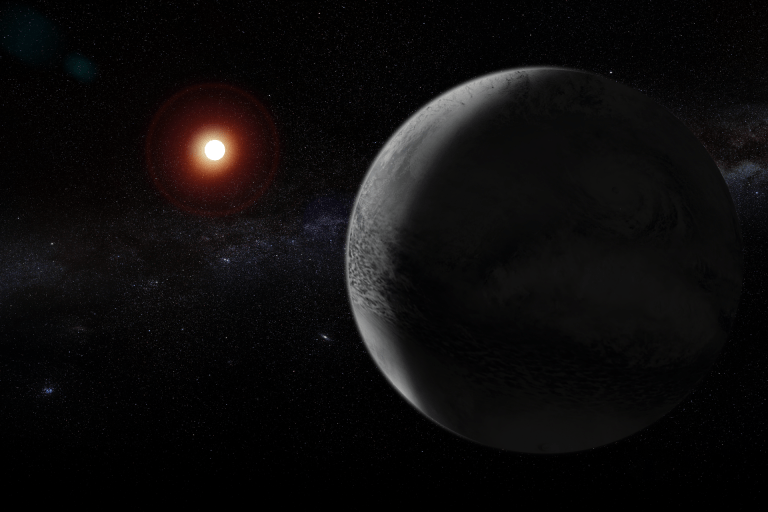
New James Webb Space Telescope (JWST) observations reveal that the so-called “Roasted Planet” is getting cooked by its host star at temperatures even more extreme than previously assumed — and that the planet’s atmosphere is responding to that heat faster than models predicted.
What is HD 80606 b?
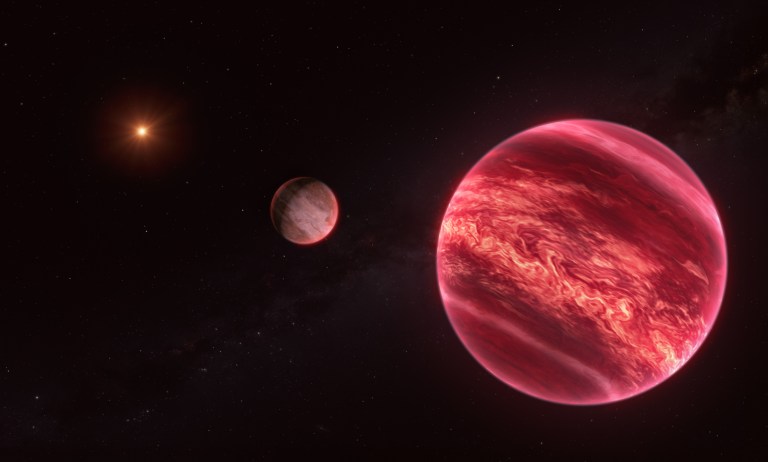
Discovered in 2001, the “Roasted Planet”, formally known as HD 80606 b, is an exoplanet located about 190 light-years from Earth with the radius of Jupiter and a mass of roughly 4 Jupiters. HD 80606 b orbits its host star on an eccentric, cometlike trajectory every 111 days. Unlike most hot Jupiters — gas giants that stay in tight, nearly circular orbits and bake continuously — HD 80606 b spends most of its orbit far from its star before swinging around and experiencing massive temperature fluctuations.
JWST finds a more extreme heat spike
Using JWST spectroscopy, a new study from NASA’s Jet Propulsion Laboratory (JPL) found that during its closest stellar approach, the planet’s temperature shoots up by 1,100 degrees Fahrenheit (610 degrees Celsius) — a spike more severe than prior observations had indicated. These so-called “flash heating events” offer data on an enormous range of physics at once.
“Eccentric exoplanets are a one-stop shop for planetary physics,” said Tiffany Kataria, the study’s principal investigator at JPL, during a June 16 press conference at the 248th meeting of the American Astronomical Society (AAS) in Pasadena, California. “The temperatures rise, the chemical regimes may change, the winds may increase — and all of that is convolved within a single set of observations.”
How JWST tracked the exoplanet’s temperature swing
Kataria presented preliminary findings from the study at the June AAS meeting. The team used JWST’s Mid-Infrared Instrument (MIRI) to observe HD 80606 b continuously for roughly 24 hours through its closest approach to its host star — its periastron — capturing the heating before, during, and after the planet passed behind the star as seen from Earth. The observation required years of scheduling work. Catching the planet at periastron meant coordinating its 111-day orbit against JWST’s own viewing restrictions, which change throughout the year based on Earth’s position relative to the Sun.
Why spectroscopy beats Spitzer’s photometry
Previous observations from NASA’s now-retired Spitzer Space Telescope had demonstrated that the system was worth a closer look, but Spitzer’s photometric data were limited. What JWST brings is spectroscopy: the ability to break incoming light into discrete wavelength slices and read the chemical and thermal signatures encoded in each one. For the first time, the team can track changes in specific molecules — methane, carbon dioxide — as the planet heats and cools, giving a far sharper picture of how extreme the temperature swing actually is.
“Spitzer did amazing work on this exoplanet, and now Webb is building on that legacy by enabling us to drill down to distinguish specific chemical signatures like methane and carbon dioxide, which is just amazing progress,” said study co-author Ryan Challener, a research associate at Cornell University, in a NASA press release.
More findings on the horizon for this hot Jupiter
While the massive temperature spike was the biggest finding so far, the researchers are just starting to dive into all the data they were able to gather from the observations. More findings are already on the horizon.
Co-investigator Laura C. Mayorga of the Johns Hopkins Applied Physics Laboratory noted that HD 80606 b’s unusual orbit makes it a uniquely efficient laboratory — those extreme shifts in temperature and chemistry play out over hours rather than across separate observing campaigns. “Observing a planet like HD 80606 b is actually very efficient because its unusual orbit, with the corresponding swings in temperature and chemical composition, allow us to gather data under varying conditions in just hours and apply those findings to other hot Jupiters or more conventional exoplanets,” Mayorga said in the press release.
One such finding is already emerging from the data. The observed peak in the planet’s infrared brightness — a signal that reflects the combined effects of heat, chemistry, and atmospheric dynamics — arrives significantly earlier than either of the team’s weather models predict. Kataria said the discrepancy could reflect gaps in our understanding the planet’s rotation rate, an atmosphere that sheds heat more efficiently than expected, or some combination of the two. Untangling those possibilities is among the next steps as the team works toward a full manuscript.
Editor’s note: This story has been updated to correct the temperature conversion between Fahrenheit and Celsius.
Brooks Mendenhall is a staff writer for Astronomy and is based in Chattanooga, Tennessee.