Prior to computer technology, how did astronomers so precisely predict solar eclipses?
Kurt Petersen
Sheboygan Falls, WI
What a wonderful question! The simple answer is that they relied on centuries of previous observations. Remember, even computers have to be programmed with the right data to produce future times of eclipses.
The more involved answer is that, around the seventh century b.c.e., the Chaldeans, an ancient Mesopotamian society, began using a specific time period to predict lunar eclipses. It’s called the saros, and it also works for solar eclipses. Simply put, the saros is a time period after which nearly identical eclipses repeat. The Greeks living in the second century b.c.e. also knew of the saros.
The saros cycle equals 6,585.3211 days. That’s how long it takes for four different cycles of the Moon to once again coincide. Those periods are: the Moon’s orbital period; its phase or synodic period; its nodal or draconitic period; and its anomalistic period, which is the time from one lunar perigee to the next. The number of days in a saros cycle works out to 18 years plus a bit more than 11 days. In 11 days, Earth travels only 3 percent of its orbit and the Sun’s declination (its height in the sky) varies by no more than 4°. So, if you know the date of one eclipse, you can predict that a nearly identical eclipse will occur one saros later, with the midday Sun of each at nearly the same altitude. That second eclipse, however, will occur at a much different place on Earth. That’s because the saros isn’t a round number of days. The extra — 0.3211 day — equals 7 hours 42 minutes 23 seconds, so that next similar eclipse will happen this much later. During that time, Earth rotates 115.6°, so you couldn’t see the next eclipse from the same spot. (OK, maybe the partial phase of each, but not totality.)
But in three saros cycles, Earth would shift by 346.8°, only 13.2° less than a full rotation. So, not only will that eclipse be similar to one 54 years and 33 days before, it will occur within an hour of the same time of day.
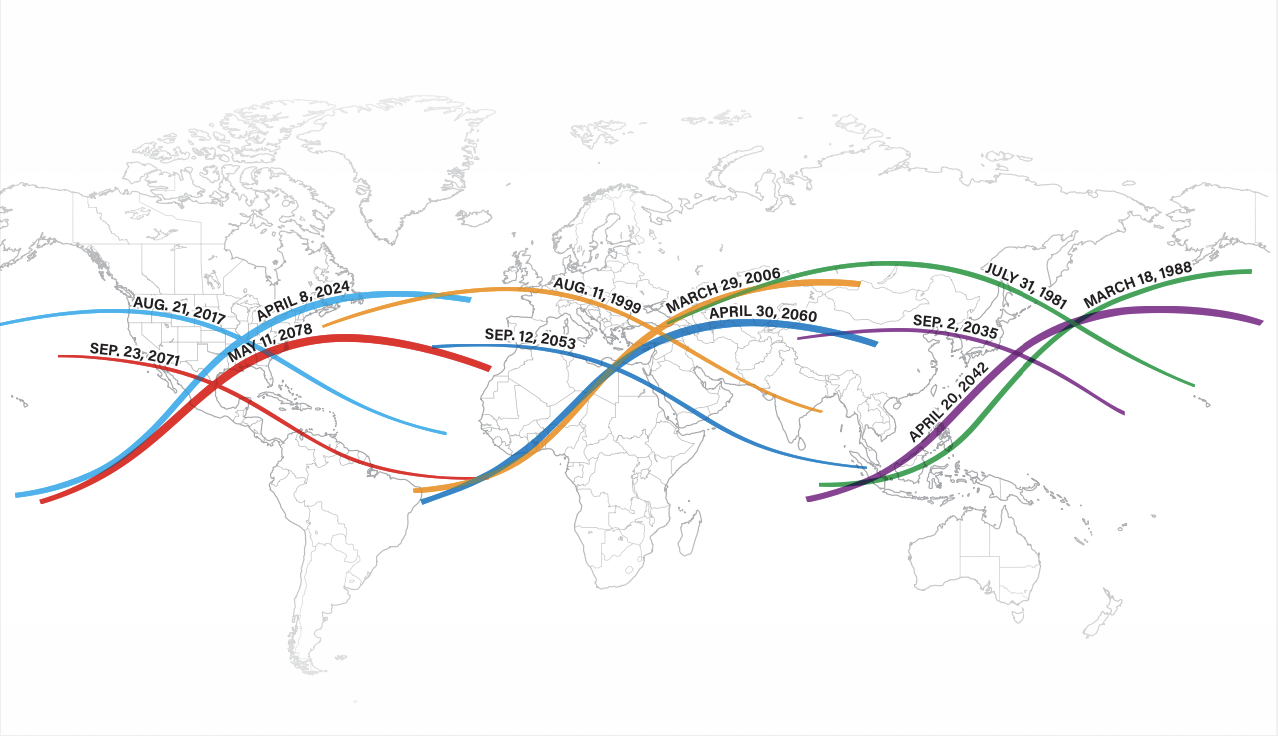
Ancient skywatchers may not have been able to duplicate the subsecond accuracy of today’s eclipse predictions, but, by keeping careful records and using the saros, they could get pretty close.
Michael Bakich
Associate Editor