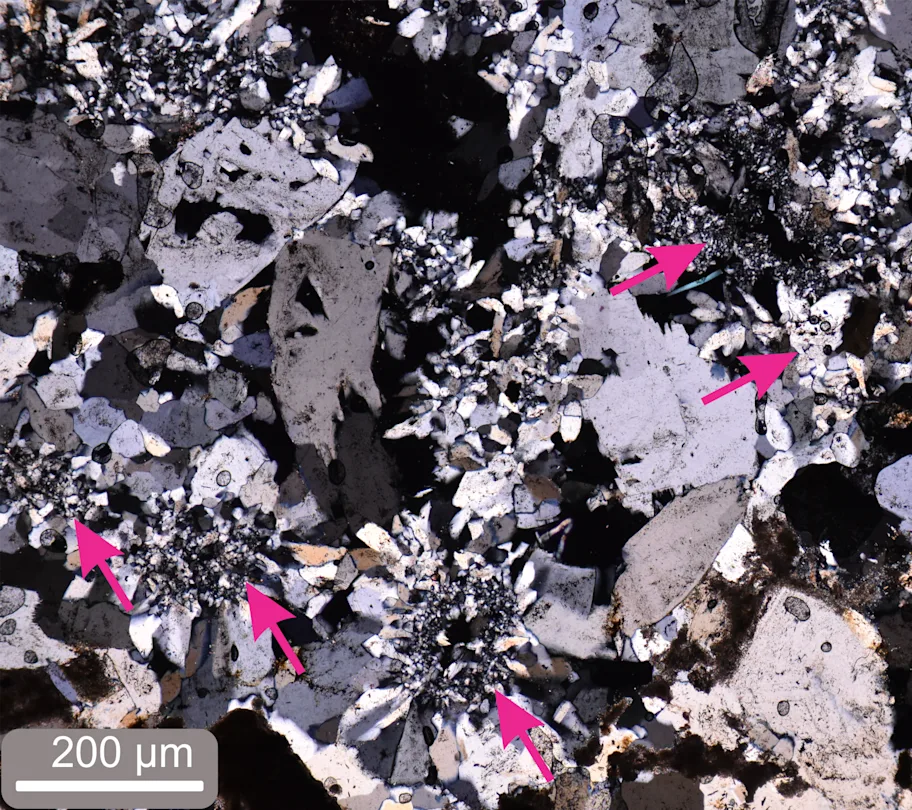
Gypsum is well known for its role in construction, whether it’s in modern drywall or plastering the pyramids in ancient times. But in extreme environments on Earth, it’s also excellent at preserving microbial life. And scientists think it may be doing just that on Mars as well. This image from a study published in Frontiers in Astronomy and Space Sciences on Feb. 4, captures that preservation in action. Pink arrows point to spherulitic gypsum crystals — spiky, radial clusters — within a stromatolite, an ancient layered rock formation. These gypsum crystals house extant microbial communities and protect the remains of extinct organisms. Researchers collected this sample at Salar de Pajonales, a high-altitude salt flat in northern Chile. Gypsum is a sulfate mineral formed when water evaporates in mineral-rich environments. It acts as both shelter and time capsule for microbial life by preserving evidence of organisms that once lived (and, in some layers, still live) within the mineral itself.
What makes this site compelling for astrobiology is how closely it mirrors conditions martian life would have experienced. Like Mars, Salar de Pajonales’s environment is defined by extreme UV exposure and chronic dryness broken up by brief periods of moisture. Because gypsum and similar sulfate minerals have been detected on Mars, particularly in Gale and Jezero craters, understanding how life leaves its mark in Chilean gypsum could tell us where — and what — to look for on the Red Planet.
RELATED: NASA announces strongest evidence yet for ancient life on Mars