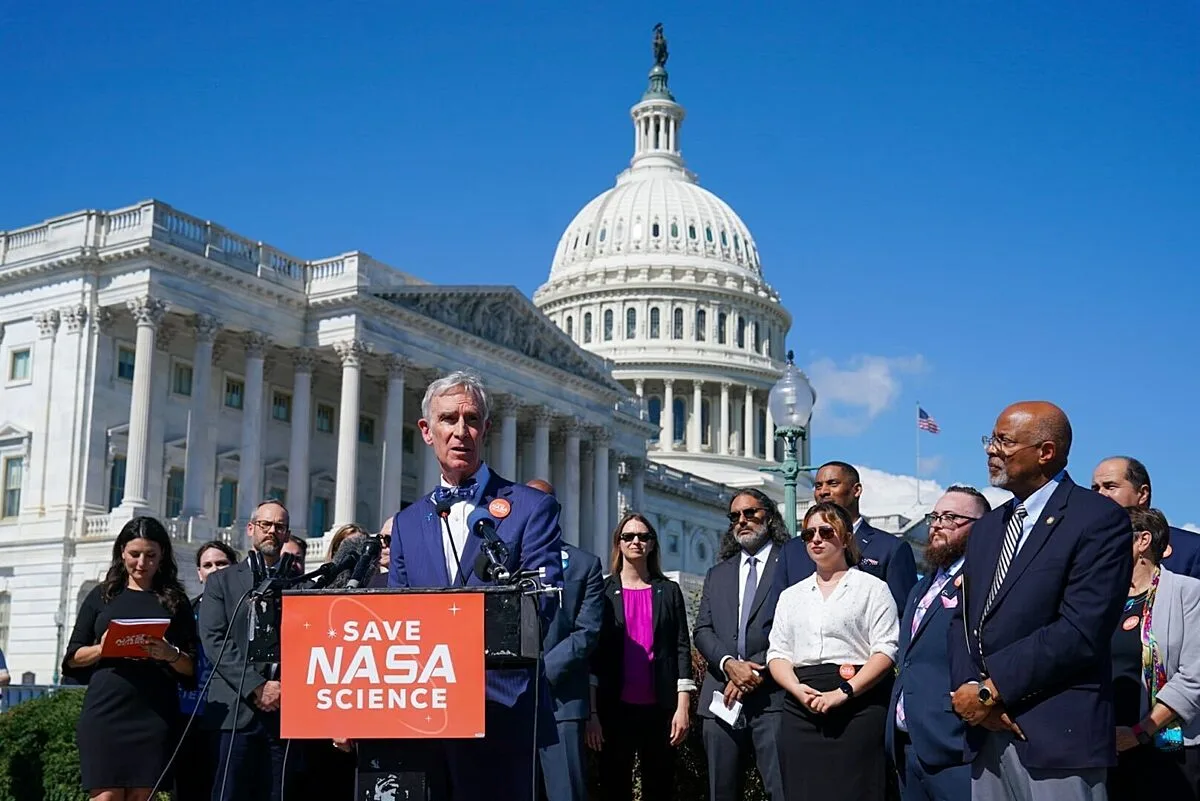
Nearly 300 space advocates from across the United States converged on Capitol Hill on Oct. 6 for a “Save NASA Science” Day of Action, pressing lawmakers to protect the agency’s budget. The event, organized by The Planetary Society and a coalition of 20 science and education organizations, took place against the backdrop of a federal government shutdown that has furloughed approximately 85 percent of NASA’s workforce.
The advocates are responding to the 2026 President’s Budget Request (PBR), which would cut NASA’s science funding by 47 percent. However, the more immediate threat is amplified by the current government shutdown, now entering its second week. The shutdown, which began after Democrats blocked a short-term Republican funding measure, has provided an opening for the administration to threaten mass layoffs. The White House has warned it may use the shutdown to implement the PBR cuts through widespread “reductions in force” (RIFs).
Proponents of the Day of Action argue that if enacted, the PBR cuts would terminate one-third of NASA’s science portfolio, shuttering 41 missions, wasting billions in taxpayer investment, and ceding U.S. leadership in space exploration. The coalition is urging Congress to restore NASA Science funding to its Fiscal Year 2024 level of $7.3 billion and protect the National Science Foundation’s budget.
Advocates held meetings with nearly 250 congressional offices, according to The Planetary Society, and held an afternoon media press conference on the steps of the U.S. Capitol.
“Turning off billions of dollars-worth of functioning spacecraft isn’t a savings. It’s a waste,” said Bill Nye, Planetary Society CEO, at the Day of Action press conference. “And Congress agrees! Both the House and Senate have advanced bipartisan legislation rejecting nearly all of these cuts. We are here today to urge them to finish the job, to work together to finalize a budget that protects NASA and NASA science.”
Speaking at the event, Rep. Glenn Ivey (D-MD), a member of the House Appropriations Committee, warned that the nation is “falling behind with respect to China,” noting that while China is investing heavily in science and technology, the proposed U.S. budget does the “exact opposite.” He framed the debate as a critical moment for the country’s future. “We need to…commit ourselves to funding science moving forward so we can win the future just like as we have in the past,” Ivey said.
Ivey’s comments underscored the bipartisan support within Congress for NASA. Both the House and Senate have advanced spending bills that represent a “near full rejection of the proposed cuts,” according to Planetary Society Chief of Space Policy Casey Dreier. He noted that while the Senate bill more comprehensively protects all areas of NASA science, the House bill contains “really good provisions” such as mandated minimum spending levels for key missions.
Dreier expressed optimism that lawmakers could combine the “best of both appropriations bills and really come out with a great NASA budget,” framing the advocates’ message to Congress as one of thanks and encouragement to “finish the job.” The ongoing government shutdown, however, introduces further uncertainty, with administration threats of permanent staff reductions looming.
In addition to the in-person lobbying, supporters nationwide made over 1,300 calls and sent emails to congressional offices, according to The Planetary Society.
A central argument presented by the advocates was that continued investment in space science is a vital component of the nation’s economy, security, and future. To underscore this point, speakers referenced a Planetary Society analysis of federal spending data. The analysis shows that NASA’s Science Mission Directorate (SMD) — the division responsible for iconic missions like the James Webb Space Telescope and the Perseverance Mars rover — distributed contracts and research grants across all 50 states and numerous congressional districts between 2022 and 2024.
As the shutdown continues, initial administration threats of mass RIFs appear to have softened, though the long-term status of federal workers and programs, including NASA Science, remains uncertain.