Looking for a sky event this week? Check out our full Sky This Week column.
November 18: Catch Leonid meteors this morning
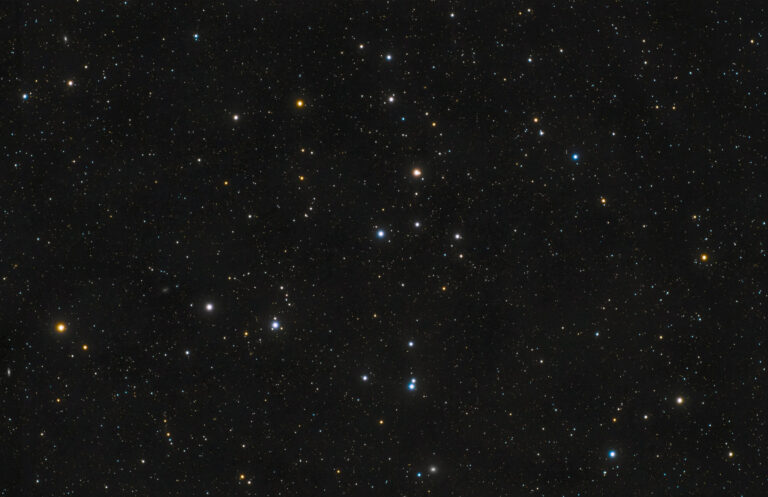
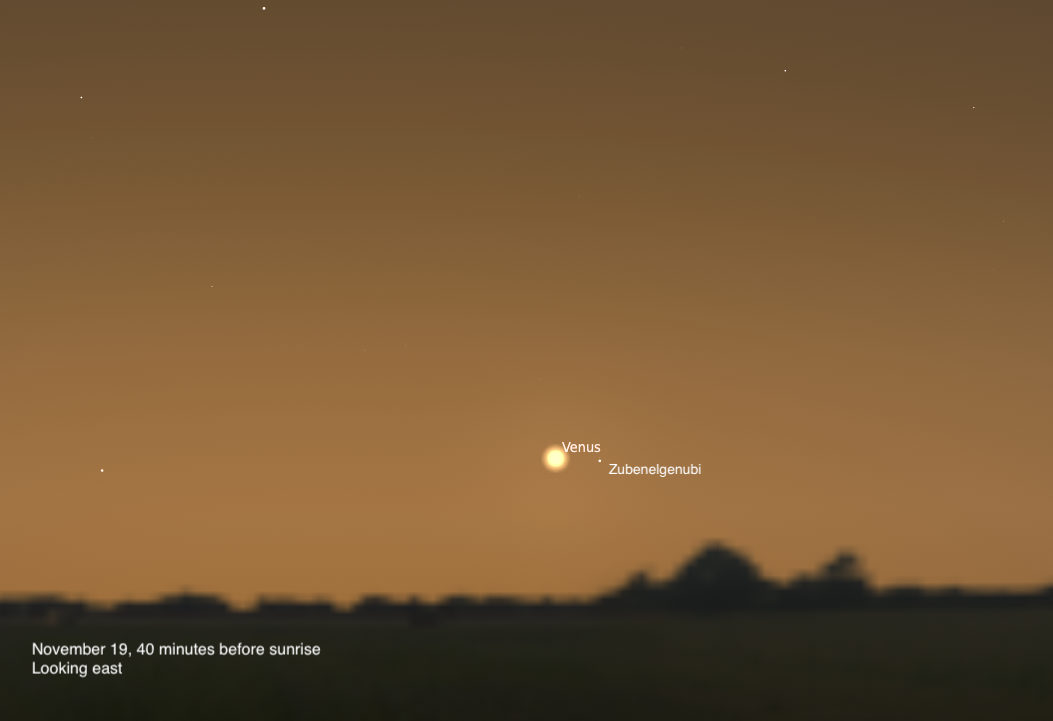
Bright Venus rises near magnitude 2.8 Zubenelgenubi, also cataloged as Alpha2 (α2) Librae. Try for the pairing about 40 minutes before sunrise, when the two are about 3° high in the east. At magnitude –3.9, Venus is easy to find. Zubenelgenubi is 0.8° to the planet’s right, roughly even with it in altitude as it rises. If you can’t see the star without optical aid in the brightening sky, try using binoculars or a telescope. Both will appear in the same field of view.
The Moon passes 6° south of Venus at 4 A.M. EST. When it rises around 6:30 A.M. local time, the Moon will be less than 1 percent lit and less than 24 hours from New, posing an extreme challenge for viewing. However, if you want to give it a try, it is possible — just take extreme care never to point any optics, such as binoculars or a telescope, near the rising Sun.
The Moon reaches apogee at 9:48 P.M. EST. This is the farthest point from Earth in its orbit around our planet, and our satellite will sit 252,706 miles (406,691 kilometers) away at that time.
Sunrise: 6:50 A.M.
Sunset: 4:40 P.M.
Moonrise: 6:25 A.M.
Moonset: 3:59 P.M.
Moon Phase: New
*Times for sunrise, sunset, moonrise, and moonset are given in local time from 40° N 90° W. The Moon’s illumination is given at 10 P.M. local time from the same location.