Looking for a sky event this week? Check out our full Sky This Week column.
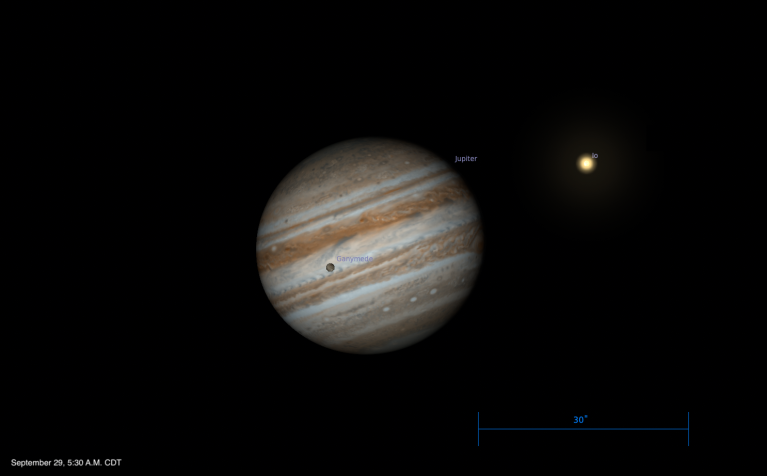
April 14: An Io transit
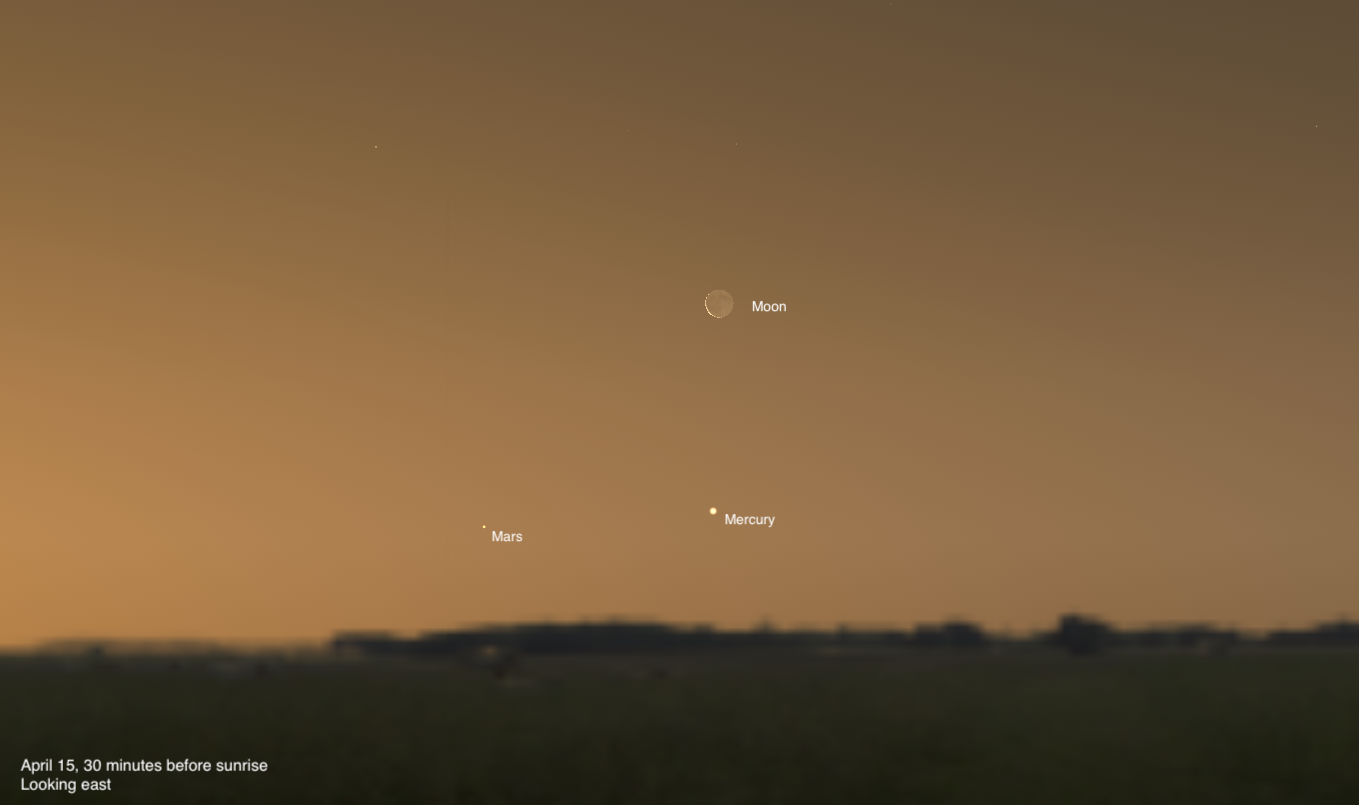
The Moon passes 5° north of Mercury at 3 P.M. EDT. Although the pair rises only shortly before the Sun, the Moon’s visibility and Mercury’s brightness may allow you to spot them.
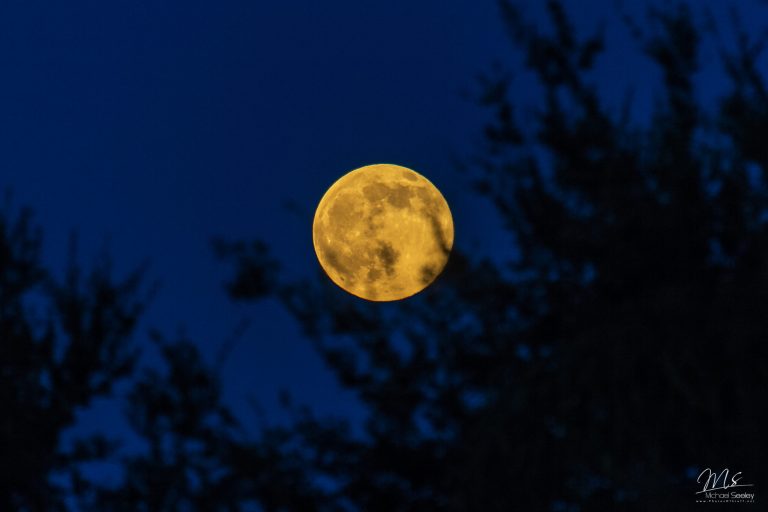
You’ll only have a short window to do so, however, as the Moon rises roughly an hour before the Sun and Mercury just 40 minutes ahead of sunrise. Try about 30 minutes before sunrise, when the delicate, 6-percent-lit Moon hangs just 6° above the horizon. You may spot earthshine on its darkened portion, as sunlight bounces off Earth to light up this region, already experiencing lunar night.
Mercury is much closer to the horizon, only 2.5° high in the east at this time. It hangs some 4° below the Moon, shining at magnitude 0.0. You should be able to easily spot it through binoculars; with a telescope, you may discern that its 6”-wide disk is some 66 percent illuminated.
Although Mars and Neptune — which the Moon will pass later today — are also above the horizon, they are difficult to view in the bright twilit sky. You should try to catch magnitude 1.2 Mars located 4.2° to the left of Mercury in binoculars or a telescope, but it may be challenging. Much fainter Neptune will not really be visible.
The Moon later passes 4° north of Neptune at 5 P.M. EDT and 4° north of Mars at 9 P.M. EDT.
Sunrise: 6:22 A.M.
Sunset: 7:39 P.M.
Moonrise: 5:13 A.M.
Moonset: 5:52 P.M.
Moon Phase: Waning crescent (3%)
*Times for sunrise, sunset, moonrise, and moonset are given in local time from 40° N 90° W. The Moon’s illumination is given at 10 P.M. local time from the same location.