Looking for a sky event this week? Check out our full Sky This Week column.
October 15: Check out Comet Lemmon
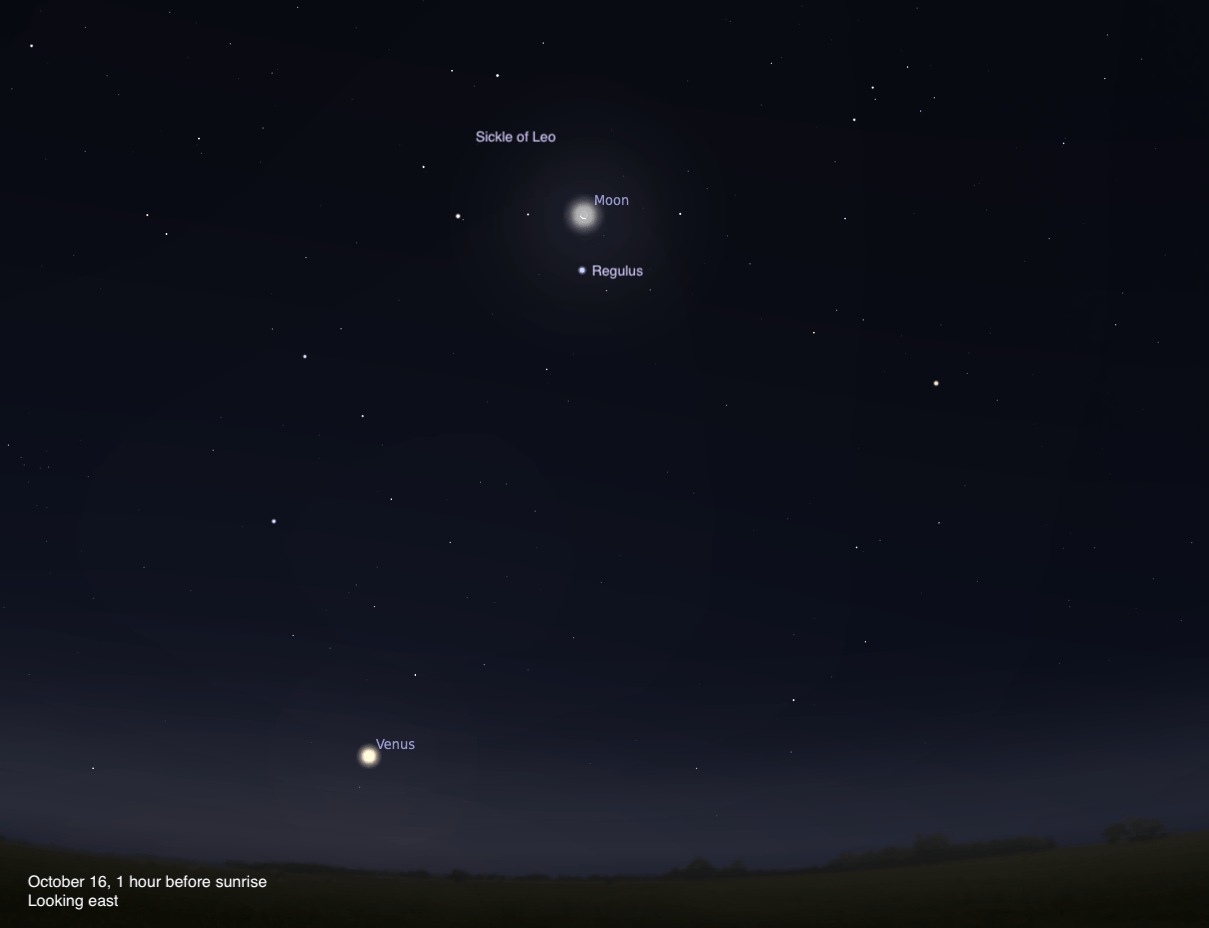
The waning Moon has moved into Leo and stands close to Regulus, the Lion’s bright heart, in the early-morning sky today. An hour before sunrise, they are 40° high in the east, with the crescent Moon just to the upper right of Regulus.
Magnitude 1.4 Regulus shines some 150 times brighter than the Sun. It is not one star but a four-star system; the easiest companion to spot in a telescope lies 175” away and shines at 8th magnitude. This is itself a double, though the faint companion here requires a very large scope to view (it’s magnitude 13.5). The fourth star in the system is a white dwarf companion to the brighter Regulus A and cannot be seen.
Regulus anchors the asterism known as the Sickle, which outlines Leo the Lion’s regal head. This group of stars looks like a backwards question mark in the sky; see if you can spot it this morning as well, even with the Moon nearby.
The Moon will pass 1.2° due north of Regulus at 2 P.M. EDT. If you view the pair at the same time tomorrow morning, you’ll note the Moon has moved to the far lower left of Regulus.
Sunrise: 7:12 A.M.
Sunset: 6:18 P.M.
Moonrise: 2:16 A.M.
Moonset: 4:15 P.M.
Moon Phase: Waning crescent (18%)
*Times for sunrise, sunset, moonrise, and moonset are given in local time from 40° N 90° W. The Moon’s illumination is given at 10 P.M. local time from the same location.