Looking for a sky event this week? Check out our full Sky This Week column.
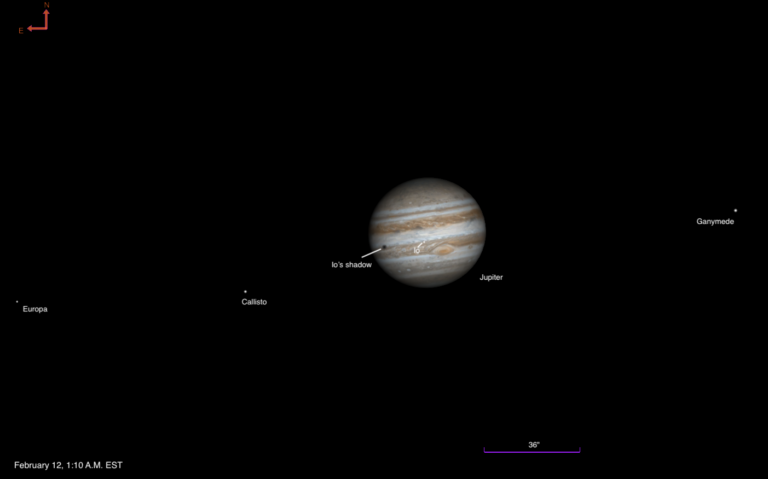
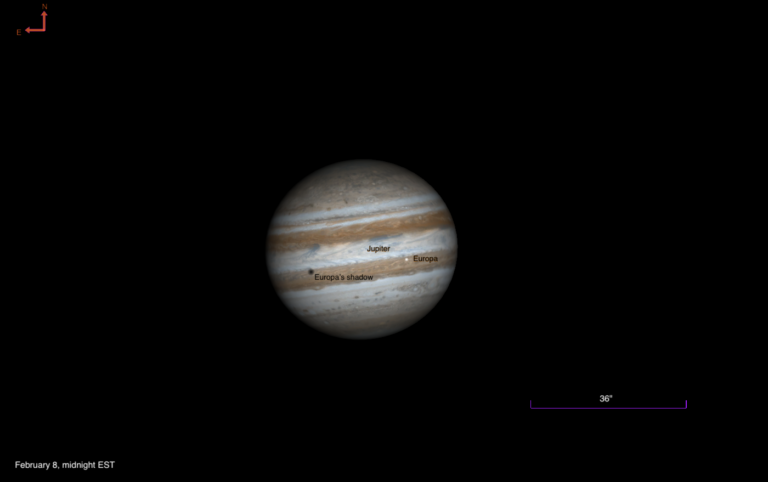
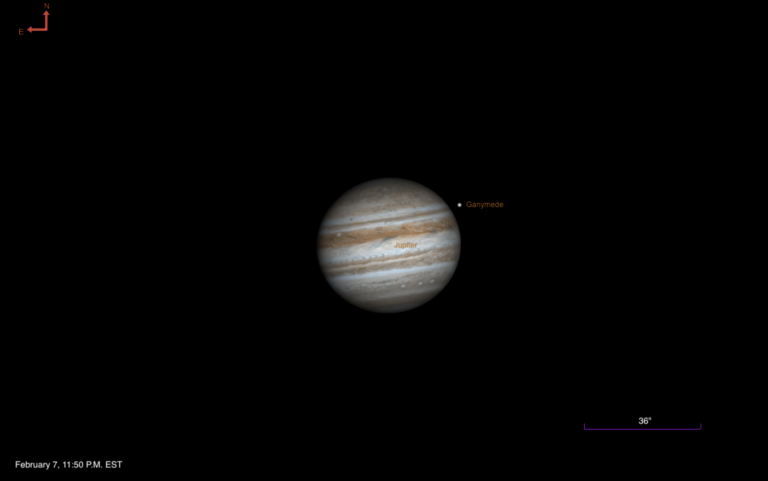
February 11: Ganymede’s shadow, Io cross Jupiter
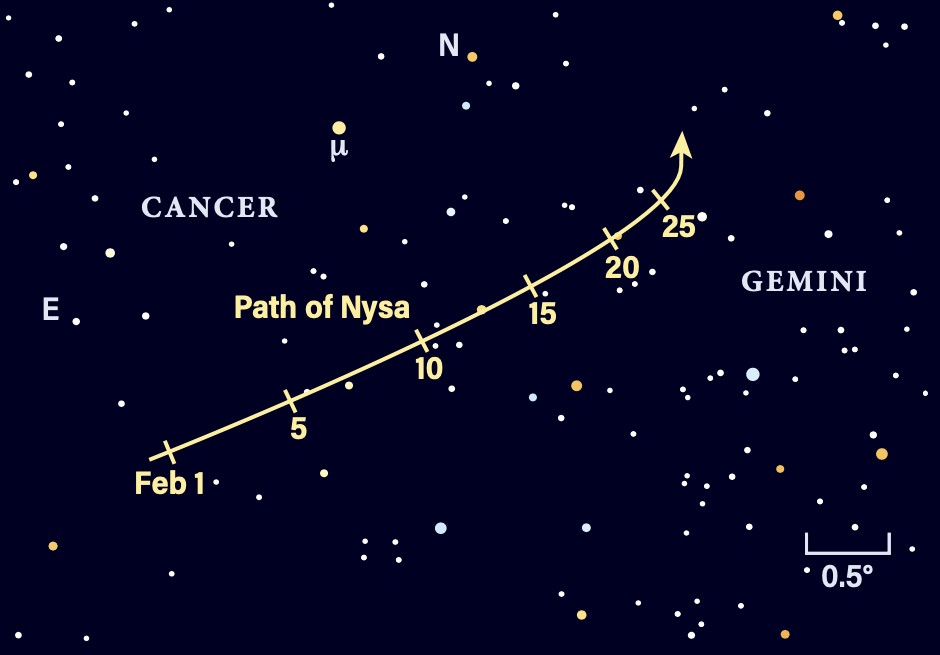
Asteroid 44 Nysa may be just past opposition, but it’s still placed perfectly for evening viewing in Cancer the Crab. Wait until a few hours after sunset, when Cancer is high in the eastern sky, and swing your telescope over to its western reaches, near the Crab’s border with Gemini the Twins. Ninth-magnitude Nysa is 3.3° northwest of Zeta (ζ) Cancri, also called Tegmine, a magnitude 4.6 multiple star system that can be easily split into two with a telescope.
Nysa is particularly close to a 7th-magnitude field star, which tonight lies only about 8’ northwest of the main-belt world. You can use this star as a signpost to watch Nysa’s motion over the next few nights. Spanning about 70 miles (113 km) along its longest axis, this oblong space rock is one of the brightest asteroids in our sky right now, currently only fainter than 4 Vesta and even outshining 1 Ceres at the moment, thanks to the difference in their distances from Earth as we all orbit the Sun.
Sunrise: 6:56 A.M.
Sunset: 5:33 P.M.
Moonrise: 3:57 A.M.
Moonset: 12:37 P.M.
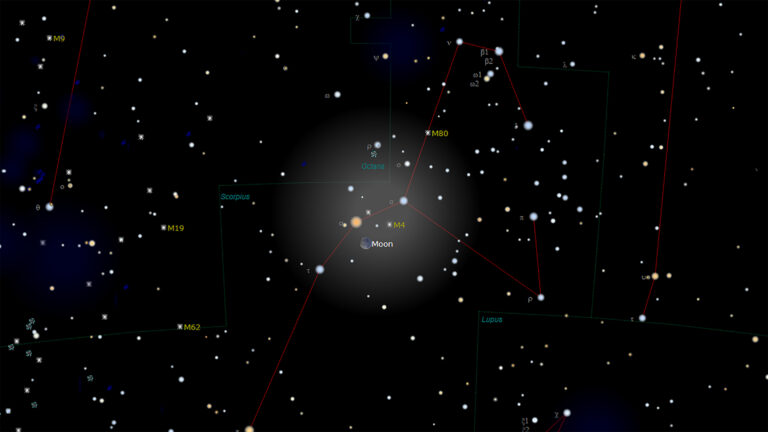
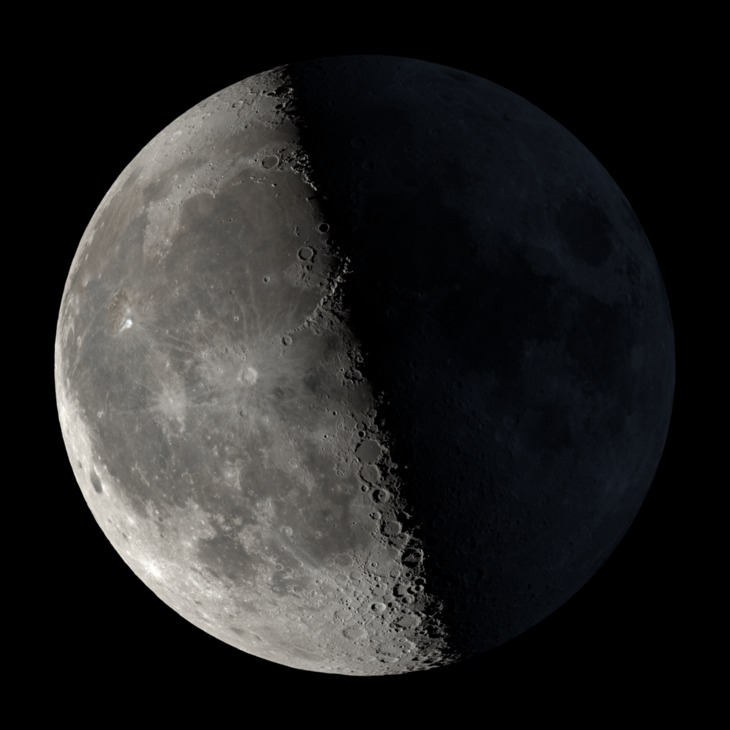
Moon Phase: Waning crescent (18%)
*Times for sunrise, sunset, moonrise, and moonset are given in local time from 40° N 90° W. The Moon’s illumination is given at 10 P.M. local time from the same location.