Credit: Philippe Moussette
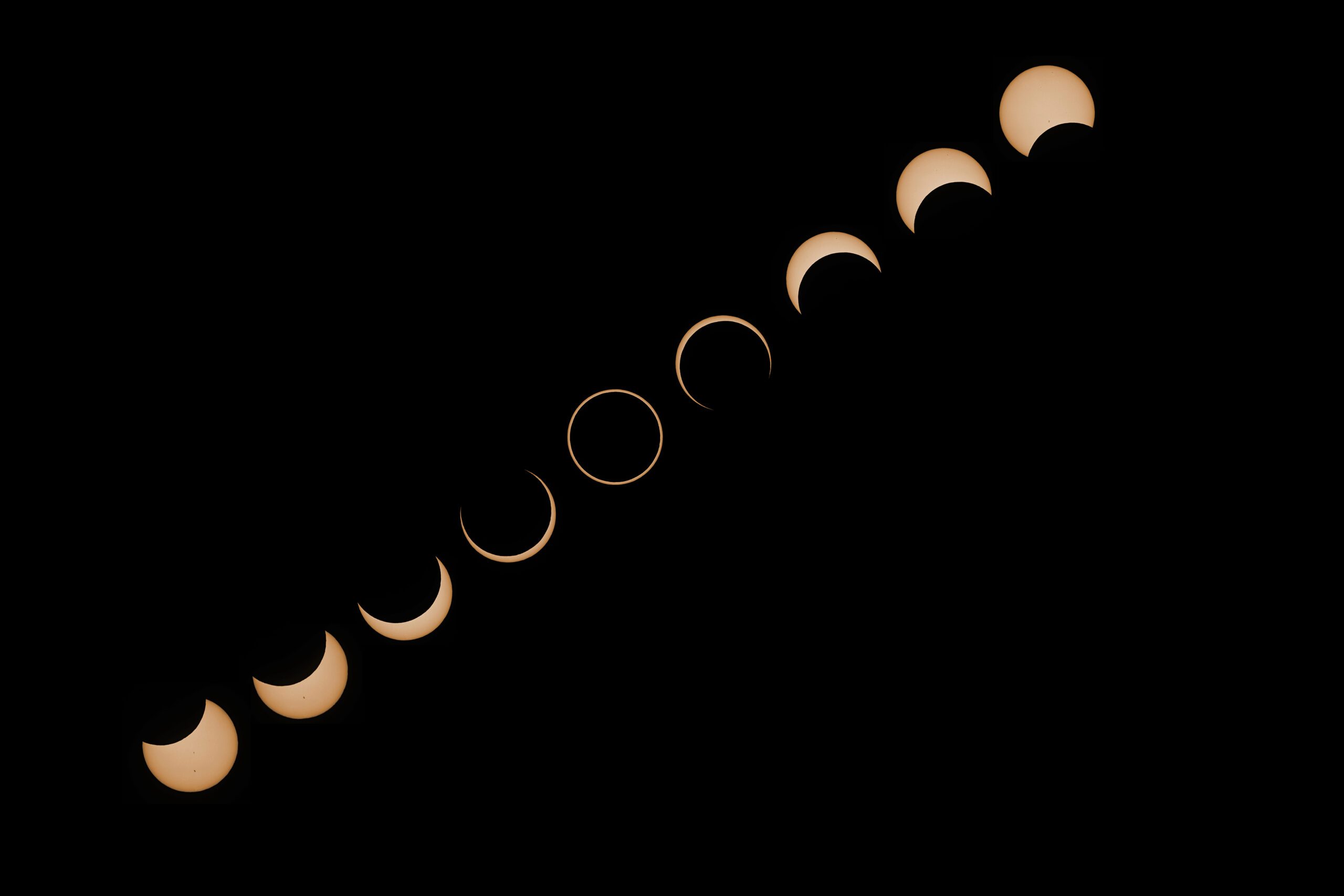
On Tuesday, February 17, an annular eclipse of the Sun will occur. Here’s the catch, though: It will only be visible as annular along a thin line in Antarctica. From the southern tips of Chile and Argentina, and in Mozambique, Madagascar, and South Africa, as well as parts of the Atlantic, Pacific, and Indian Oceans, the eclipse will be partial.
Three types of solar eclipses are possible. First, and most impressive, are total solar eclipses, during which the Moon covers the entire visible disk of the Sun. A second type is the annular eclipse (of which this one is an example), where the Moon travels across the Sun centered on its disk but our satellite’s apparent size is too small to cover the whole disk. The Moon therefore leaves a ring of Sun around the black circle it makes. In Latin, the word for “ring” is annulus, so this is an annular eclipse. Solar eclipse type three is the least impressive, the partial eclipse. Any solar eclipse in any location where there’s no total or annular eclipse is a partial eclipse.
Heading south?
From Antarctica, the Moon will cover nearly 92.5 percent of the solar disk at mid-eclipse. The annular portion, when a ring of the Sun surrounds the Moon, will last a maximum of 2 minutes 20 seconds. By contrast, from Punta Arenas, Chile, the Moon will cover less than 2 percent of the Sun’s disk. Now that’s a partial eclipse!
It must be said that few people will venture to the extreme southern reaches of our globe to view this event. If you’re one of them, however, and if you do get some pictures, please send them to me at michael.bakich@firecrown.com. Good luck!