
Key Takeaways:
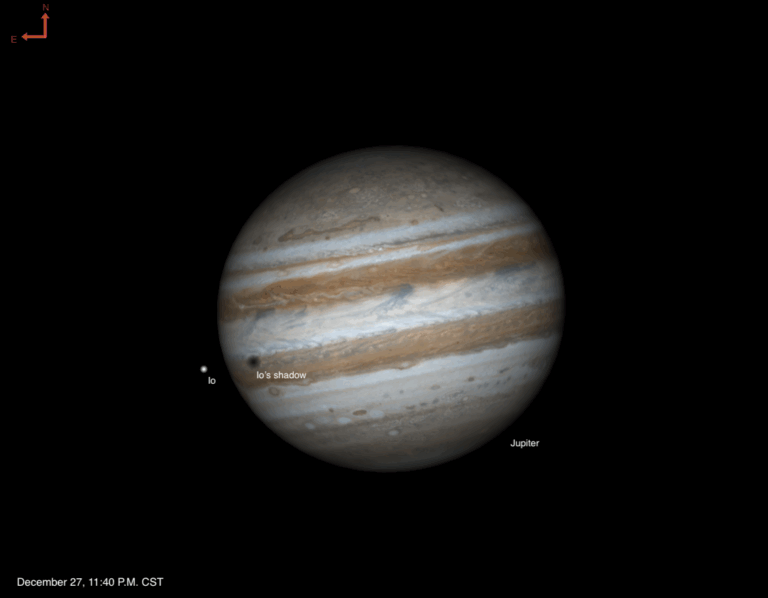
- The article highlights a specific celestial event on December 27, 2025, detailing the transit of Io and its shadow across Jupiter's disk.
- It provides guidance for observing the constellation Auriga, located high in the eastern sky after sunset, using Capella as a reference point to locate the open cluster M38.
- Observations of M38 are elaborated, noting its magnitude (7.4), angular size (20'), the apparent "pi" shape formed by its brighter stars, and its inclusion within the "Happy Face" asterism, which also features Phi Aurigae.
- Further observational targets include the open cluster M36 (magnitude 6.3), situated proximally to the "Happy Face" asterism, and the article concludes with precise ephemeris data for sunrise, sunset, moonrise, moonset, and the Moon's 65% waxing gibbous phase for a specific locale (40° N 90° W).
Looking for a sky event this week? Check out our full Sky This Week column.
December 27: Io and its shadow cross Jupiter
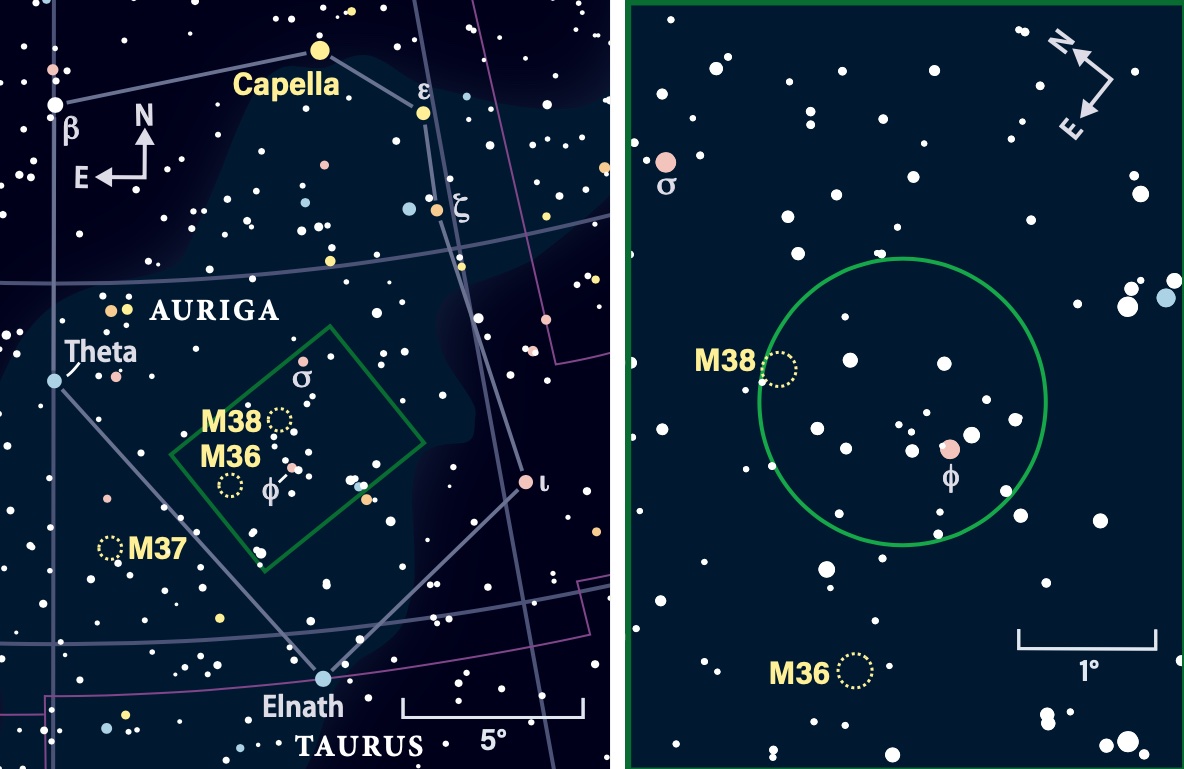
Already high in the east a few hours after sunset, the large, circular figure of Auriga lies above Gemini the Twins, the latter of which currently hosts bright Jupiter. Auriga’s brightest star is magnitude 0.1 Capella, and we’ll start our journey here. From Capella, drop about 8.7° south-southeast to 5th-magnitude Sigma (σ) Aurigae. From there, it’s just a short hop 1.7° southeast to the open cluster M38. One of three Messier clusters in Auriga, M38 shines at magnitude 7.4 and appears easily in binoculars or a telescope. It spans some 20’ and its brighter stars appear to many observers to form the shape of the Greek letter pi (π). M38 also serves as a “dimple” in the Happy Face asterism, a random pattern of stars that forms two eyes, a small nose, and a broad smile just southwest of M38. The magnitude 5.1 star Phi (φ) Aur is part of the mouth. Check out the star chart above to help you visualize the face, and see whether you can visualize it through your optics!
Just under 2° southeast of the Happy Face is another of Auriga’s Messier clusters, M36. Don’t forget to stop over for a look at this magnitude 6.3 grouping of young stars, which contains a few dozen confirmed members.
Sunrise: 7:21 A.M.
Sunset: 4:42 P.M.
Moonrise: 12:02 P.M.
Moonset: 12:40 A.M.
Moon Phase: Waxing gibbous (65%)
*Times for sunrise, sunset, moonrise, and moonset are given in local time from 40° N 90° W. The Moon’s illumination is given at 10 P.M. local time from the same location.