Looking for a sky event this week? Check out our full Sky This Week column.
December 25: Celebrate with the Christmas Tree Cluster
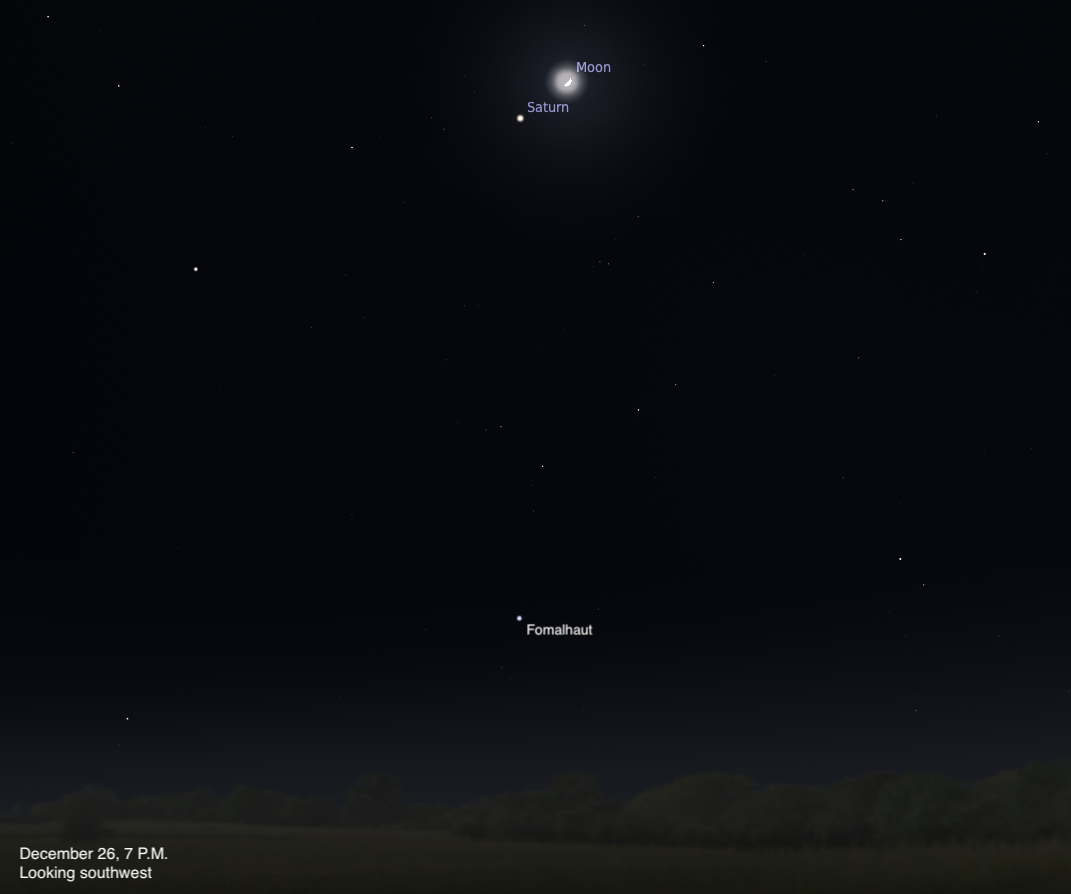
The Moon passes 4° north of Saturn at 11 P.M. EST. The pair is visible all evening, sinking toward the western horizon later on. Earlier in the evening, around 7 P.M. local time, the two worlds stand roughly 40° high in the southwest, with Saturn to the lower left of the nearly First Quarter Moon.
Saturn shines at magnitude 0.7, still easy to pick out with the naked eye. Through a telescope, its disk stretches 17” across, its rings some 39” from end to end. Those rings are tilted just 0.8° to our line of sight, appearing close to edge on. The planet’s brightest moon, Titan, lies just over 2’ west of the center of the planet. Far to the east, Iapetus is at its faintest (12th magnitude) nearly 8.5’ away. Closer to the ringed world are 10th-magnitude Tethys, Rhea, and Dione. These three moons cluster close to each other on Saturn’s western side tonight, inside the orbit of Titan.
Now drop your gaze far below Saturn toward the horizon. Do you see a similarly bright light, this one only about 13° high? That’s magnitude 1.2 Fomalhaut, the brightest star in Piscis Austrinus the Southern Fish. This young star is famous for the large, dusty disk of planet-forming material around it. Several years ago, astronomers found what they believed was a young planet orbiting within the disk, which they named Fomalhaut b. Yet in 2014, after 10 years of observations, it disappeared from view. Astronomers ultimately determined Fomalhaut b likely hadn’t been a planet at all, but a collection of debris from the previous smash-up of protoplanetary pieces within the disk. As that debris cloud expanded and spread out, it faded until it was no longer detectable from Earth.
Sunrise: 7:21 A.M.
Sunset: 4:41 P.M.
Moonrise: 11:15 A.M.
Moonset: 11:31 P.M.
Moon Phase: Waxing crescent (43%)
*Times for sunrise, sunset, moonrise, and moonset are given in local time from 40° N 90° W. The Moon’s illumination is given at 10 P.M. local time from the same location.