Looking for a sky event this week? Check out our full Sky This Week column.
December 21: The winter solstice
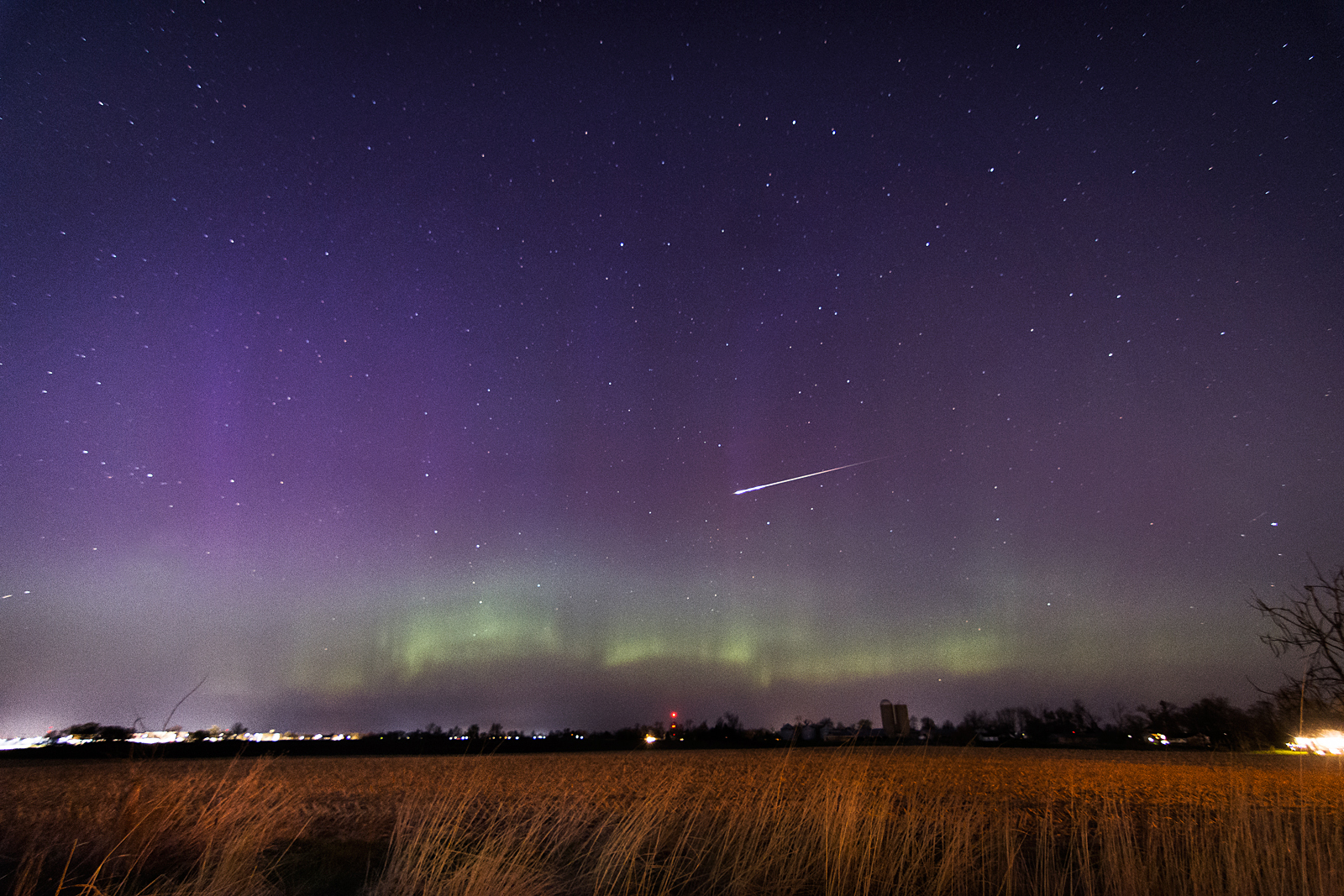
This morning offers a chance to catch the last major meteor shower of the year: the Ursids. This short-lived shower is active for only about a week and peaks this morning under dark, moonless skies.
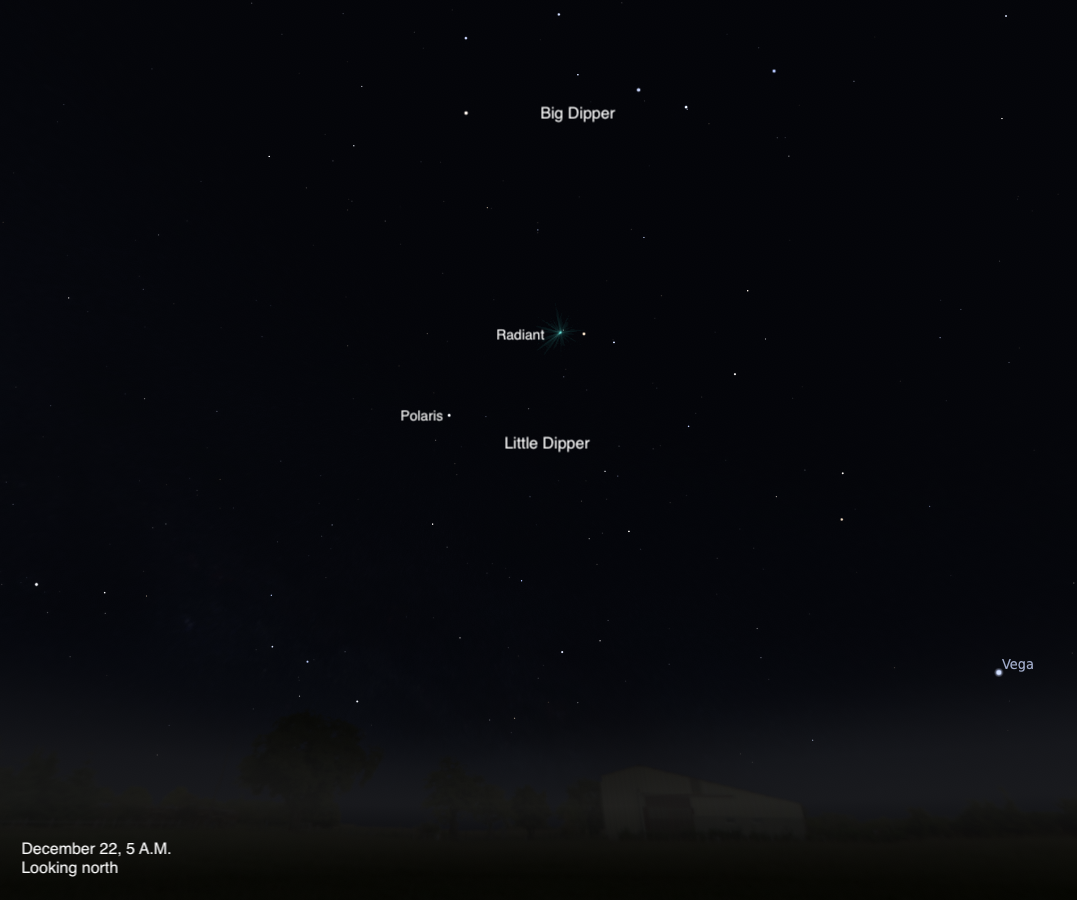
Although the Ursids’ peak rate is just ⅒ that of the Geminids last week — meaning at its best, it will only produce about 10 meteors per hour — it’s still worth stepping outside before sunrise to see if you can catch a few shooting stars. In fact, the radiant in the north is visible all night for much of the Northern Hemisphere, meaning you can watch for meteors late on the 21st as well as again this evening.
The Ursids’ radiant is located just off the cup of the Little Dipper. It is nearly 50° high in the north by 5 A.M. local time, to the upper right of the North Star, Polaris. If you can find the Big Dipper in the northern sky — upside-down early this morning — look beneath its cup to find the matching, smaller cup of the Little Dipper. These cups always appear to pour into each other as the stars wheel around the North Celestial Pole, anchored by Polaris.
Sunrise: 7:19 A.M.
Sunset: 4:38 P.M.
Moonrise: 9:32 A.M.
Moonset: 7:04 P.M.
Moon Phase: Waxing crescent (9%)
*Times for sunrise, sunset, moonrise, and moonset are given in local time from 40° N 90° W. The Moon’s illumination is given at 10 P.M. local time from the same location.
Rising around midnight and visible in the early-morning sky of December 23, Comet 24P/Schaumasse glows at roughly 11th magnitude as it prepares to enter the rich Virgo Cluster.
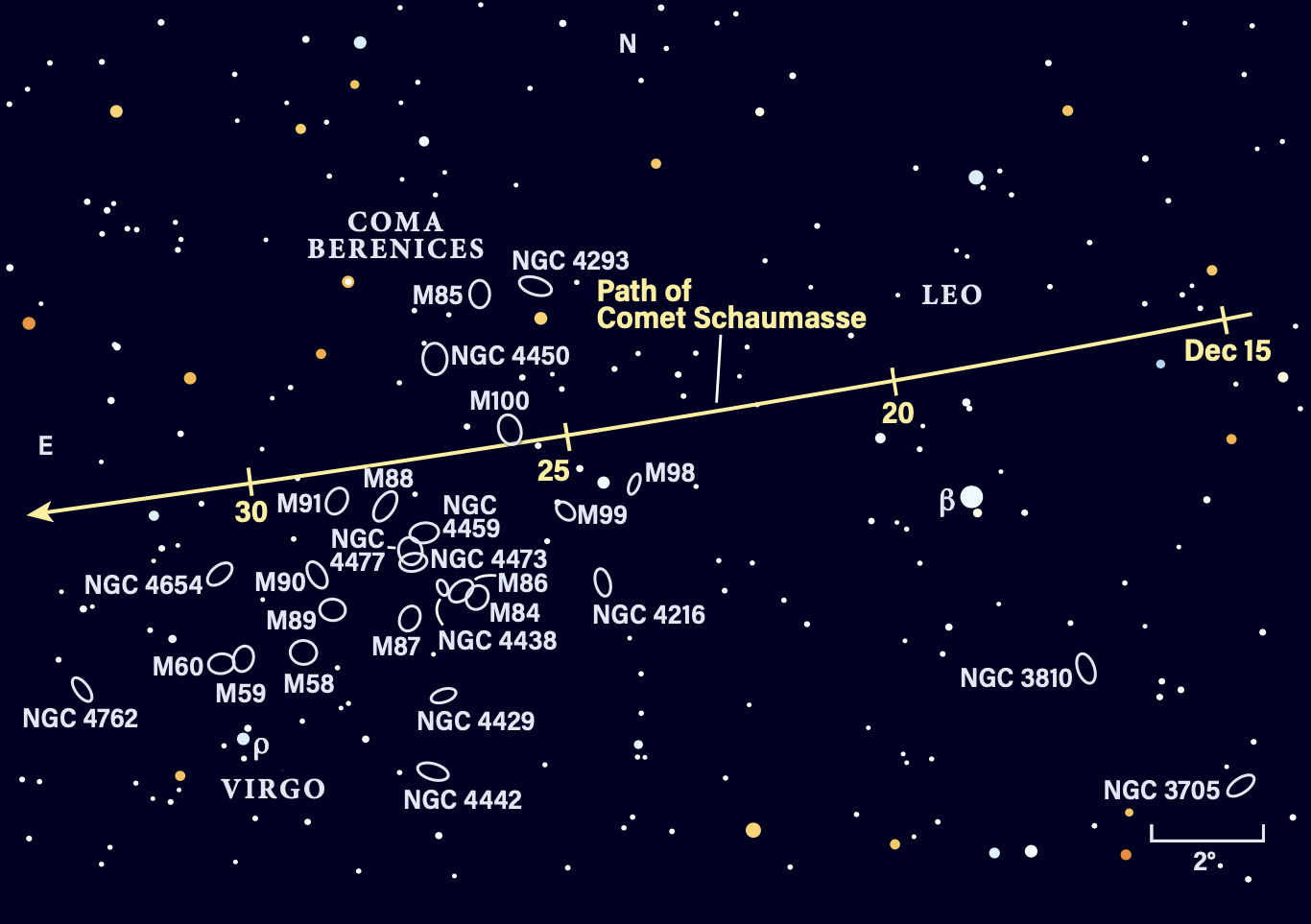
Now in far southwestern Coma Berenices, Schaumasse is just 1.7° northwest of M98, an edge-on spiral galaxy that, at magnitude 10.1, glows slightly brighter than the comet. Not far away are M99 (a little farther southeast of Schaumasse) and M100 (about 3.4° east of the comet). M99 is a face-on spiral that contrasts nicely with M98, glowing at roughly the same magnitude (9.9). M100 is brighter at magnitude 9.3 — in fact, it’s one of the brighter galaxies in the Virgo Cluster, offering a lovely example of what astronomers call a grand design spiral, with well-defined arms wrapping around its bright nucleus.
Take your time with this region, enjoying the scene as the faint, fuzzy comet approaches the galactic gaggle. Schaumasse will be passing through this rich region for the rest of the month — hang onto the chart provided above to help you identify both the comet and the galaxies it’s passing over time.