Looking for a sky event this week? Check out our full Sky This Week column.
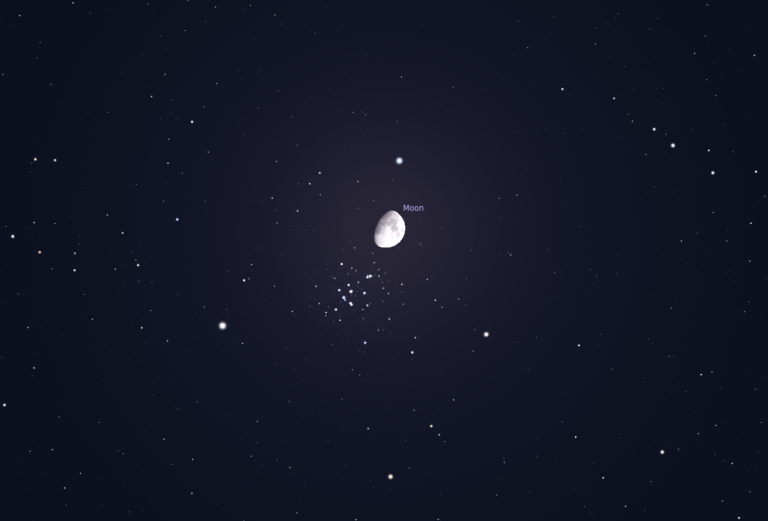
November 7: Open cluster M103 shines in the Queen
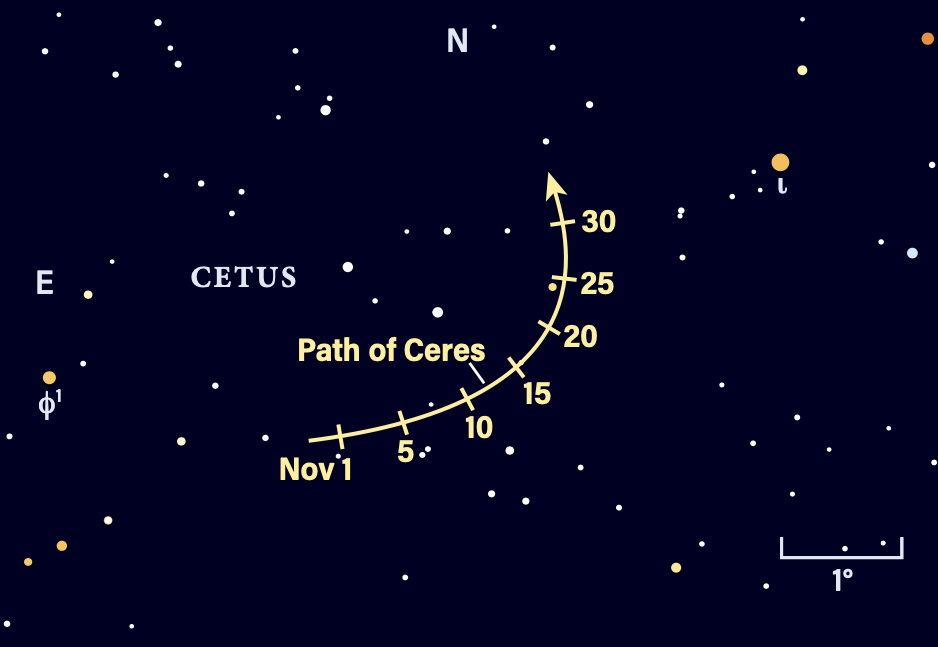
Eighth-magnitude dwarf planet 1 Ceres is passing close to a background star tonight, just 6’ southwest of a slightly fainter 9th-magnitude sun. Both are about ¼° north of an easy-to-spot pair of stars as well.
Ceres is located in Cetus the Whale, rising in the afternoon and highest around 9 P.M., when it is roughly 40° high in the south. The brightest point of light in this region of the sky is 1st-magnitude Saturn, which lies in northeastern Aquarius. Some 9.5° to Saturn’s southeast is magnitude 3.6 Iota (ι) Ceti; from here, scan about 3.5° farther southeast with binoculars or a telescope to land on Ceres. It is the southwesternmost point in the pair it currently creates with the fainter background star.
Continue looking southeast from here, and you’ll land on 2nd-magnitude Diphda, also known as Deneb Kaitos. Cataloged as Beta (β) Ceti, this is the brightest star in the constellation Cetus, even outshining its alpha star, Menkar, which sits far to the northeast, near the constellation’s border with Taurus.
Sunrise: 6:37 A.M.
Sunset: 4:49 P.M.
Moonrise: 7:29 P.M.
Moonset: 10:38 A.M.
Moon Phase: Waning gibbous (82%)
*Times for sunrise, sunset, moonrise, and moonset are given in local time from 40° N 90° W. The Moon’s illumination is given at 10 P.M. local time from the same location.