Looking for a sky event this week? Check out our full Sky This Week column.
July 3: Glimpse the Milky Way’s center
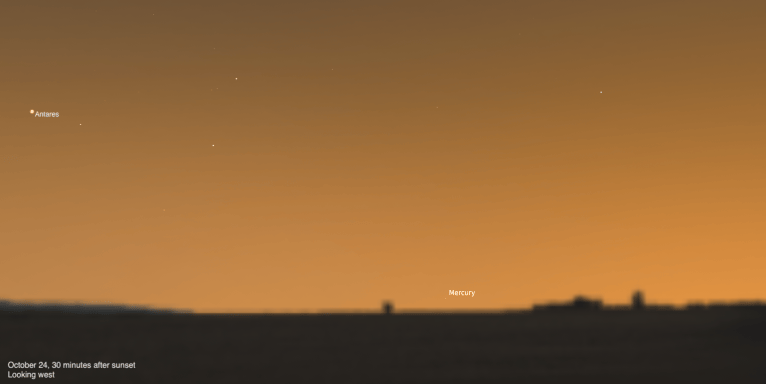
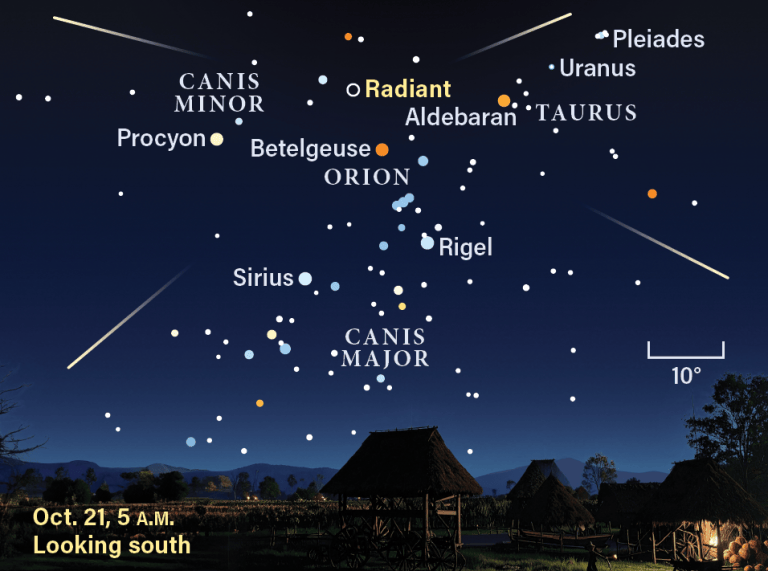
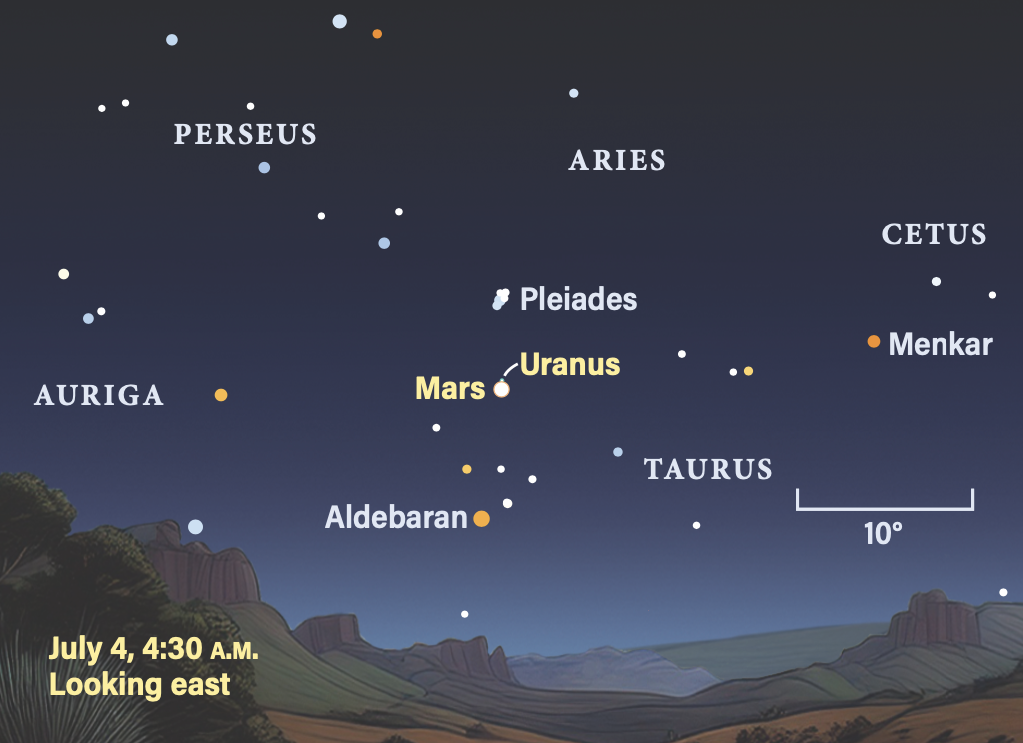
Mars passes 0.1° south of Uranus in Taurus the Bull at 1 A.M. EDT. By about an hour before sunrise, roughly 4:30 A.M. local daylight time, you’ll find both planets some 16° high in the east, between the bright star Aldebaran and the Pleiades star cluster.
Mars will be readily visible to the naked eye, a reddish-orange light glowing at magnitude 1.3 above Aldebaran. Uranus, however, will be difficult without optical aid in the slowly growing twilight — but any optics will show it, including binoculars or a small telescope. Look for it just 9′ northwest of Mars, glowing at magnitude 5.8. It should appear as a tiny, circular disk with a slight bluish-green hue. You might even spot a fainter, 8th-magnitude field star between the planets — but don’t be misled, Uranus is brighter and farther northwest of Mars than this star.
Follow the pair of planets as long as you can in the growing twilight. By tomorrow, they will have pulled farther apart, with Mars 45′ due east of Uranus — still in the same telescopic or binocular field of view, so if you can’t catch the pair today, try again tomorrow.
Sunrise: 5:37 A.M.
Sunset: 8:32 P.M.
Moonrise: 11:20 P.M.
Moonset: 10:01 A.M.
Moon Phase: Waning gibbous (77%)
*Times for sunrise, sunset, moonrise, and moonset are given in local time from 40° N 90° W. The Moon’s illumination is given at 10 P.M. local time from the same location.
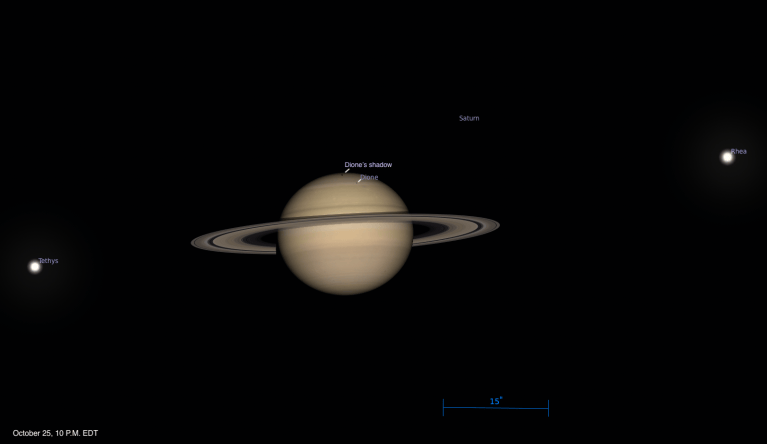
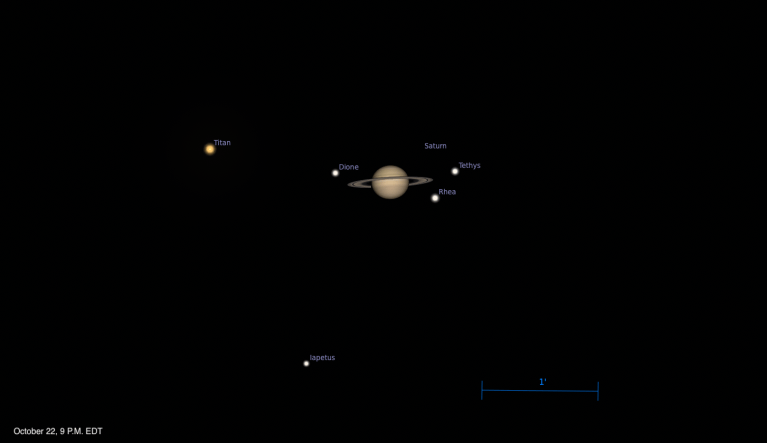
Saturn’s largest and brightest moon, Titan, lies close to its parent planet the morning of July 6. You can spot it — along with several of Saturn’s other moons — with a telescope in the early-morning sky.
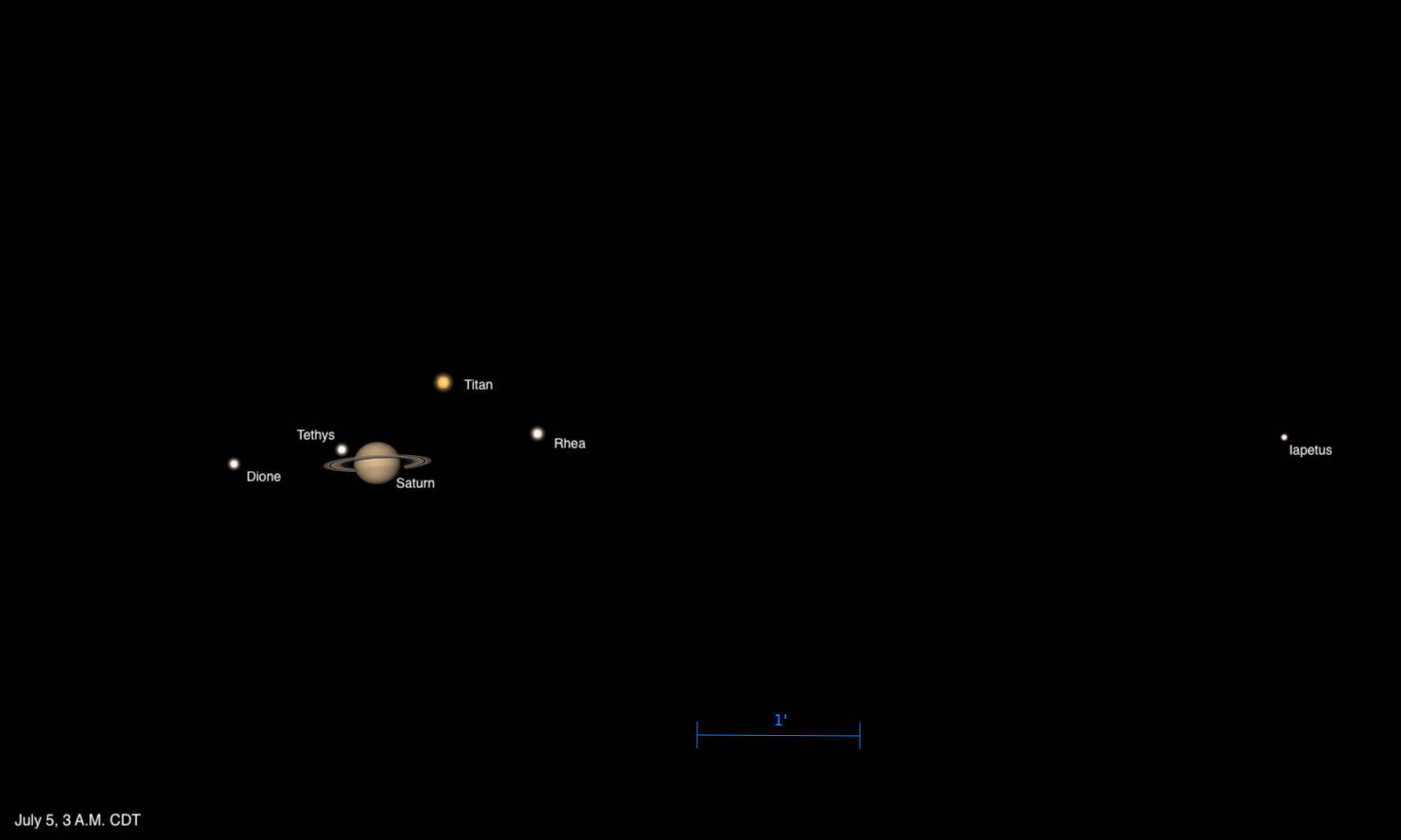
Try between about 3 A.M. local daylight time and sunrise, when Saturn is more than 20° above the horizon. You’ll find the ringed planet in the east around 3 A.M. and in southeast after 4 A.M. Glowing at magnitude 0.7, it’s the brightest light in this region of the sky. Through a telescope, Saturn’s disk stretches some 18”, with rings that span roughly 40” from end to end. Titan, which glows at mid-8th-magnitude, is just northwest of the planet. Depending on when you look, you may catch at least three other moons: 10th-magnitude Tethys, Rhea, and Dione.
Around 3 A.M. CDT, Dione lies east of the planet, in line with the rings. Tethys is just northeast of the disk, above the rings, while Rhea is west of the planet and slightly north of the plane of the rings. Tethys is moving toward the limb and disappears behind it shortly after 4 A.M. CDT.
Iapetus, which is now approaching western elongation, shines at roughly 10th magnitude as well. Look for it some 5½’ from Saturn, far to the planet’s west.
Alison Klesman is senior editor of Astronomy magazine. She holds a Ph.D. in astronomy and has studied a variety of topics, from minor planets to supermassive black holes.