Looking for a sky event this week? Check out our full Sky This Week column.
July 2: The King’s wizard
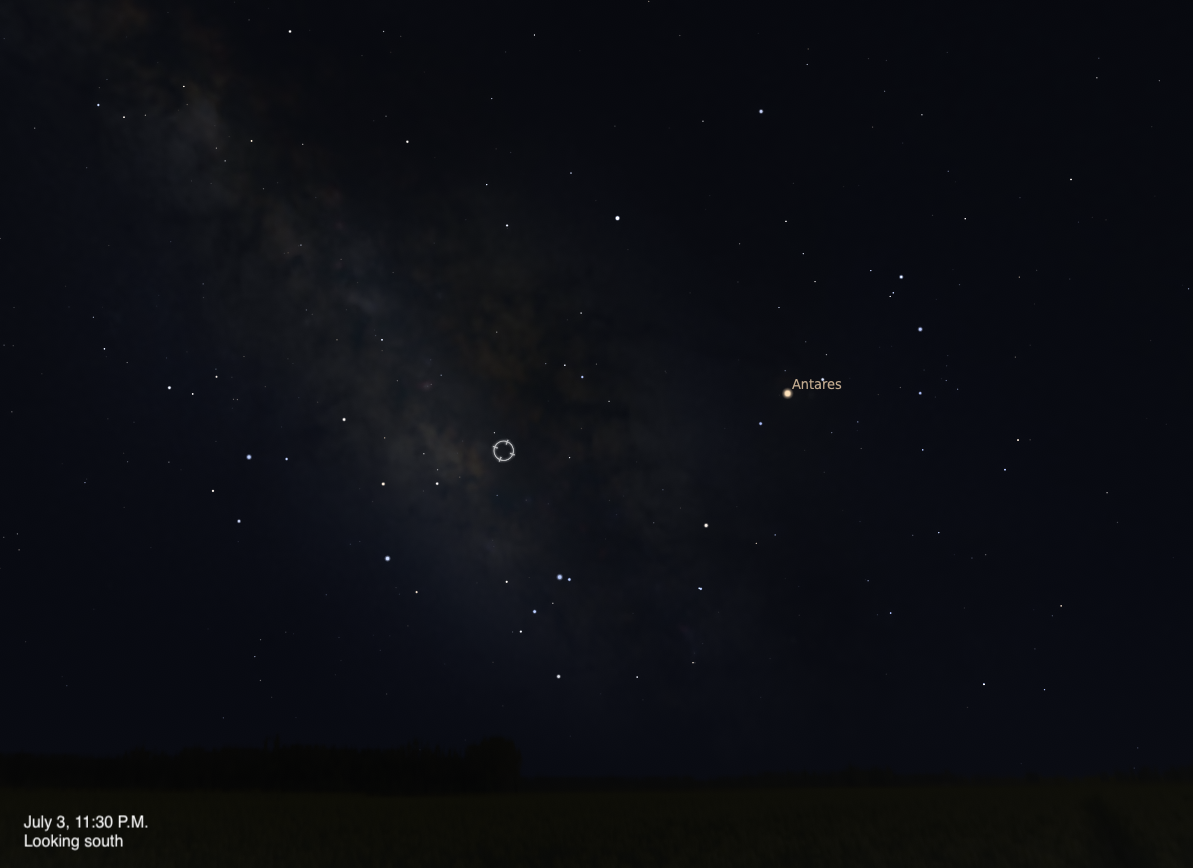
Have you ever wondered where the center of the Milky Way is located in the sky? You can spot it late tonight, when it stands above the southern horizon.
Shortly before midnight, face south and look for the bright orange-red star Antares, which marks the heart of Scorpius the Scorpion. To its left is the Teapot asterism in Sagittarius, with its spout facing to the right and handle to the left. Find the tip of the spout — marked by the 3rd-magnitude star Alnasl (Gamma [γ] Sagittarii) — and glance about 4.5° to its upper right (northwest). That’s the location of Sagittarius A*, the supermassive black hole at the center of our galaxy.
If you’ve got a dark sky and dark-adapted eyes, you may be able to pick out the soft glow of the Milky Way’s plane, which consists of numerous stars whose light combines to create a stripe of diffuse light reaching up from the horizon from lower right to upper left. You may also notice a dark swath cutting through it — this is dust along the plane of our galaxy, which blocks the light of the many stars behind it. Because the Milky Way is a relatively flattened disk-shaped spiral, we see its plane as a stripe across our sky. Imagine turning a plate on its side and seeing only the edge — that’s what you’re seeing here.
Sunrise: 5:36 A.M.
Sunset: 8:32 P.M.
Moonrise: 10:57 P.M.
Moonset: 8:57 A.M.
Moon Phase: Waning gibbous (85%)
*Times for sunrise, sunset, moonrise, and moonset are given in local time from 40° N 90° W. The Moon’s illumination is given at 10 P.M. local time from the same location.
Alison Klesman is senior editor of Astronomy magazine. She holds a Ph.D. in astronomy and has studied a variety of topics, from minor planets to supermassive black holes.