
Key Takeaways:
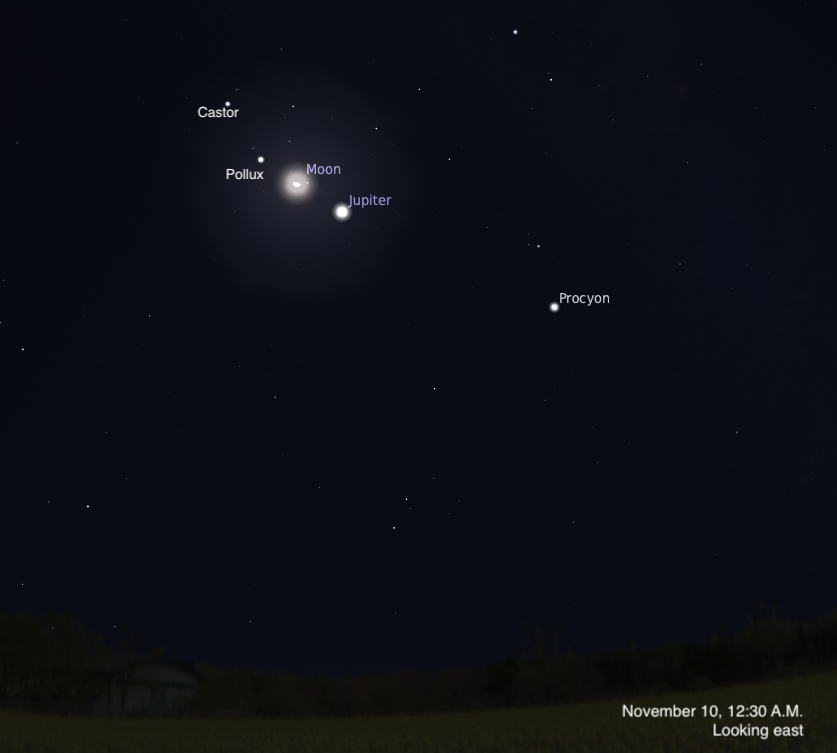
- On November 9, at 3 A.M. EST, the Moon will pass 4° due north of Jupiter, with both celestial bodies observable in Gemini during early morning hours.
- Jupiter, shining at magnitude –2.4, will be easily identifiable despite the bright waning gibbous Moon, reaching a peak altitude of 70° above the southern horizon around 4:30 A.M. local time.
- Asteroid 471 Papagena will achieve opposition on November 9 at 10 A.M. EST, situated within the constellation Cetus.
- With a magnitude of 9, Papagena can be viewed after its 6 P.M. local time rise and prior to the 10 P.M. local time moonrise, located 1.3° south of the 5th-magnitude star Kappa Ceti.
Looking for a sky event this week? Check out our full Sky This Week column.
November 9: Mercury stands still
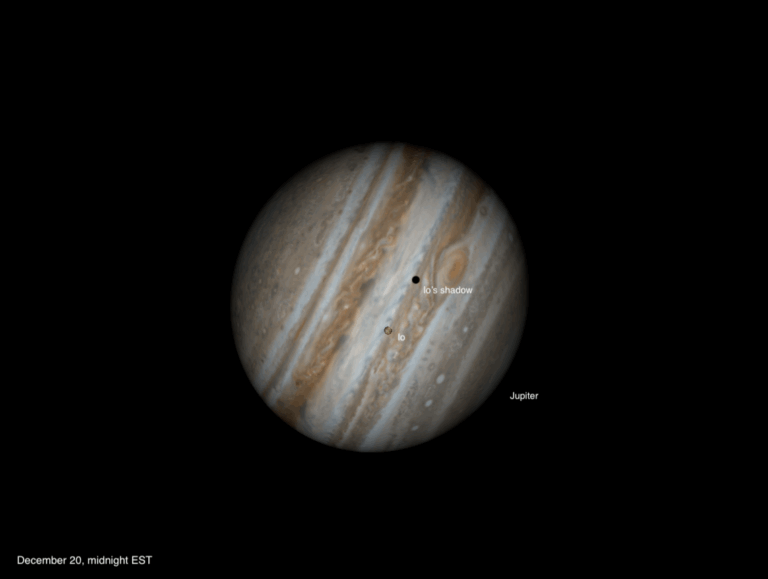
The Moon passes 4° due north of Jupiter at 3 A.M. EST. Both are visible into the early-morning hours, setting after sunrise. They are highest around 4:30 A.M. local time, when the pair reaches an altitude of 70° above the southern horizon.
Despite the bright Moon, Jupiter should be easy to find with the naked eye, glowing at magnitude –2.4. Both lie in Gemini the Twins, hanging below the constellation’s two bright stars, Castor and Pollux.
Asteroid 471 Papagena reaches opposition today at 10 A.M. EST in the constellation Cetus, also currently home to Ceres. Papagena rises tonight around 6 P.M. local time, so you can try taking advantage of the dark window before moonrise (around 10 P.M. local time) to view it. By 8:30 P.M., 9th-magnitude Papagena is 30° high in the east, near the border of Cetus and Taurus. It is located 1.3° due south of 5th-magnitude Kappa (κ) Ceti, offering a good signpost to find it, with the two likely just visible together in a telescope eyepiece at either edge of your field of view (depending, of course, on the size of that field).
Sunrise: 6:40 A.M.
Sunset: 4:48 P.M.
Moonrise: 9:56 P.M.
Moonset: 12:18 P.M.
Moon Phase: Waning gibbous (61%)
*Times for sunrise, sunset, moonrise, and moonset are given in local time from 40° N 90° W. The Moon’s illumination is given at 10 P.M. local time from the same location.