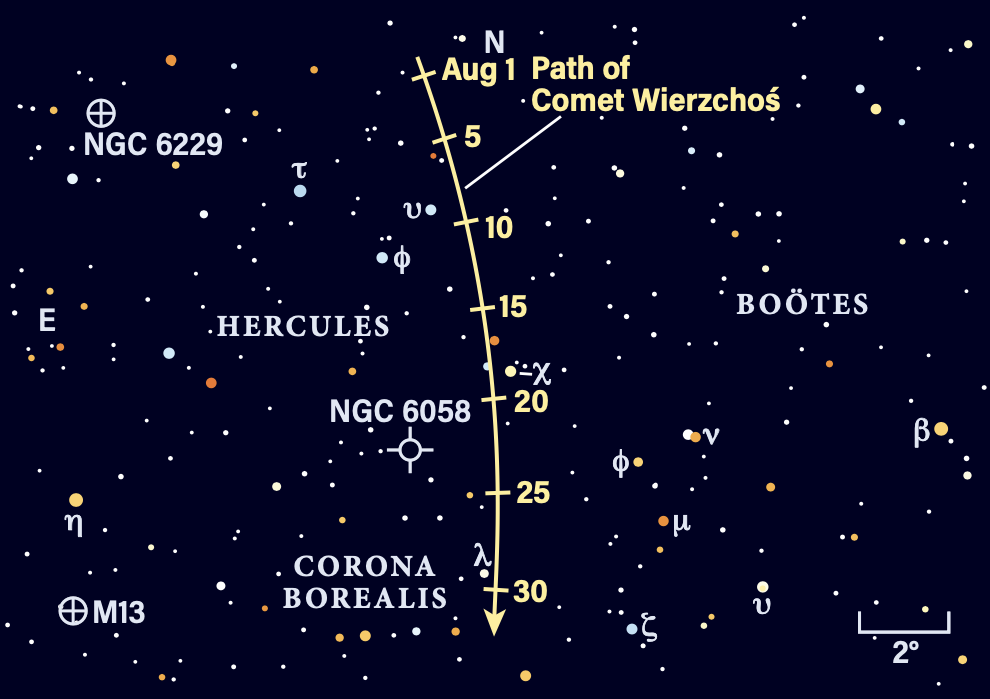
With no Moon in the evening sky, it’s time to check in with Comet C/2024 E1 (Wierzchoś), now in Hercules and visible for several hours after sunset.
By 9:30 P.M. local daylight time, Wierzchoś is still 60° high in the west. You’ll find it about 9.5° west of magnitude 3.5 Eta (η) Herculis, one of the four stars that make up the Keystone asterism. A closer signpost is magnitude 4.6 Chi (χ) Her, which tonight stands just less than 2° north of Wierzchoś.
This comet is currently still a target for larger scopes (8 to 10 inches or more), glowing faintly around 14th magnitude, though it is slowly brightening as it draws closer to the Sun, due to reach perihelion early next year.
There’s plenty else to observe in this region while you search for the comet, including NGC 6058, a planetary nebula some 7.5° west of Eta Her, along the path you’ll trace from this star to the comet. Alternatively, it’s just a short 2.8° jump southeast of Chi Her. NGC 6058 is a small nebula about 40” across that glows at magnitude 13, slightly brighter than the comet’s current brightness. The largest scopes (14 inches or more) will reveal a halo-like structure surrounding the nebula’s 14th-magnitude central star; smaller scopes will show it more as an evenly illuminated glow, though perhaps with a slightly brighter center.
Sunrise: 6:18 A.M.
Sunset: 7:46 P.M.
Moonrise: 5:28 A.M.
Moonset: 7:43 P.M.
Moon Phase: New
*Times for sunrise, sunset, moonrise, and moonset are given in local time from 40° N 90° W. The Moon’s illumination is given at 12 P.M. local time from the same location.
For a look ahead at more upcoming sky events, check out our full Sky This Week column.