A partial lunar eclipse is visible across the U.S. this month, while a total solar eclipse occurs in Europe. Venus dominates after sunset, reaching 50% illumination. Most planetary activity is after midnight, as Saturn and Neptune rise in Pisces. The predawn hours reveal a fine conjunction between Jupiter and Mercury. And Mars crosses into Gemini, while western Taurus hosts Uranus.
Venus shines brilliantly at magnitude –4.4 in the western sky soon after sunset. It crosses the constellation Virgo all month. On Aug. 15, it lies 4.5° southwest of Porrima (Gamma [γ] Virginis) and is joined by a three-day-old crescent Moon, 4° below Venus. The pair sets roughly 90 minutes after sunset.
Follow Venus with a telescope as it approaches dichotomy, when it is 50% lit. The month opens with Venus 55% lit and its disk spanning 21″. Dichotomy is predicted to occur Aug. 11/12. U.S.-based observers should see a phase of 50.4% on the 11th and 49.9% on the 12th. However, dichotomy occurs earlier than predicted for evening apparitions, an effect first noted by Johann Schröter in 1793. Astronomers think this is due to the scattering of sunlight off the thick venusian atmosphere. Check a few days earlier than the predicted dichotomy to see what you observe.
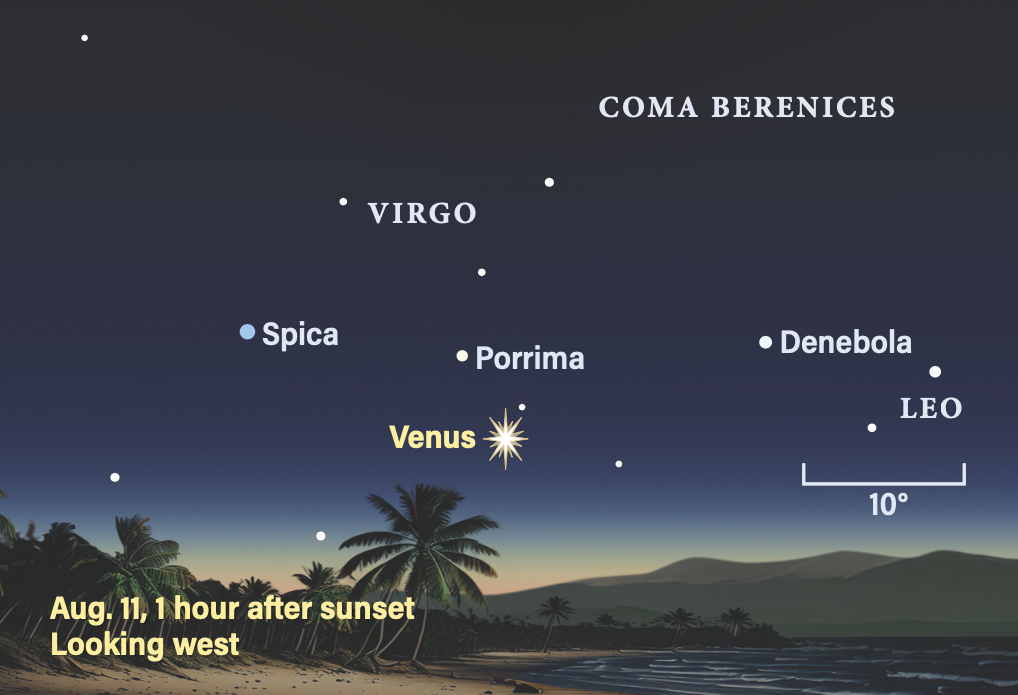
On Aug. 31, Venus is 1.7° southwest of Spica, the brightest star in Virgo. Venus is now magnitude –4.6 and shows off a 39%-lit disk spanning 30″.
Next is Neptune, which rises at 10:30 p.m. local daylight time on Aug. 1, and at 8:30 p.m. by the 31st. It lies in southern Pisces. At magnitude 7.7, Neptune requires binoculars or a telescope to view. It’s an easy target if you know where to look.
One useful guide is Algenib, the southeastern star of the Great Square of Pegasus. Neptune is 15° due south of this star. Nearby lies a parallelogram of 4th- and 5th-magnitude stars, consisting of 27, 29, 30, and 33 Piscium. Neptune stands 4.7° northeast of 29 Psc. The planet’s bluish hue will give it away. Its 2″-wide disk moves west relative to the background stars, covering about 0.6° during August.
Saturn also lies in Pisces, near its border with Cetus, and forms a triangle with 4th-magnitude Epsilon (ε) and Delta (δ) Psc. Saturn shines at magnitude 0.5 much of the month and brightens by 0.1 magnitude by the 31st, when it stands 10° east of Neptune. On Aug. 4, Saturn lies 7° south of a waning gibbous Moon. Both Saturn and Neptune are best observed after midnight.
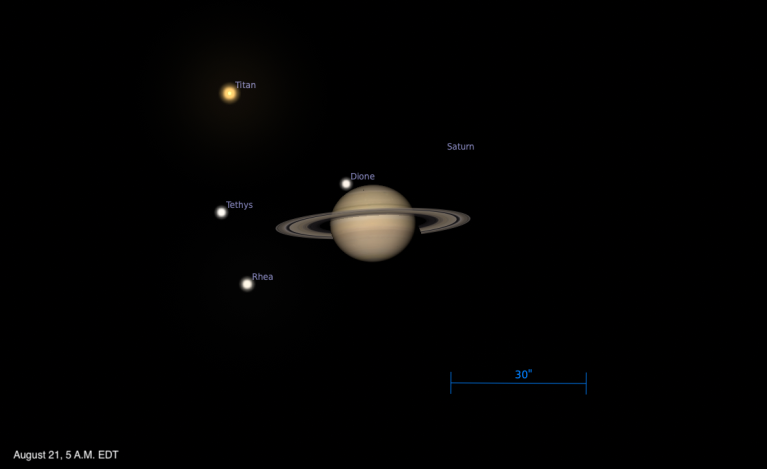
You’ll find Titan, Saturn’s brightest moon, close by on the 5th and 6th, when it is northeast and northwest of the planet, respectively. This configuration repeats Aug. 21 and 22. Titan lies southwest of Saturn Aug. 13 and 29, and southeast of the planet Aug. 14 and 30.
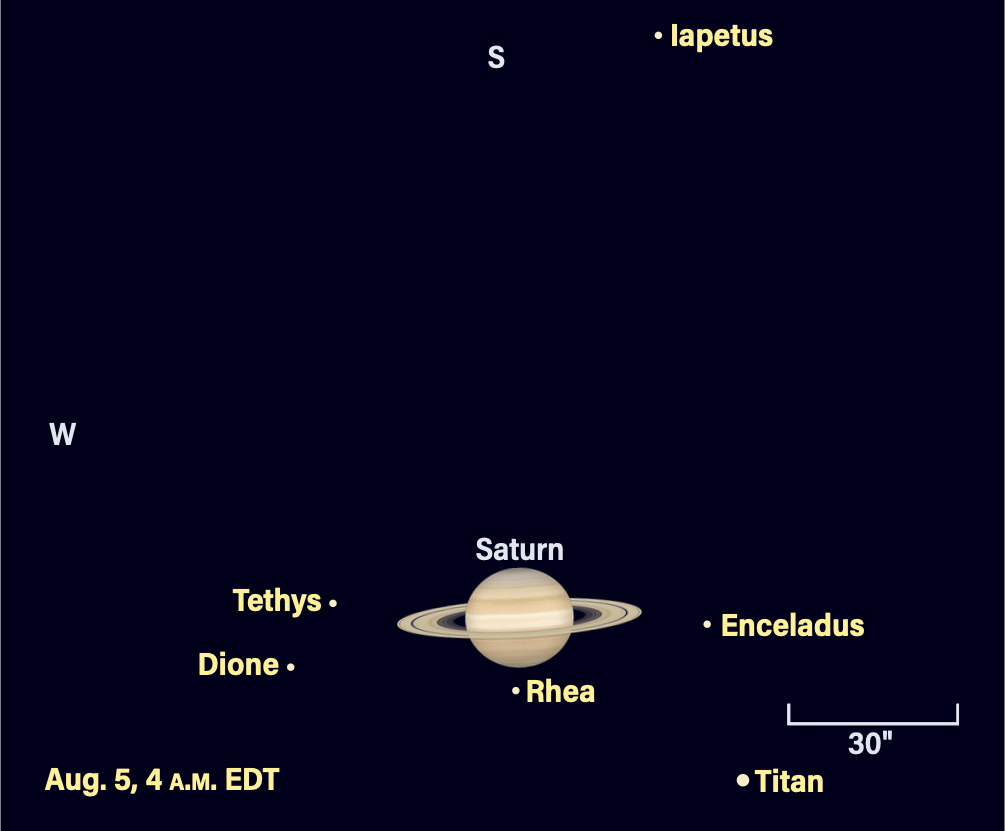
Iapetus passes through superior conjunction Aug. 5, the best time this month to view the challenging moon. It shines at 11th magnitude 1.7′ south of Saturn. Iapetus is moving eastward, reaching its fainter eastern elongation Aug. 24, when it is near 12th magnitude and 9.4′ from the ringed planet, quite difficult to spot.
Uranus rises by 1:30 a.m. local daylight time on Aug. 1. It is an easy binocular object in the predawn sky, reaching magnitude 5.7 around midmonth. It stands 6.5° from the Pleiades, midway between this cluster and the Hyades. Uranus is just less than 2° southeast of 4th-magnitude 37 Tauri, which serves as a perfect signpost to find the ice giant in binoculars.
Uranus moves eastward during August and ends the month 1° northwest of magnitude 4.9 Omega (ω) Tau. A telescope reveals a 4″-wide, greenish-blue disk.
Taurus, famous for its red giant star Aldebaran, hosts a second orangey-red object this month. On the eastern side of the constellation, between the horns of the Bull, Mars is wandering eastward, shining at magnitude 1.3. That’s just under half a magnitude fainter than Aldebaran to the west.
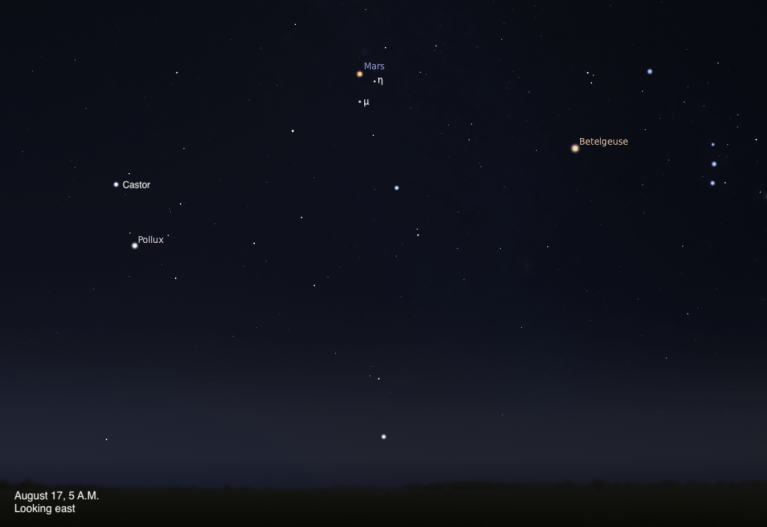
Rising around 2:30 a.m. local daylight time in early August and by 2 a.m. at the end of the month, Mars is joined by a waning crescent Moon Aug. 9. On the 12th (the morning of the Perseid meteor shower), Mars crosses into Gemini.
On Aug. 14 and 15, Mars passes within 1° of open cluster M35. From Aug. 17 to 19, it is just over 1° north of Eta (η) and Mu (μ) Geminorum. By the 27th, it stands 1.6° south of Epsilon Gem and begins to cross central Gemini. Telescopic views of Mars are challenging as it spans a mere 5″, but advanced planetary imagers can take advantage of its rapidly increasing elevation in the hour before dawn.
Mercury is visible early in the month, reaching greatest western elongation Aug. 2. On this morning it stands nearly 5° high in the east an hour before sunrise. Gemini sits on the eastern horizon, the bright stars Castor and Pollux readily visible. Mercury is 9° to the right of Pollux and outshines both stars at magnitude 0.2. On the 6th, Mercury is just over 7° due south of Pollux and has brightened to magnitude –0.3.
On the morning of Aug. 11, watch the eastern sky for the waning crescent Moon, one day before a total eclipse of the Sun, with Mercury 2° to its south. Earthshine reveals the dark nearside as a gray outline in the brighter twilight. Mercury now shines at magnitude –0.9. Half an hour before sunrise, you might spot Jupiter if you have a clear enough horizon. It hangs 7° below the Moon. On Aug. 14, Mercury passes 0.6° south of M44, the Beehive Cluster.
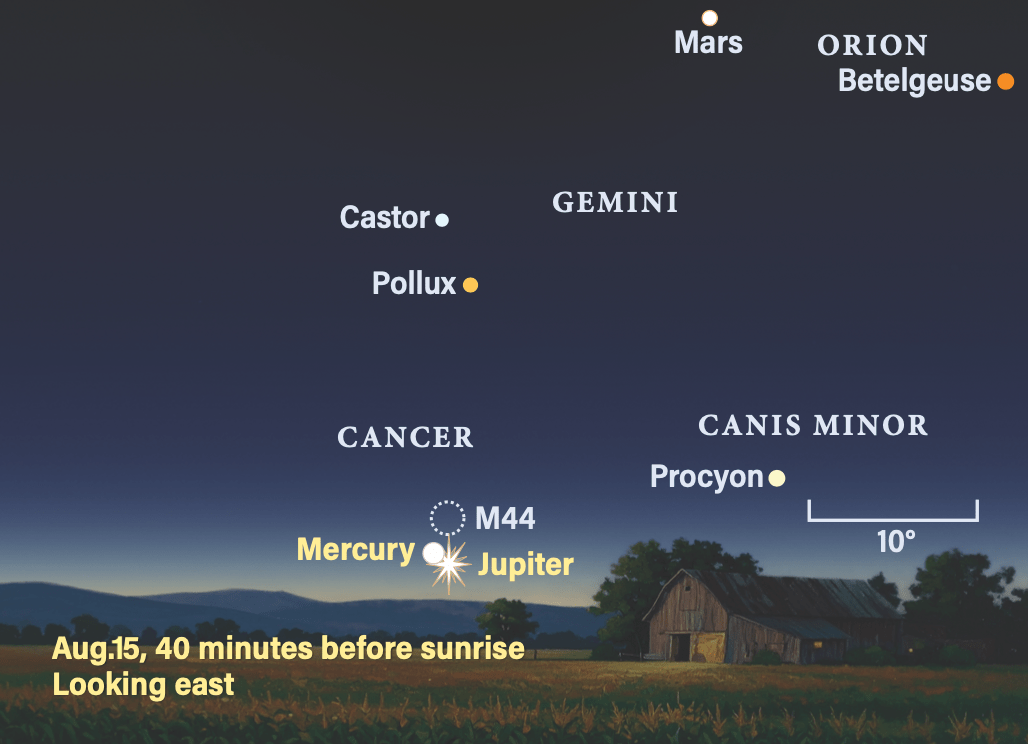
Jupiter is out of view for the first half of August. By Aug. 15, it rises a full hour before the Sun and meets Mercury in a fine conjunction. The planets are separated by only 33′ and rise together in the eastern sky shortly after 5 a.m. local daylight time. Mercury is magnitude –1.2 and Jupiter is brighter, at magnitude –1.8. The conjunction takes place less than 3° southeast of M44, but the cluster’s stars are too faint to see in the growing twilight unless you are at high altitude (above 5,000 feet) and employ binoculars.
Jupiter and Mercury are nearly 2° apart on the 16th. Mercury is now magnitude –1.3. Mercury loses altitude as it descends deeper into twilight and is lost from view around the 19th. It reaches superior conjunction with the Sun Aug. 27. Meanwhile, Jupiter continues to grow in visibility and stands 11° high an hour before sunrise on the 31st.
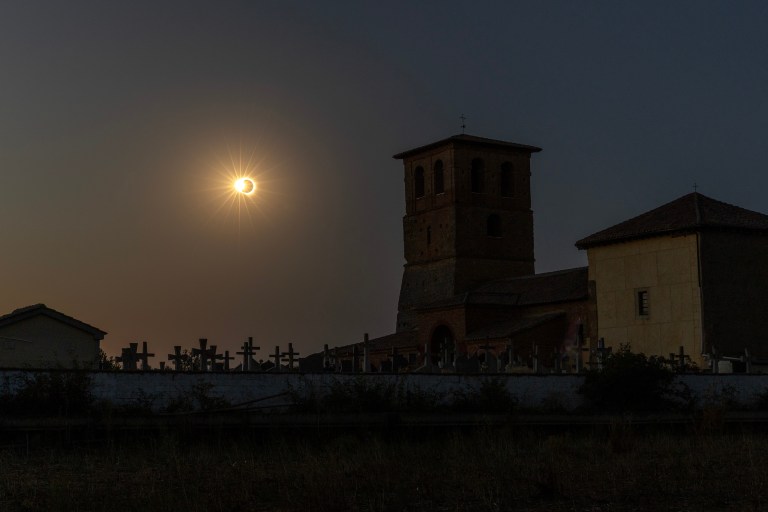
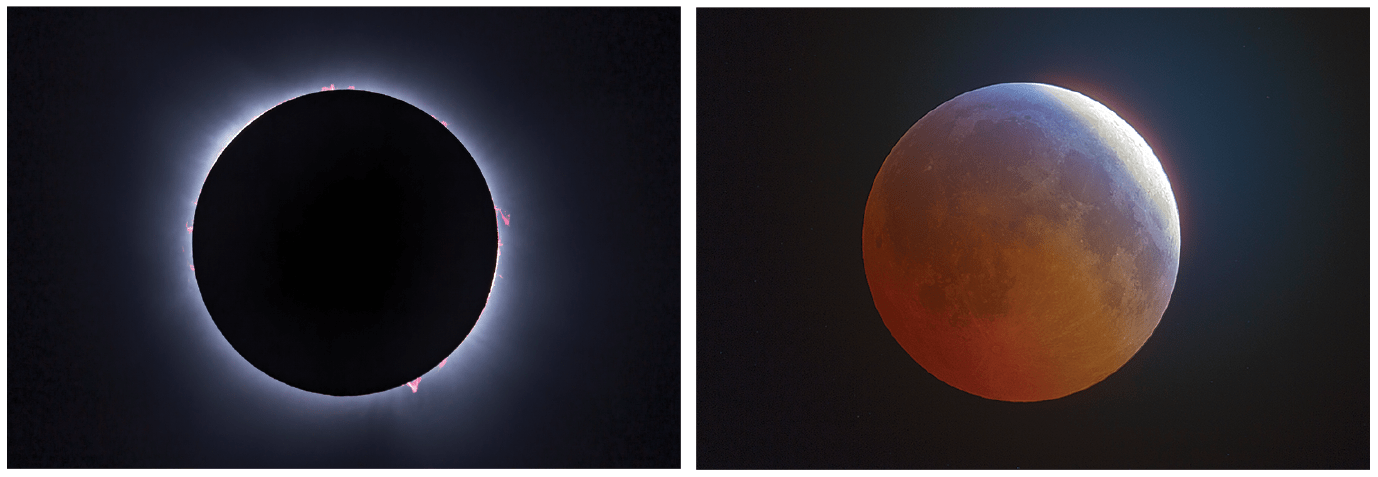
There’s a total solar eclipse Aug. 12, crossing Greenland and Iceland, and visible across Spain before sunset. Greatest eclipse occurs off the coast of Iceland, where totality lasts 2 minutes 18 seconds. Totality across Spain ranges from about 30 seconds to nearly two minutes.
Alaska, Canada, the northeastern U.S., northwestern Africa, and much of Europe experience a partial solar eclipse of varying degrees. Philadelphia, New York, and Boston experience partial eclipses with 7%, 9%, and 16% of the Sun’s total area covered, respectively. Anchorage, Alaska, experiences the largest partial eclipse for U.S. observers at 28%. St. John’s, Newfoundland, reaches 53%.
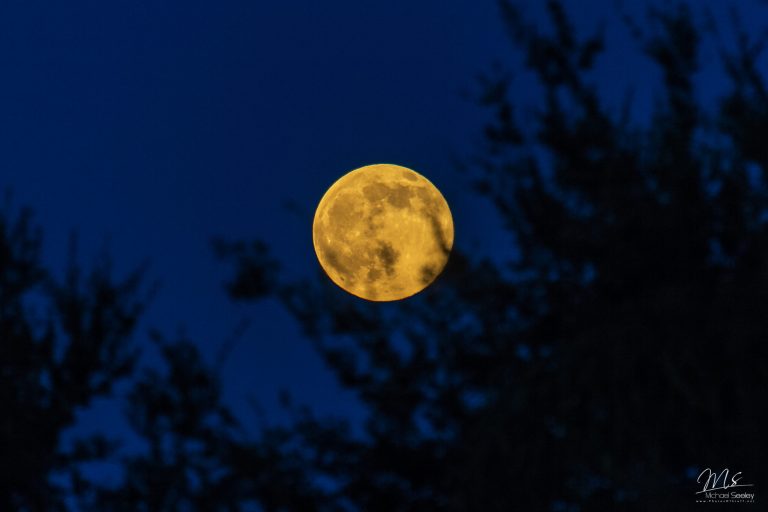
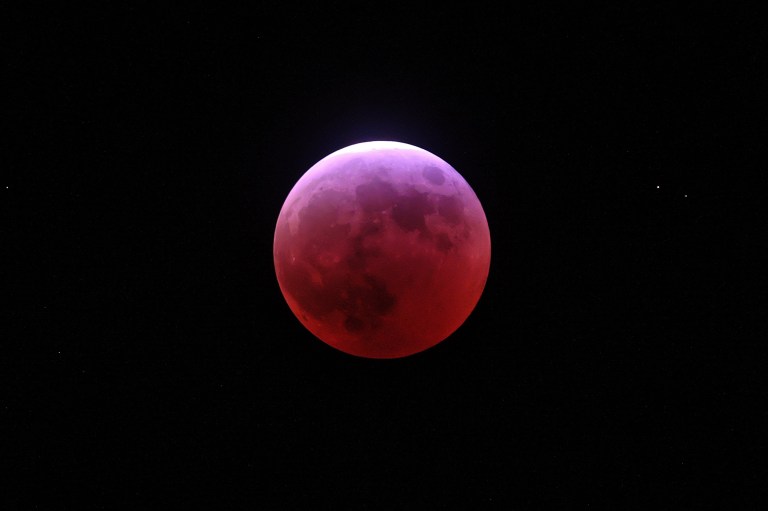
Two weeks later, a spectacular partial lunar eclipse occurs in the U.S. the evening of Aug. 27, with 96% of the Moon’s total area in darkness. It is visible across North and South America, Africa, and western Europe. Only about 2′ of the Moon’s limb remains outside Earth’s umbral shadow. At maximum eclipse, most of the Moon will take on a familiar orange glow, except for the brilliant northeastern limb.
The partial eclipse begins Aug. 27 at 10:33 p.m. EDT. Across the Mountain time zone, this coincides with evening twilight, so the Full Moon will rise and soon enter Earth’s shadow. Maximum eclipse occurs at 12:13 a.m. EDT, and the partial phases ends 99 minutes later. The Moon is in Aquarius during this eclipse.
Rising Moon: Walled-up perfection
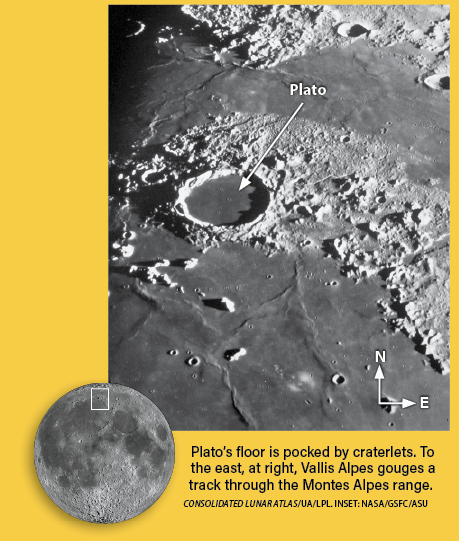
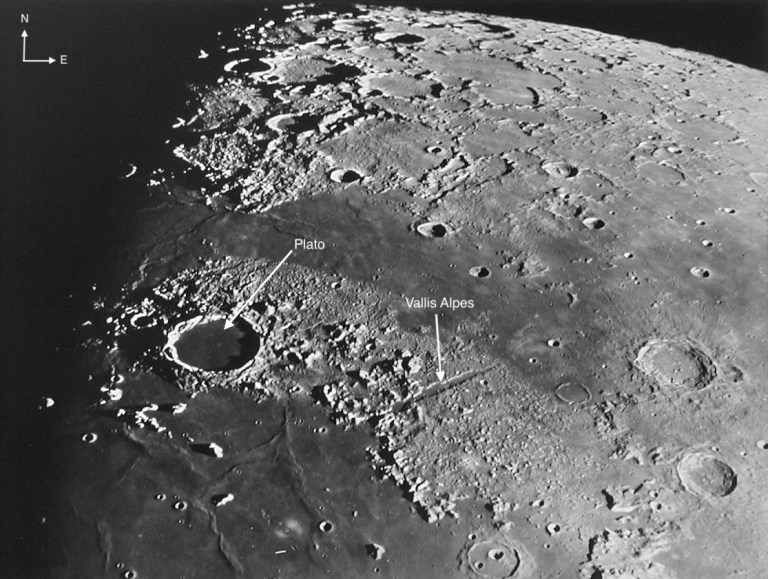
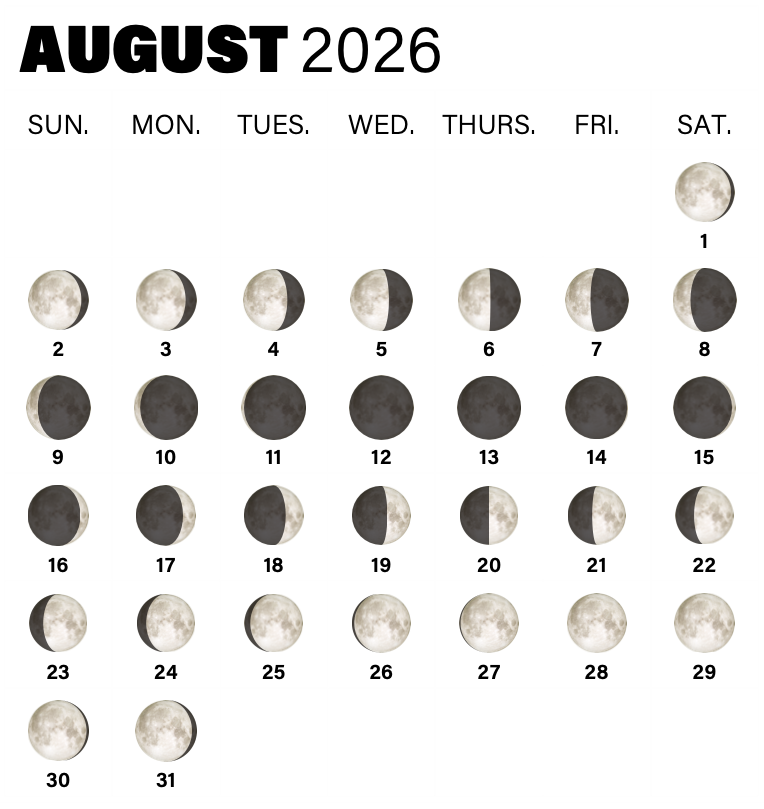
Plato impresses the newcomer as much as it mesmerizes the experienced selenophile. On the evening of the 20th, the large oval is a striking sight in the northern half of the Moon. Watch the long black fangs painted onto the canvas of its smooth floor slowly retreat over a few hours as the rising Sun in the lunar sky shortens them. The mountains along the rim are not as sawtooth-shaped as their shadows imply. You can test this yourself by stepping outside near sunset and confirming that your own head isn’t as pointy as its shadow! As a bonus, be sure to look just south of the equator, where the Straight Wall casts a thin, black shadow almost bisecting a larger crater.
The central peaks that formed during the birth of Plato lie hidden well below the now-solid surface. During the great floods some 3.5 billion years ago, the red-hot molten lava welled up through cracks, but could get no farther than the tall walls. Since then, a handful of modestly small impacts have pitted the frozen floor. With a 6-inch scope and a very steady atmosphere, patient observers can pick out the largest of the craterlets near the center of Plato.
Return to Plato over the next couple of evenings. A higher Sun can better show off the way the walls slumped into the basin. The next time you’re at the beach, you can replicate some of the features by digging to different depths in moist sand and watching the sides cave in.
It’s also neat to compare the texture just inside and outside the large ring — while you may not be able to resolve the tiniest features, the smooth floor is notably different from the dappled area beyond the elevated rim.
Meteor Watch: No Moon
With a total solar eclipse on the same day as the peak of this year’s Perseid meteor shower, the Moon is New and won’t interfere with the show. Plus, the weather is warm.
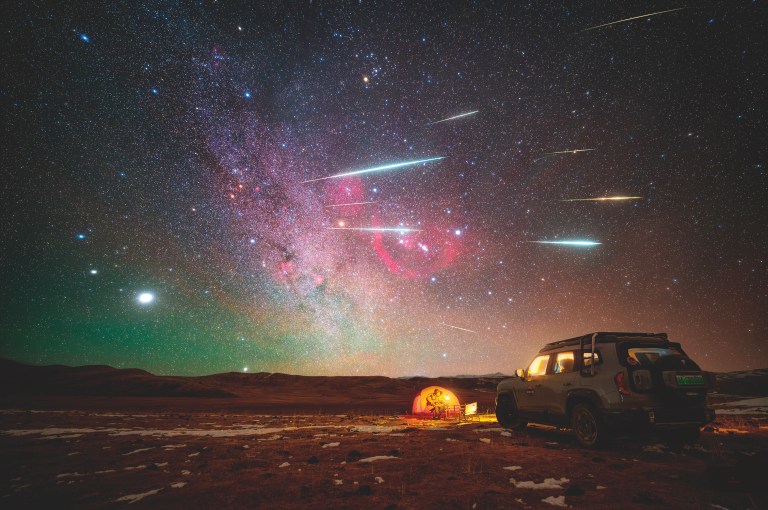
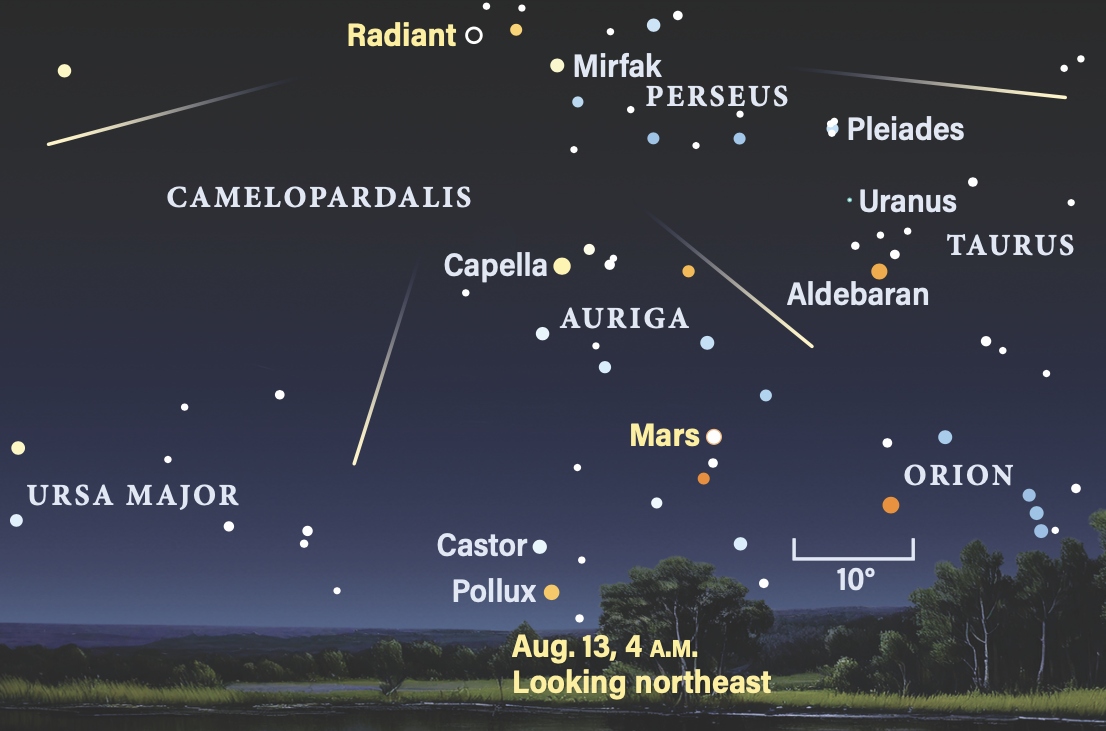
The shower is active from July 17 to Aug. 24, and peaks the night of Aug. 12/13. The mornings of Aug. 12 and 13 should provide very good rates. The zenithal hourly rate (ZHR, which occurs when the radiant is at 90° in altitude) can reach 100 meteors per hour.
The shower is best observed after midnight. Its radiant in Perseus reaches 60° above the northeastern horizon two hours before dawn, attenuating the ZHR by about 15%, so expect some 60–80 meteors per hour. Rates from the city will drop by more than 50%, since you will only see the brighter shower members.
Each meteor is a brief streak of light as the dusty debris burns up in Earth’s atmosphere. Many bright Perseids leave a fluorescent trail called a persistent train. Longer streaks lie some distance from the radiant, so center your view 40° to 60° away from the radiant.
This annual shower is the result of debris left by Comet 109P/Swift-Tuttle, which has a 133-year orbit around the Sun.
Comet Search: Martians beware
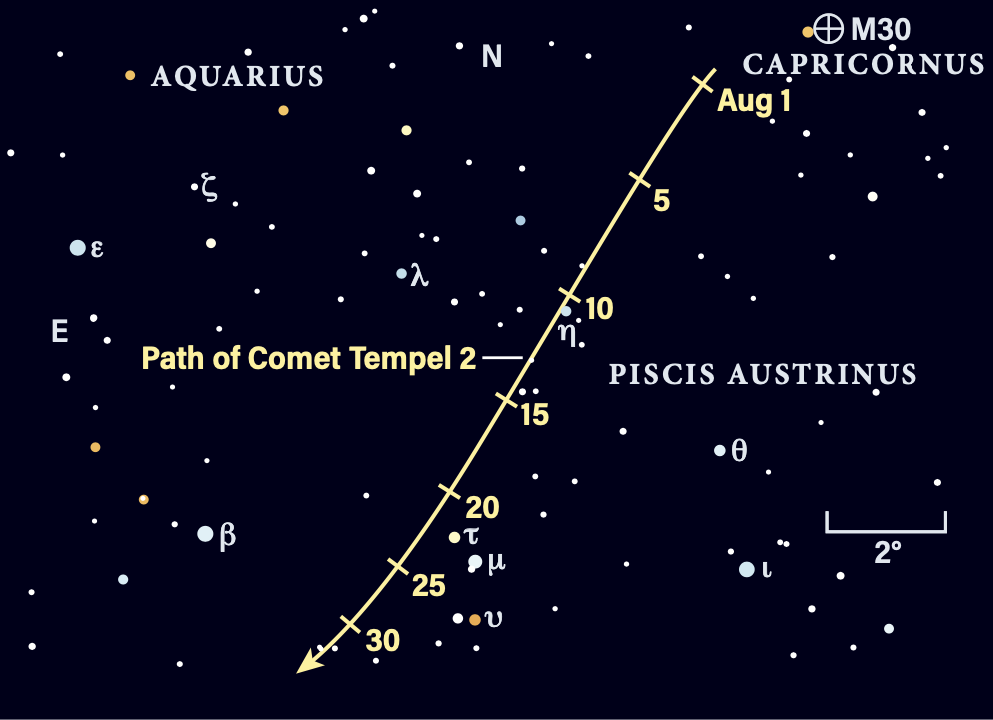
The best return of Comet 10P/Tempel (also called Tempel 2) since the 60s is underway. It passes perihelion, its closest point to the Sun, Aug. 2, and is predicted to be about 7th magnitude — a fine telescopic object and easily picked up in binoculars from a dark site.
Dropping south of M30 in Capricornus, Tempel 2 rises late in the evening, not getting above the horizon murk until midnight. The moonless window opens for an hour Aug. 7/8, while the next night is better, with Luna interfering only after 2 a.m. local daylight time. In binoculars, is M30 brighter? Bigger? How quickly do both objects’ halos brighten into their cores?
Cometographer Gary Kronk notes that historically Tempel 2 has undergone outbursts a week or two after perihelion, so maybe we’ll be in luck.
A long time from now, future martians could be in for some fear — or fun — as Tempel 2 takes repeated aim at the Red Planet. The comet crosses the ecliptic barely outside Mars’ orbit, and with continuing gravitational tugs from Jupiter, Ceres, and Mars itself, an impact is possible. Maybe they’ll blow it up first.
Locating Asteroids: A group of four
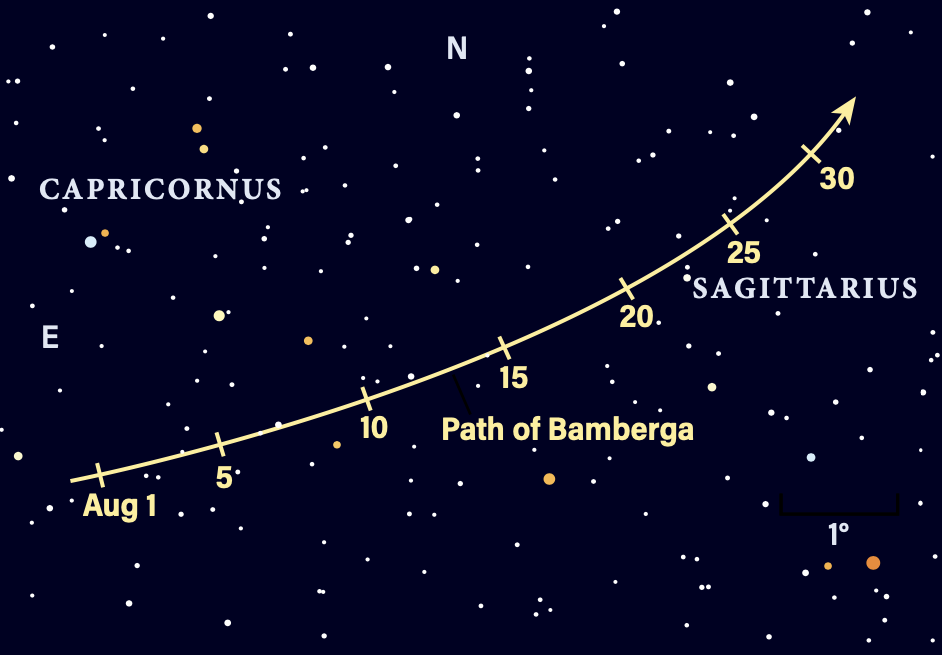
All northern summer nights start late and, with the ecliptic passing through Sagittarius, all asteroids are low. (This is great if you’re south of the equator.) The easiest minor planet to get to that remains brighter than 10th magnitude is main-belter 324 Bamberga. It lies a few degrees east of the asterism Herman’s Cross. Halley’s Comet popularized this asterism when it passed by in 1986. From a country sky, its four mid-4th-magnitude stars are quite eye-catching. Indeed, two millennia ago, Ptolemy noted the 2°-wide collection, simply calling it a quadrilateral.
From the suburbs, you’ll need a 4-inch scope to confidently identify and follow our target. We’re not far from the Milky Way’s central hub and legions of faint stars, with plenty approaching the brightness of Bamberga. To pick it out for sure, make a quick sketch of four or five stars, then return on another night to note which one moved. The 4th, 7th, 12th, and 23rd have the best backgrounds.
Despite being among the top 20 largest asteroids at 140 miles across, Bamberga’s higher number tells you the roundish rock was a later discovery. Its elliptical orbit means it spends more time far from the Sun and few nights brighter than 9th magnitude. Johann Palisa of Austria picked it up in 1892 — as one of a Herculean total of 122 discoveries — by visually comparing the eyepiece view with star atlases at a time when photographic discoveries had just begun.
Star Dome
The map below portrays the sky as seen near 35° north latitude. Located inside the border are the cardinal directions and their intermediate points. To find stars, hold the map overhead and orient it so one of the labels matches the direction you’re facing. The stars above the map’s horizon now match what’s in the sky.
The all-sky map shows how the sky looks at:
11 p.m. August 1
10 p.m. August 15
9 p.m. August 31
Planets are shown at midmonth
Martin Ratcliffe is a planetarium professional with Evans & Sutherland and enjoys observing from Salt Lake City. Alister Ling, who lives in Edmonton, Alberta, is a longtime watcher of the skies.