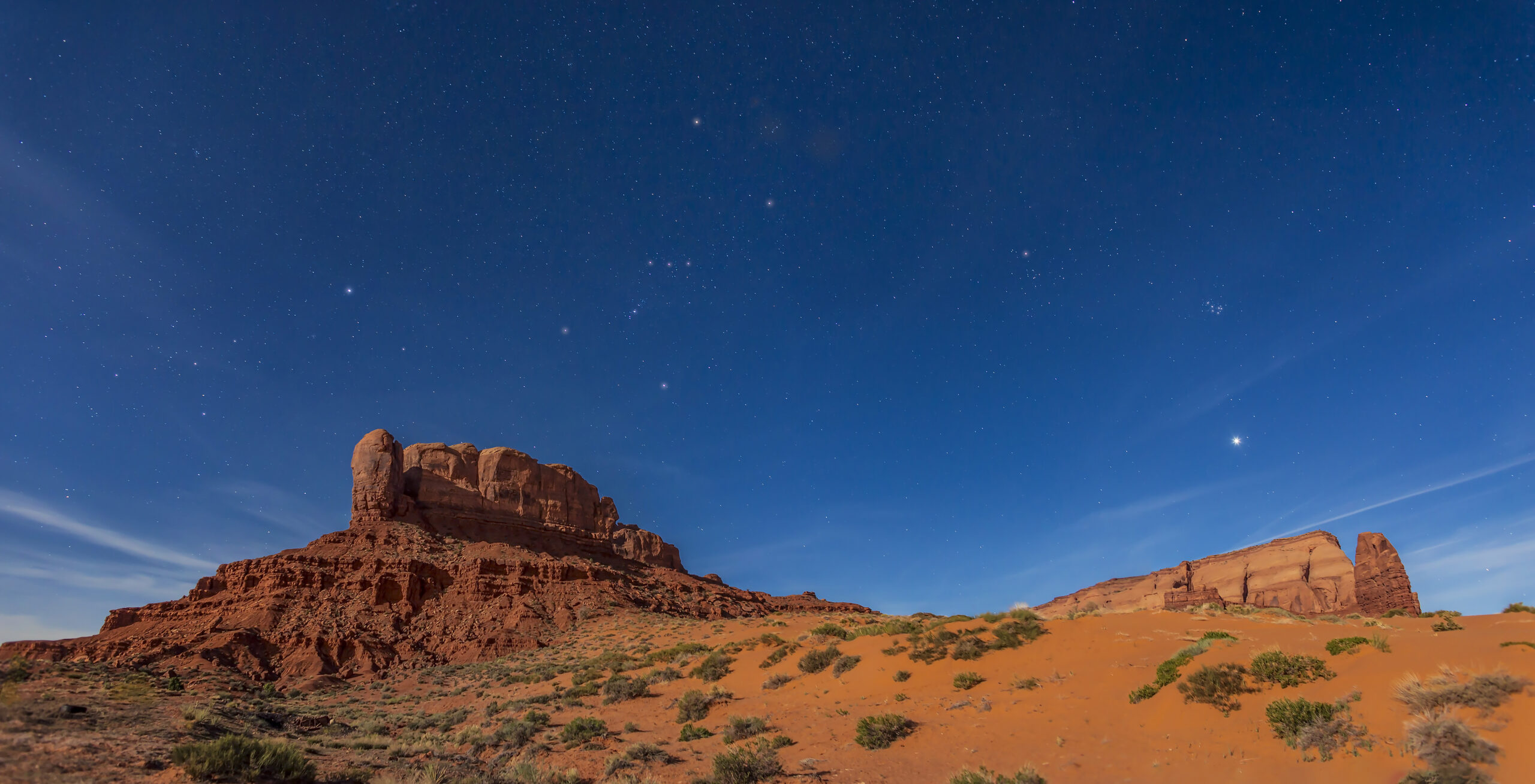
Exciting planetary action takes place this month. Venus and Uranus vie for attention and lie close to each other in late April. Jupiter offers a lot to observe through a telescope, particularly events involving its Galilean moons. The rest of the action takes place just before dawn, with Mars, Mercury, and Saturn making an appearance in late April. And remember to take time out to watch the Lyrid meteor shower, with no Moon to interfere.
Venus is brilliant in the western sky soon after sunset. On April 1 it stands 13° high 30 minutes after sunset and shines at magnitude –3.9. Twenty minutes later, as twilight darkens, the stars of Taurus the Bull and the Pleiades star cluster (M45) pop into view above it.
During the month, Venus slides from Aries into Taurus. Venus moves into Taurus on April 18, just as the crescent Moon climbs up to sit adjacent to the planet in the evening sky. They stand 6° apart, with M45 7° above Venus in a stunning evening display.
The Moon, just over 1½ days old, displays beautiful earthshine, so the entire globe of our satellite is visible against the darkening sky. Watch until it sets soon before 10 p.m. local daylight time. The following evening, April 19, the Moon stands 5° east of M45.
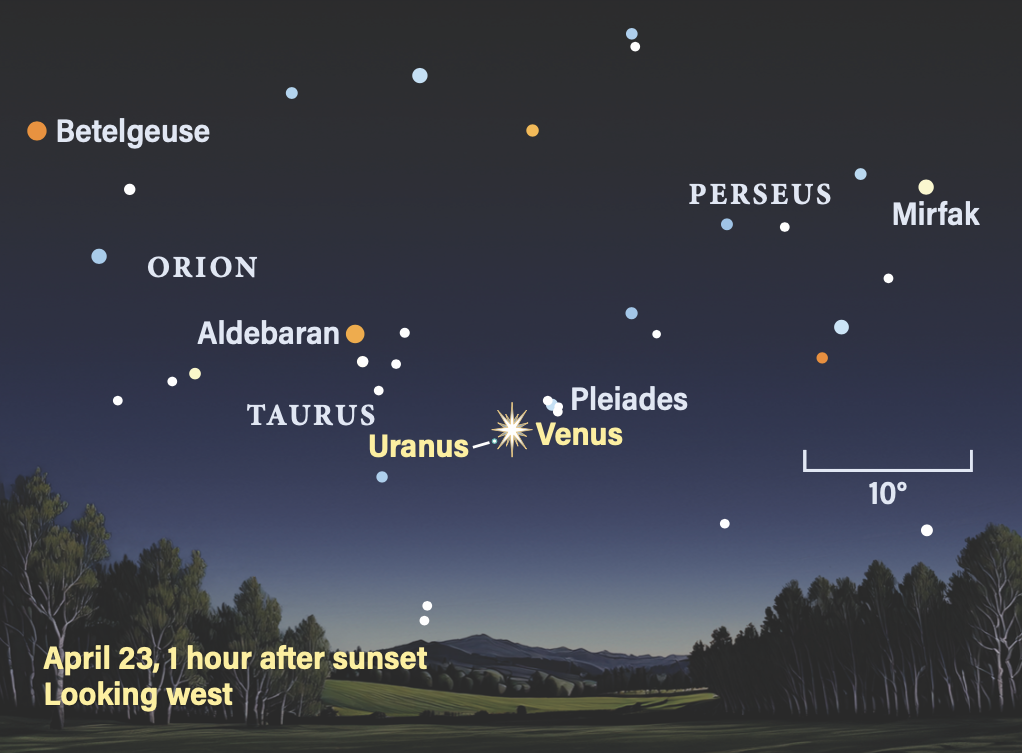
A special conjunction occurs April 23, when Venus stands 45′ north of Uranus. The Pleiades are about 3.5° north of Venus. Uranus can be spotted with binoculars — just point at Venus and look for the faint, flat “star” to its south, shining at magnitude 5.8. That’s the seventh planet from the Sun. One day on either side of conjunction, Uranus stands within 1.5° of Venus, still a great time to spot the distant planet.
Venus moves deeper into Taurus, ending the month near a pair of 4th-magnitude stars, Kappa (κ) and Upsilon (υ) Tauri. Use a telescope the evening of April 30 to capture the view of Venus with these bright stars, along with 5th- and 6th-magnitude field stars nearby.
Venus’ telescopic appearance changes throughout April. On the 1st, it spans 11″ and displays a 94-percent-lit disk. At the end of the month, Venus has grown to 12″ wide and is 88 percent lit.
Returning to Uranus, on April 1 you’ll find the dim planet near a pair of stars 4.5° south-southwest of M45. Binoculars will easily find 13 and 14 Tau, shining at magnitude 5.7 and 6.1, respectively. Uranus is 16′ east of 14 Tau on April 1. By April 16, Uranus has moved to stand 1° east of this star. It extends the gap to 1.7° by April 30. As usual this year, use the Pleiades as your main guide to finding Uranus. A telescope will reveal a disk spanning 3″ with a subtle bluish-green hue.
Jupiter shines brilliantly, high in the western sky after sunset. It is a beautiful magnitude –2.1 addition to Gemini the Twins. It dims by just 0.1 magnitude by the end of April. The gas giant is visible all evening, setting around 3 a.m. local daylight time on the 1st, and by 1:15 a.m. on the 30th.
Jupiter moves eastward against the backdrop of Gemini. It’s joined by a waxing crescent Moon on the 22nd, with the 4th-magnitude star Wasat (Delta [δ] Geminorum) roughly 1° southeast of Jupiter. By April 29, Jupiter stands just 0.5° (a Full Moon’s width) due north of this star.
Jupiter’s attraction, aside from its brilliance, is the wealth of detail visible through any telescope. Primarily — and most noticeable at first — are the two dark equatorial belts. More subtle features on other parts of the globe, which spans a healthy 39″ in early April, come into view during moments of steady seeing, provided you are a patient observer. Earth is speeding around its orbit and increasing our distance from Jupiter, so the disk shrinks to 36″ by April 30.
Most observers want to see the Great Red Spot as it’s carried around the planet on its 9-hour 55-minute rotation period. The large oval storm sits on the edge of the South Equatorial Belt and is typically visible every other night.
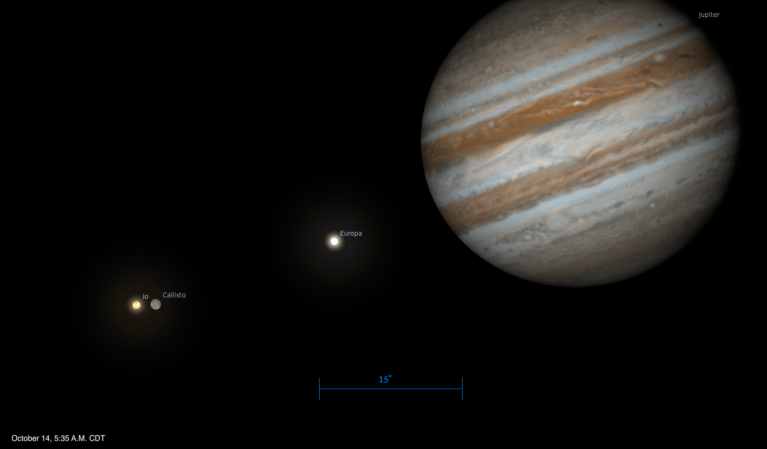
Check out Jupiter early on the evening of April 1 (before midnight EDT) because the Galilean moons are all visible east of the planet in order of distance. Closest to Jupiter is Io, followed by Europa, Ganymede, and finally Callisto. Continue observing through the evening because over a couple of hours you’ll see Io and Europa moving farther east, until Europa swaps position with Ganymede at 2:20 a.m. EDT (now April 2 for much of the U.S.), when the former passes 7″ due north of the latter. You’re seeing orbital dynamics in motion!
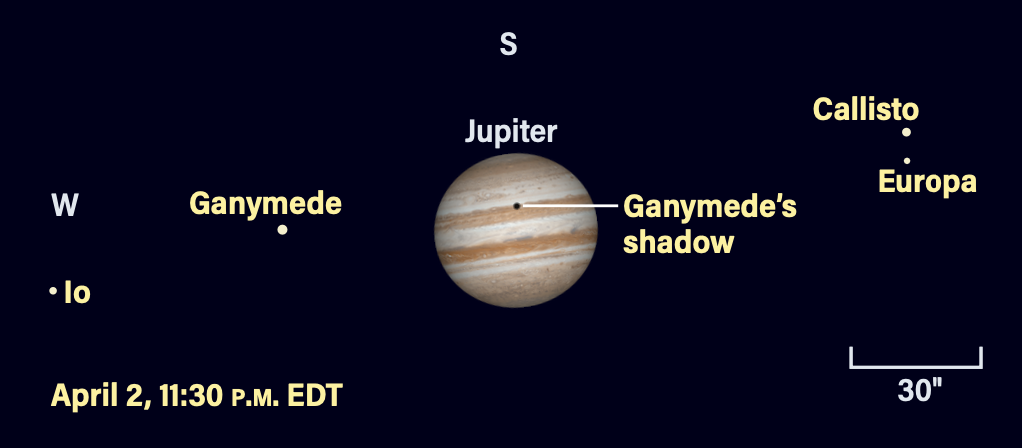
The shadows of both Ganymede and Callisto cross Jupiter’s face on consecutive nights, April 2 and 3. Around 11:30 p.m. EDT on the 2nd, Europa stands 7″ north of Callisto, while the shadow of Ganymede is midway across Jupiter. Ganymede itself is west of the planet, showing the angle of the Sun. The eastern half of the U.S. will see the shadow transit begin around 9:58 p.m. EDT. The transit ends at 1:22 a.m. EDT (the 3rd for the eastern half of the U.S.), better viewed from the western half of the country.
Callisto’s shadow transits April 3 with similar timing. The shadow first appears at 9:14 p.m. EDT and takes over four hours to cross the planet, longer than Ganymede’s because Callisto lies farther from Jupiter and consequently its shadow moves more slowly across the planet. The transit ends at 1:32 a.m. EDT (now the 4th in the Eastern and Central time zones). Because the shadows of both Ganymede and Callisto are so large, watch for the start of the transits a few minutes before the predicted time and see when you first notice the black notch appear. The shadow’s first appearance is heavily affected by your local seeing conditions.
On the 4th, Europa slips behind Jupiter’s disk at 11:30 p.m. EDT and remains hidden for nearly three hours, but isn’t visible when it clears the limb because it lies deep inside the planet’s extended shadow. It finally reappears one jovian disk diameter east of the planet’s eastern limb more than five hours later, only visible from the western half of the U.S., around 2 a.m. PDT on April 5, with Jupiter sinking very low in the western sky.
Ganymede’s shadow begins another transit April 10 at 12:57 a.m. CDT (late on the 9th farther west), visible from the western two-thirds of the U.S. Jupiter sets while the shadow transit is underway.
Eagle-eyed observers may spot Callisto reappearing at Jupiter’s northeastern limb April 11 at 8:27 p.m. EDT. This moon is far enough from Jupiter to avoid the planet’s shadow.
Io and Europa undergo regular, frequent events. We don’t list them all, but an interesting one occurs April 13/14. Europa is transiting the planet as darkness falls on April 13 across the Central and Mountain time zones. Shortly before the transit ends at the western limb, Europa’s shadow appears at the eastern limb at 11:42 p.m. EDT. Europa leaves the disk 18 minutes later.
Watch as Europa continues westward, while Io (already to Jupiter’s west) moves eastward. Io stands 5″ north of Europa soon after midnight CDT. Their relative motion can be spotted within a few minutes.
The following night, Io has come around the back of Jupiter and transits along with its shadow, beginning at 11:25 p.m. EDT on the 14th.
Ganymede transits Jupiter south of the South Equatorial Belt April 16/17 beginning at 12:53 a.m. EDT (the 17th in the Eastern time zone only, late on the 16th farther west). The large moon takes over three hours to cross the disk. Observers in the Pacific time zone will see the transit end.
The last event of note is the reappearance of Ganymede far from Jupiter’s eastern limb on April 28. It comes out of eclipse at 12:19 a.m. PDT, east of the limb by some 1.3 times Jupiter’s apparent diameter. The moon slowly brightens over a couple of minutes. It’s challenging to watch from the Mountain time zone due to the planet’s low altitude, but Pacific Coast observers should have a ringside seat.
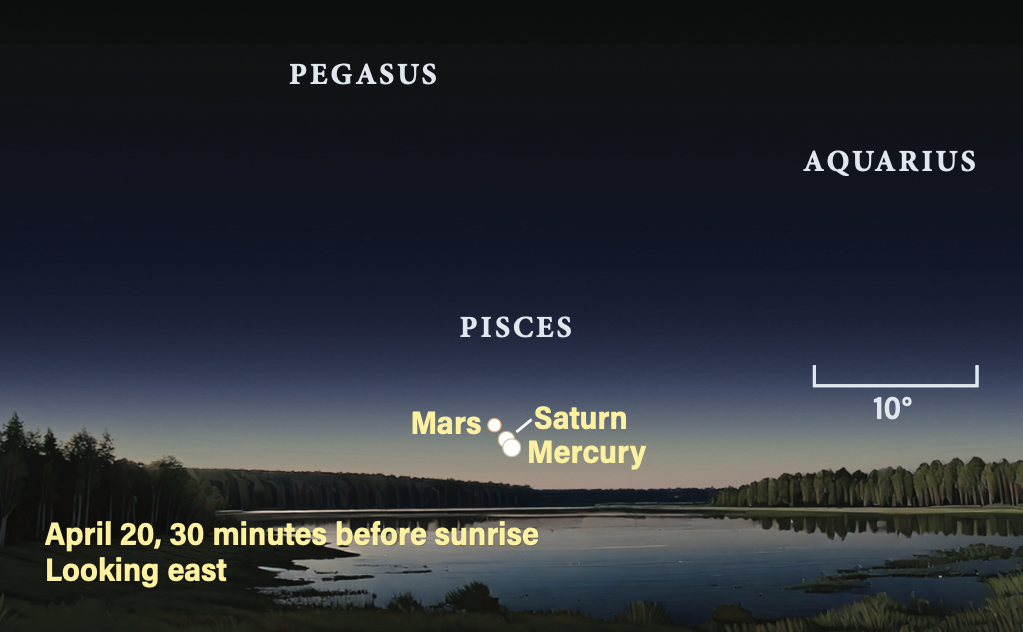
Mars, Mercury, and Saturn lie within 2° of each other on April 20. Located in the morning sky soon before sunrise, spotting them will be difficult. They stand about 2° high due east 30 minutes before sunrise. Your best chance is to spot the brightest of the trio, Mercury, shining at magnitude –0.2. Next brightest is Saturn, standing 28′ north of Mercury and shining at magnitude 0.9. It will likely need binoculars or a low-power telescope to view. Mars stands 1.2° north of Saturn, and is the dimmest at magnitude 1.2.
Viewing dim planets at low altitude is difficult due to haze. You can overcome this if you have access to mountains: Higher altitude reduces the effects of atmospheric scattering and renders dimmer planets easier to spot.
Saturn becomes a bit easier to view by April 30, standing 3.5° high in the east 45 minutes before sunrise on this morning.
Neptune, in the same region as Mars and Saturn, is only 4° high in the east an hour before sunrise on the 30th. It is too faint to be readily visible.
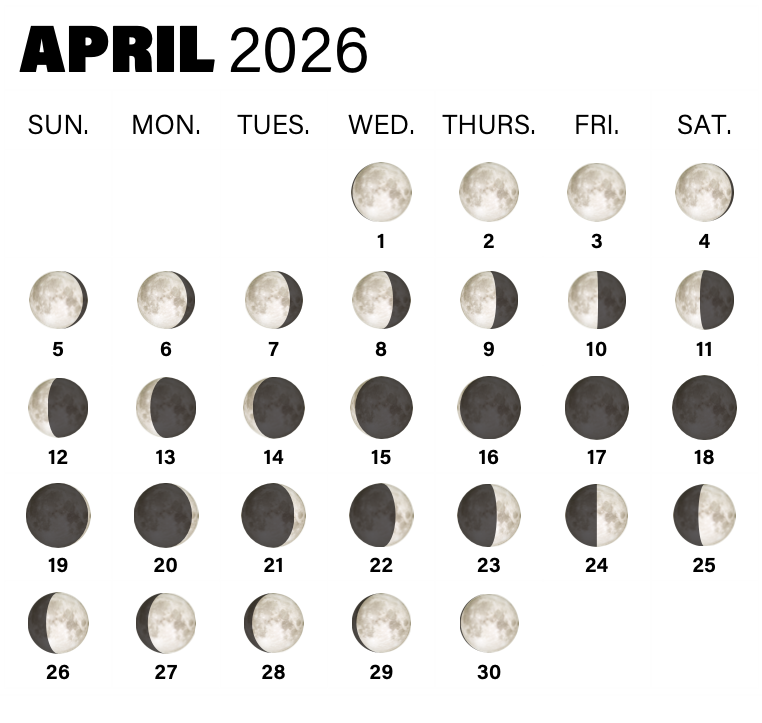
Rising Moon: A fortnight of features
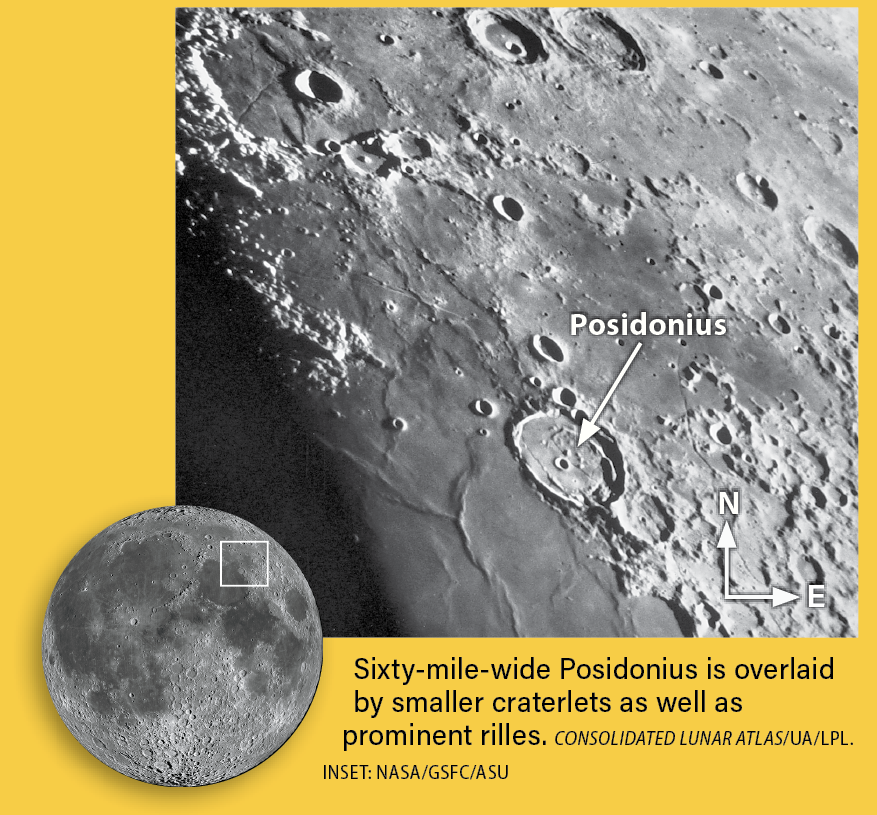
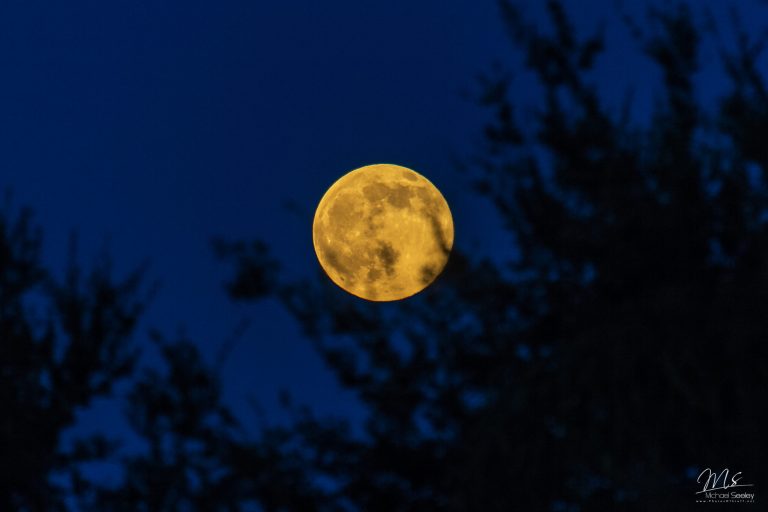
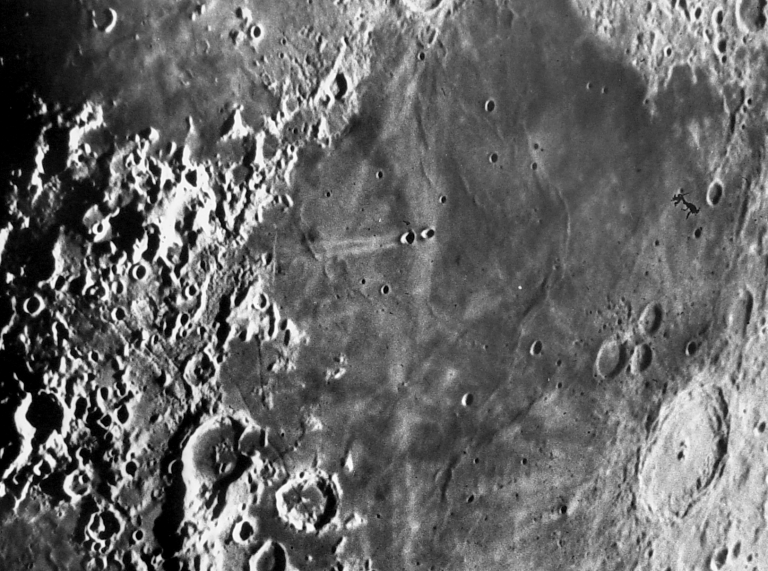
Packed with detail, the large crater Posidonius is near the top of the lunar lover’s list. Catch a sneak peek as you finish observing on the night of the 6th, when lunar sunset lengthens the shadows as the minutes pass and features become increasingly exaggerated. It returns to light on April 22. The lava-filled interior of this 60-mile-wide, age-old impact sports cracks, jumbled peaks poking up from the floor, an off-center craterlet, and bright segments of slumped walls.
Unlike most craters that seemingly vanish at Full Moon, Posidonius brags a bright rim with a cream-pie face full of detail on the inside that lasts into May. Long shadows that were obvious last week have disappeared under a high Sun. Instead, the variety of gray we see comes from the differences in albedo, or reflectivity. The darker lava on the flooded floor contrasts nicely against the brighter specks of small impact events and the curved light of a slumped terrace, whose face aims upward.
Look for Posidonius in the northeastern quadrant of the Moon. Posidonius B is a noticeable 9-mile-wide fresh impact on the northeast rim, while the slightly smaller crater A has the sharp edges of youth. Age is relative, since a “fresh” feature here is 100 million years old.
Easily confused with Poseidon, the Greek god of the sea, Posidonius is actually named after a Greek astronomer and philosopher who lived around 100 B.C.E.
Meteor Watch: Clear viewing
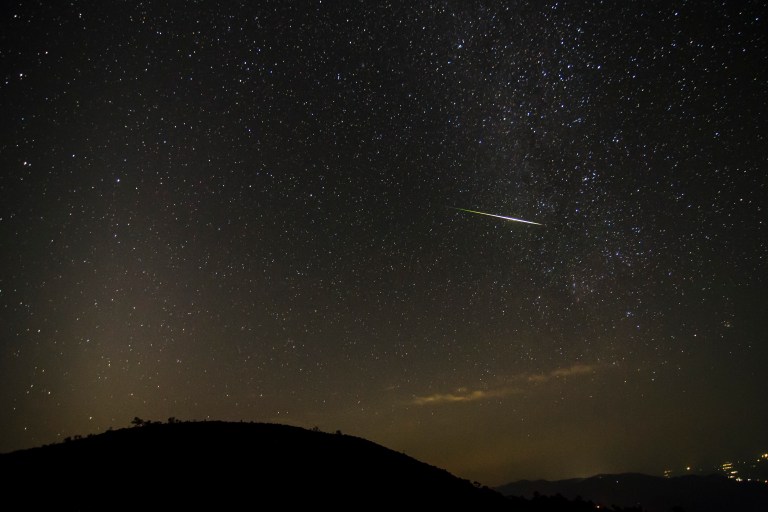
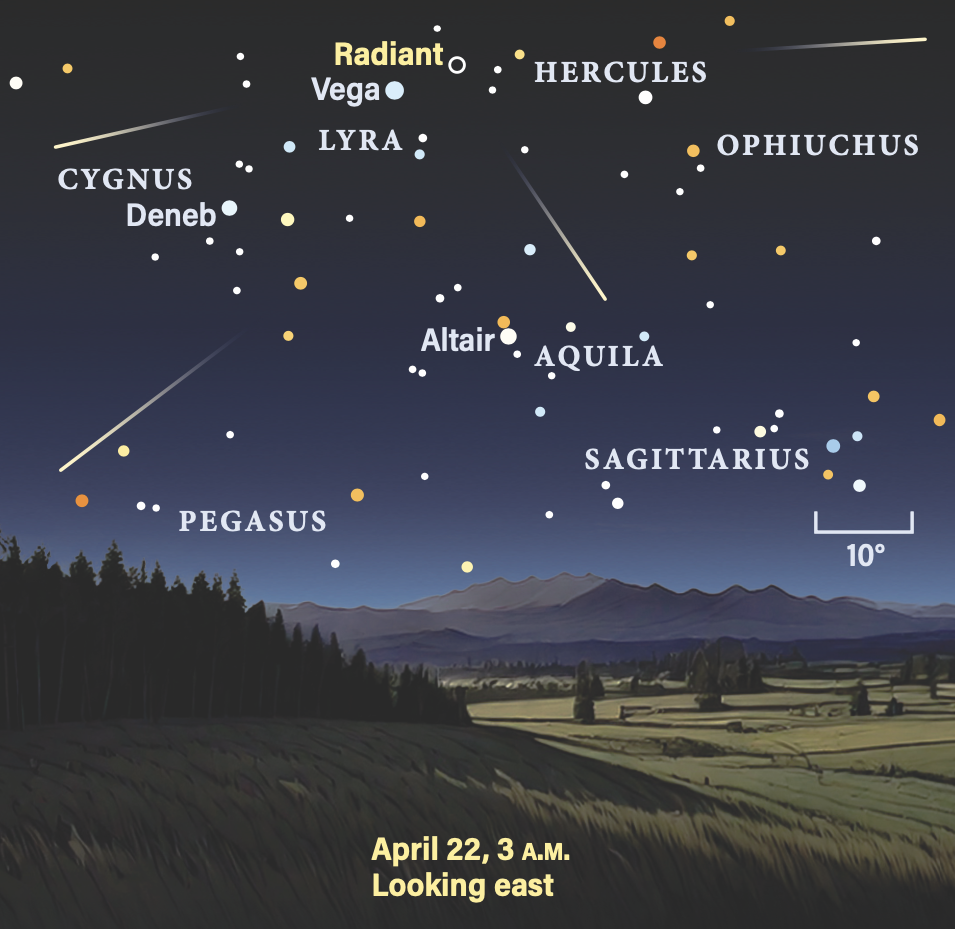
The Lyrid meteor shower is active from April 14 to 30, peaking the night of April 22. The radiant, located near Lyra, rises in the late evening and reaches an altitude of about 20° at local midnight. Once the few-day-old Moon sets, shortly after 1 a.m. local daylight time on the morning of the 22nd and an hour later on the 23rd, dark skies continue through to dawn. Lyra approaches the zenith just before dawn, offering the best viewing in a dark sky. Meteors tend to be more abundant in the predawn hours, as the shower particles strike Earth’s atmosphere at a higher relative velocity.
The Lyrids typically produce a zenithal hourly rate of about 20 meteors per hour. With Lyra positioned high above the horizon after 2 a.m., the early-morning sky offers one of the best opportunities to view this seasonal meteor shower.
Comet Search: One after another
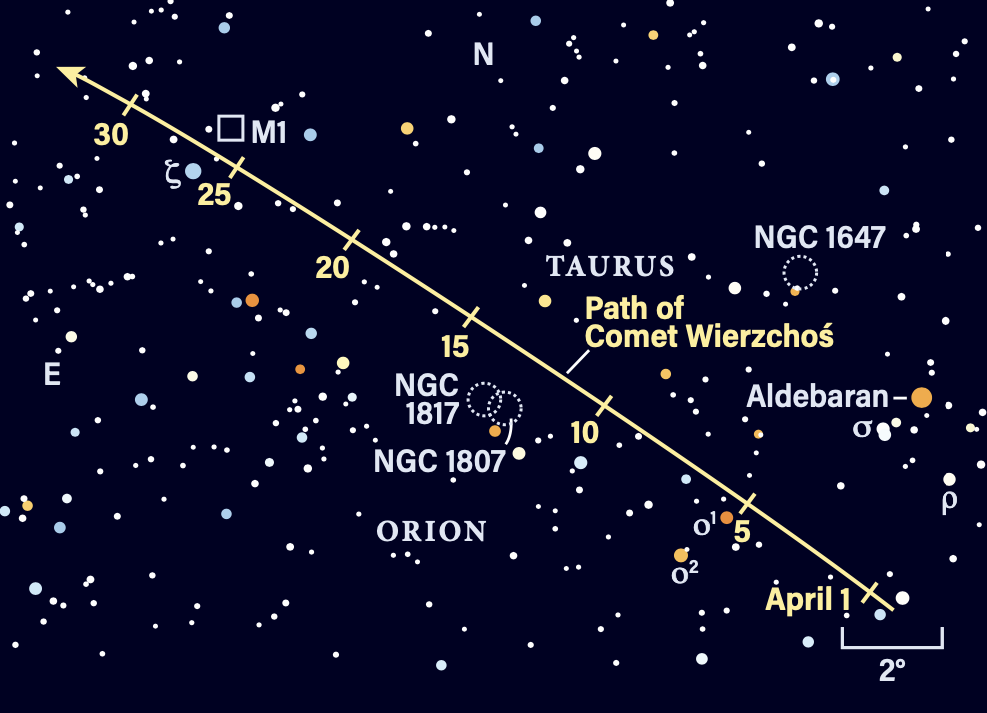
As the moonless evenings begin April 4, get to a dark site to say farewell to 10th-magnitude C/2024 E1 (Wierzchoś), modestly high in the west as it slides past Aldebaran. When the lunar crescent returns in mid-April, the comet’s retreat has eaten another magnitude off its shine. An 8-inch scope at medium power reveals a form similar to a lopsided galaxy. Ardent imagers can capture a moonlit pairing with M1 (the Crab Nebula) on the 27th as the coma’s pale green glow dies out.
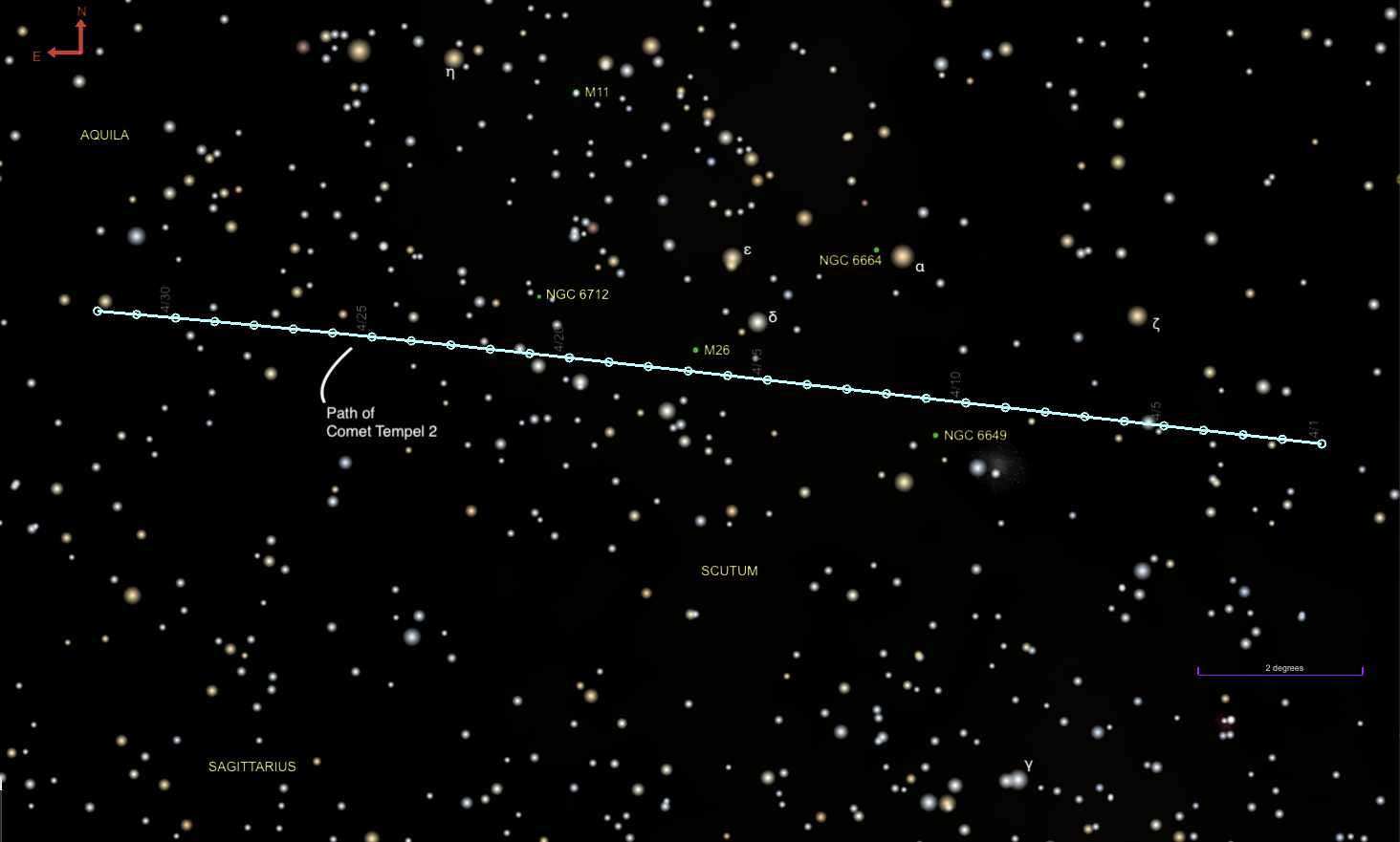
Let’s reintroduce Comet 10P/Tempel, also known as Tempel 2, which is on the way in for an extended stay over the summer. Already brightening past 9th magnitude, its dark-sky window opens overnight April 11/12 as you’re closing up at 3 a.m. During the New Moon Messier marathon, the nearly round fuzz is crossing the Scutum Star Cloud, near doppelgänger globular NGC 6712.
Don’t dally with C/2025 R3 (PanSTARRS). It hits binocular range crossing the Square of Pegasus midmonth, disappears into the dawn a week later, then fades rapidly in a Southern Hemisphere moonlit evening sky shortly after.
Locating Asteroids: I see you
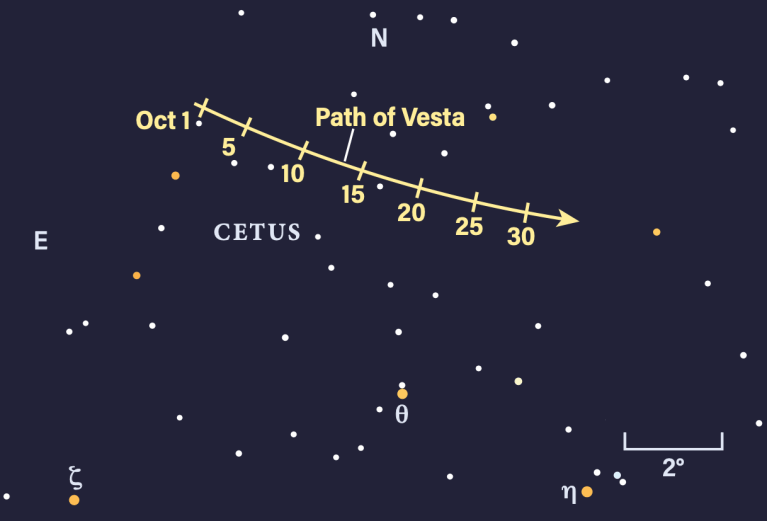
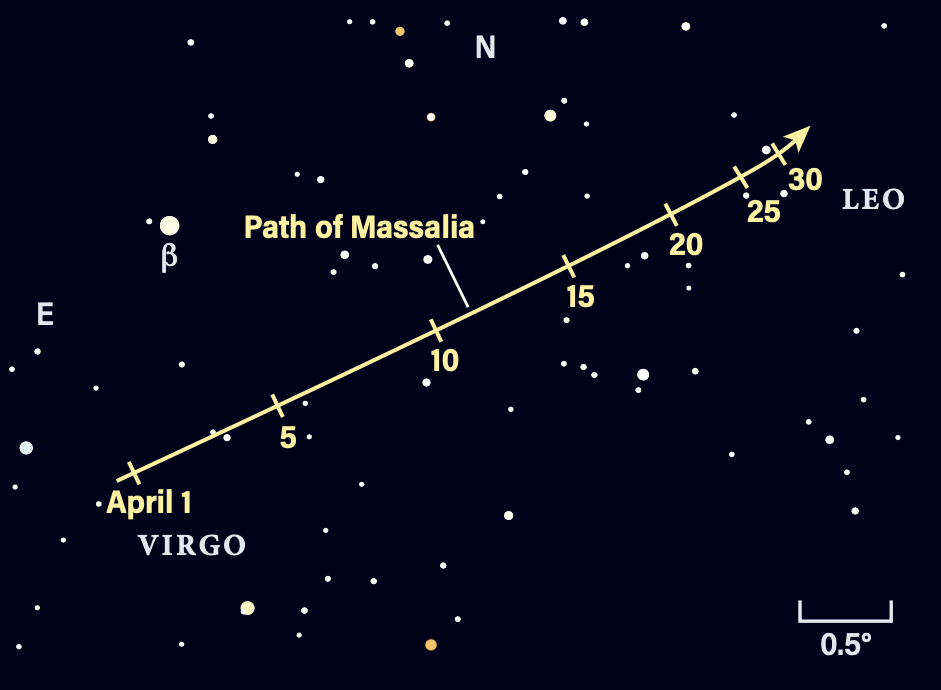
Orbiting at a safe viewing distance in the main belt is 20 Massalia, within reach of a 3-inch scope from the suburbs. Climbing up the southeastern sky, it’s a 2° to 3° hop from Beta (β) Virginis, about halfway between the luminaries Spica and Regulus.
It shouldn’t be tough tracking down the 90-mile-wide Massalia in this star-poor region far from the Milky Way. Our target’s modest, magnitude 9.7 glow outshines many of the background stars here. A direct go-to might show you a single dot in the field, in which case it’s a good idea to slightly shift the scope north or south to encounter the stars on our chart for reference. From Naples, Italian astronomer Annibale de Gasparis visually compared his fields of view with star charts to discover Massalia in 1852. He bagged nine asteroids in all with this method.
From April 3–4 and 16–20, there are nearby field stars to use as a reference for noting Massalia’s displacement from one night to the next.
Star Dome
The map below portrays the sky as seen near 35° north latitude. Located inside the border are the cardinal directions and their intermediate points. To find stars, hold the map overhead and orient it so one of the labels matches the direction you’re facing. The stars above the map’s horizon now match what’s in the sky.
The all-sky map shows how the sky looks at:
midnight April 1
11 p.m. April 15
10 p.m. April 30
Planets are shown at midmonth