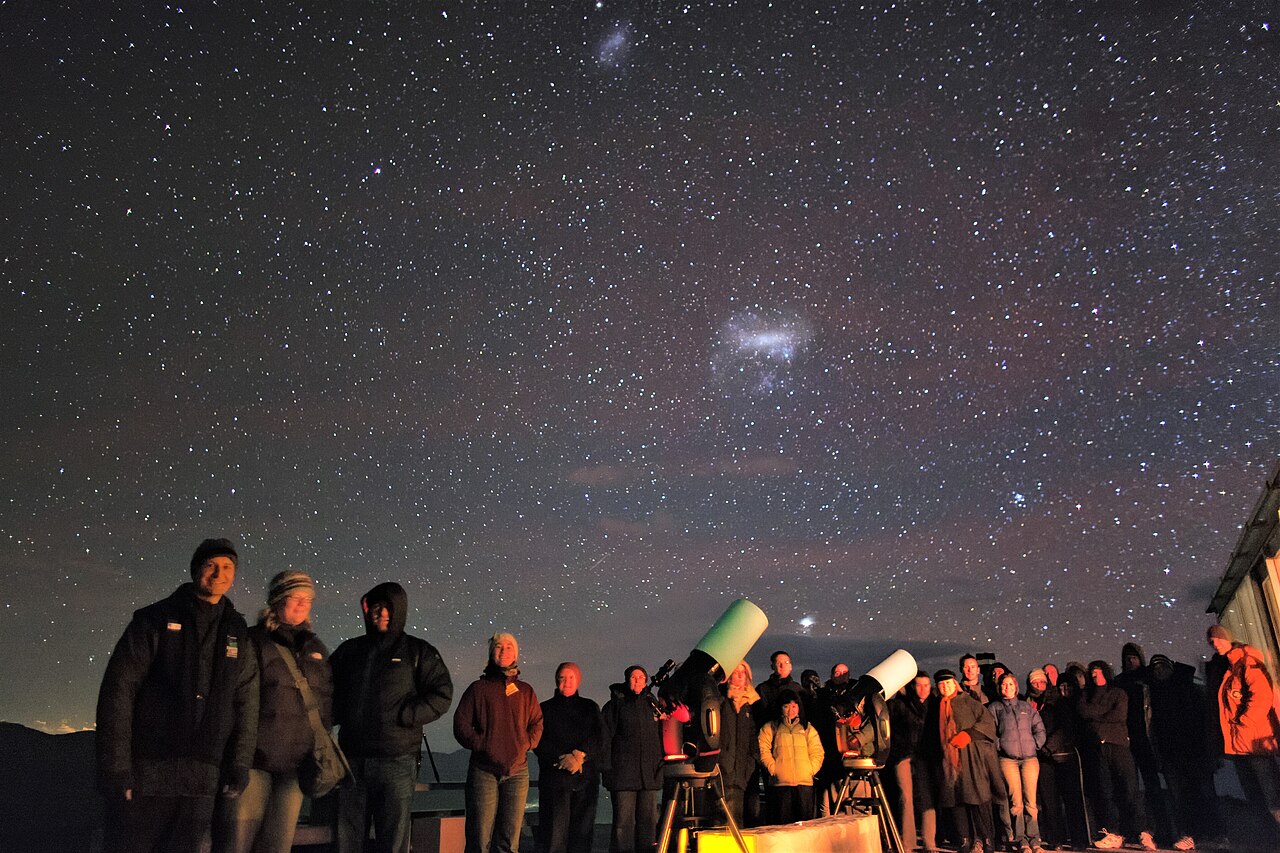
Credit: Fraser Gunn/International Astronomical Union
So, you’re ready to pack up your telescope and head out again, are you? Well, here are a few more things I’ve learned through the years that might make your session more successful. Good luck!
High-altitude observing
In such instances, acclimatization is the key. A couple studies I’ve read suggest that the visual effects of altitude are measurable at about 2,000 feet (610 meters) higher than where you live for the average person. But those who live at sea level can go to twice that altitude before experiencing any effects, so it’s not a strictly linear relationship. People in good shape can go higher before encountering any effects than people who aren’t.
The lack of oxygen at high-altitude locations results in a degree of hypoxia. More importantly, it has a significant adverse impact on low-light color perception. It generally takes a couple of days for your body to adapt to the lower level of oxygen. Having a small oxygen tank with you and taking occasional breaths will let you see more, at least temporarily.
Sky brightness
Believe it or not, the finest skies on Earth are not the darkest. This is simply because the more stars you’re able to see, the brighter the overall sky appears. In such locations, I’ve seen the Milky Way cast a shadow. The zodiacal light, gegenschein, and other skyglowsare also contributors to the overall brightness.
No, a site rated “excellent” has three characteristics: 1) It is free of light pollution; 2) It contains low amounts of aerosols (dust, air pollution, water vapor); 3) It is at a relatively high altitude, at least a mile (1.6 kilometers) high.
Sunlight
Exposure to bright sunlight has a cumulative — and negative — effect on dark adaption. Reflective surfaces such as sand, snow, or water, intensify this condition. Exposure to intense sunlight for two to five hours decreases visual sensitivity for up to five hours. In addition, how fast you adapt to the dark and the level of night visual acuity both decrease. These effects may persist for several days, depending on the person. So, if you’re planning to observe faint fuzzies, stay out of the sunlight.
Weather and seeing
A cold air mass (colder than the ground) is likely to display convective clouds such as cumulus. This air is therefore cleaner overall, but it may be unsteady. So, what you’re likely to experience is good transparency but unsteady seeing. A warm air mass (warmer than the ground) is likely to display stratiform clouds, haze, or mist. And there’s likely to be a lot of dust present. This air tends to be steadier but less transparent. So, what you’ll probably experience is lower transparency but steady seeing.
Bad seeing is almost guaranteed at least 24 hours after the passage of a front (the boundary between warm and cool air) or trough (an elongated area of low pressure that can occur at the surface or at higher altitudes). So, check the weather forecast a day before you plan to observe and be forewarned.
There is, however, one instance where clouds can help. Seeing is at times very good when thin cirrus clouds are present. I stress “thin.” This isn’t true, however, if the cirrus clouds are moving in one direction and there are lower-level cross winds.