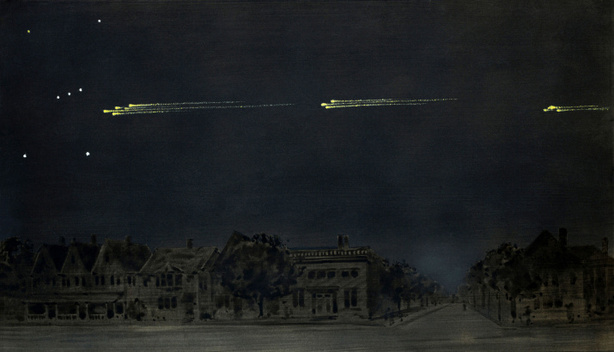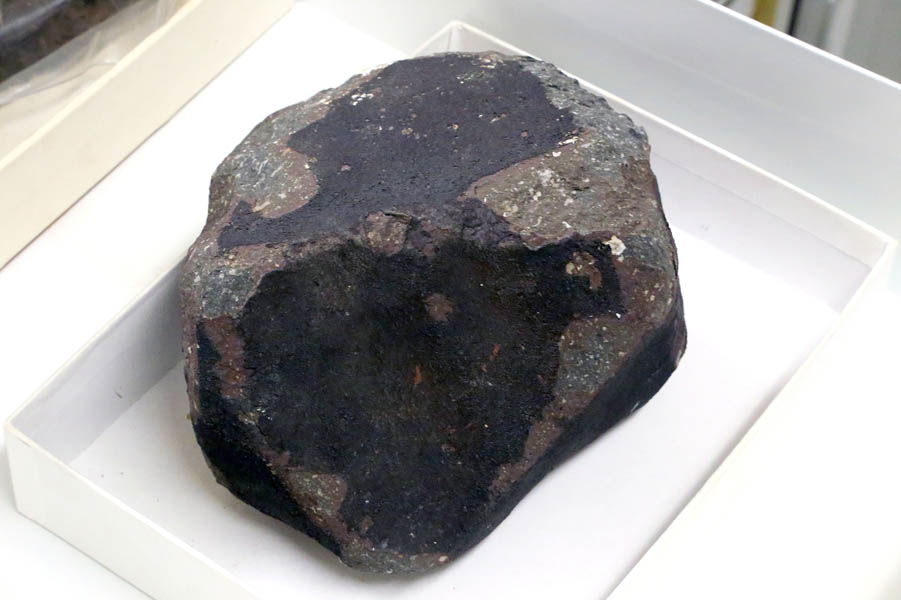
On Feb. 8, 1969, a massive meteorite rained a couple of tons of stones on the Mexican town of Allende, not far from the Texas border. The fireball scattered thousands of stones over a huge area. Over 2 tons were recovered, giving researchers — already primed by the impending Apollo missions — an abundance of material to investigate. As a result, the Allende meteorite has become one of the most studied meteorites in history.
The Allende meteorite is a rare primitive meteorite known as a carbonaceous chondrite. It is rich in carbon in the form of graphite, organic compounds, water, and amino acids. When sliced open, its interior is black and filled with beautiful white, snowflakelike inclusions. When analyzed with a mass spectrometer, these white specks were found to be the oldest known minerals in the solar system, an estimated 4.567 billion years. The calcium-aluminum materials had to form out of material from the nebula that birthed the Sun, and at extremely high temperatures that could only be found in the early solar system. Studies using mass spectrometers also showed oxygen isotopes similar to those found in the Sun. The Allende meteorite is now considered one of the oldest objects ever found on Earth.