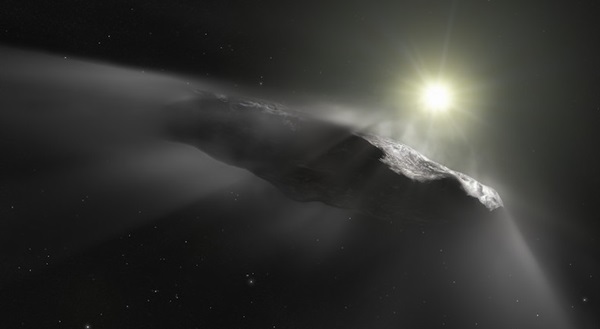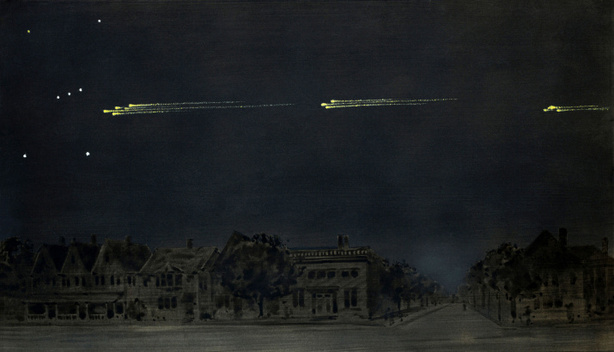
On Feb. 9, 1913, a group of fireballs moved across the sky over the Americas. Rather than the typical “shooting stars” streaking out from a radiant, the meteors moved across the sky as a group, at a “stately” and “measured” pace, parallel to the Earth’s surface. According to Canadian astronomer Clarence Chant, who wrote the first major summary and analysis of the event (published in the May-June 1913 issue of the Journal of the Royal Astronomical Society of Canada), observers frequently used comparisons to a “fleet of airships” or “great battleships, attended by cruisers and destroyers.” Some regions reported loud rumbling accompanying the meteors, which were spotted from Bermuda to Canada.
Chant concluded that the oddly behaving meteors were objects captured and trapped in Earth’s orbit as temporary satellites. Though his conclusions faced some skepticism in the 1930s, most noticeably from astronomer C.C. Wylie, who believed the event to be a typical meteor shower combined with an exploding fireball, other researchers agreed with Chant. In 2013, for the 100th anniversary of the event, astronomers Don Olson and Steve Hutcheon undertook a massive archival search of ships’ logbooks, uncovering seven previously unknown accounts of the event. Those included a log from as far south as off the coast of Brazil. The additional reports suggested the Great Meteor Procession moved parallel to the Earth’s surface for over 7,000 miles (11,000 kilometers). That scope and trajectory firmly supported the theory that they were temporary natural satellites.