Looking for a sky event this week? Check out our full Sky This Week column.
February 9: The Moon reaches Last Quarter
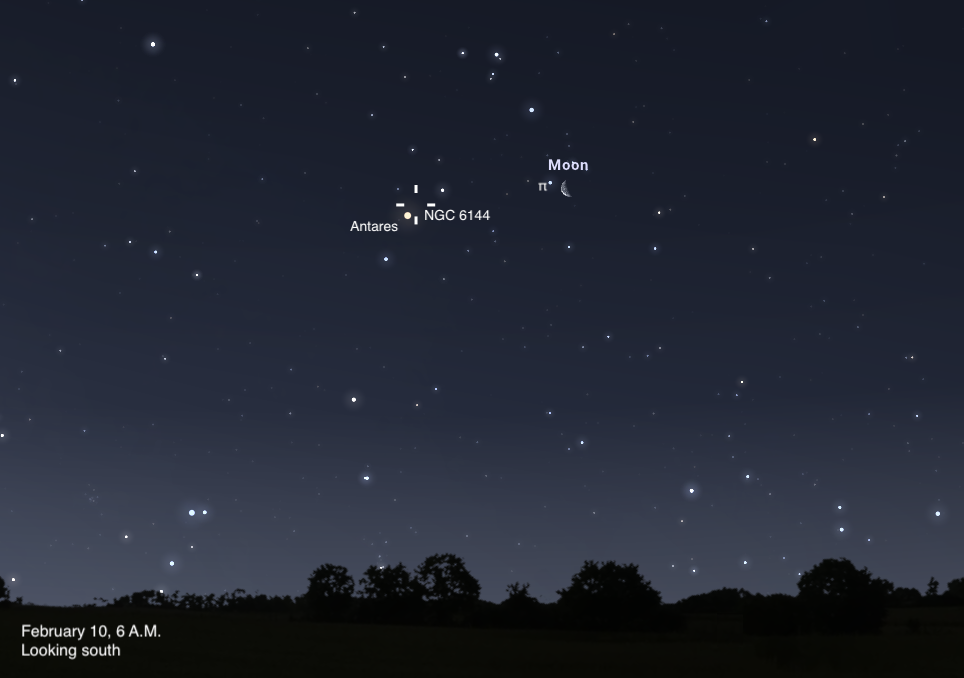
Visible in Scorpius before dawn, our waning satellite is close to the 3rd-magnitude star Pi (π) Scorpii and less than 8° from Antares, the Scorpion’s bright red heart. The Moon will pass 0.7° south of Antares late tonight at 11 P.M. EST, when both are below the horizon.
While your gaze is on this region of the sky this morning, point your telescope over to Antares itself. Just 0.6° northwest of this magnitude 1.1 star is the globular cluster NGC 6144. Both are visible together at low powers, but Antares is so much brighter than the cluster that NGC 6144 itself can be better seen by zooming in on this object alone. You can simply adjust the view so Antares falls out of your field, or switch to higher magnification or a larger scope. NGC 6144 is nearly 30,000 light-years away. Spanning just under 10’, its center is tightly packed and difficult to resolve in smaller scopes, but you may be able to pick out member stars around its outer edges.
Sunrise: 6:59 A.M.
Sunset: 5:30 P.M.
Moonrise: 2:00 A.M.
Moonset: 11:05 A.M.
Moon Phase: Waning crescent (35%)
*Times for sunrise, sunset, moonrise, and moonset are given in local time from 40° N 90° W. The Moon’s illumination is given at 10 P.M. local time from the same location.