Credit: Dr. Catalina Pimiento
A groundbreaking new study using artificial intelligence (AI) has revealed that the asteroid strike that wiped out the dinosaurs 66 million years ago caused only a modest decline in shark and ray species. The findings contradict previous theories of how severely the event affected life in the oceans.
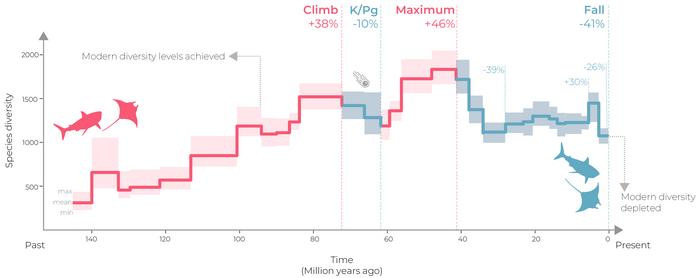
Led by Swansea University, researchers combined AI models with the most complete fossil dataset of sharks and rays. Using these tools, the team was able to map the number of species of sharks and rays across 145 million years. In doing so, they created the most detailed long‑term picture of their evolutionary history to date.
What they found
The researchers made four discoveries. First, species numbers comparable to modern levels were already reached during the Cretaceous period, more than 100 million years ago. Second, the asteroid impact caused a decline of only 10 percent in these species. This number is much smaller than the mass extinction suffered by non-avian dinosaurs and many marine predators.
Third, the number of shark and ray species peaked in the mid-Eocene period, around 50 million years ago. At that time, our planet’s oceans supported many more species than they do today. And finally, since their peak, shark and ray species have declined by more than 40 percent.
AI was the key
These patterns weren’t picked up by previous studies. But the advanced AI methods that corrected for spatial and temporal biases in the fossil record — plus the new fossil dataset — found them.
Lead author Catalina Pimiento of Swansea University’s Department of Biosciences and of the University of Zurich’s Department of Paleontology explains, “We built a new, carefully curated dataset of fossil shark and ray occurrences, which involved reviewing hundreds of studies, extracting data, checking it and resolving inconsistencies, resulting in a global synthesis of fossil occurrences spanning the past 145 million years.”
Study co-led author Daniele Silvestro of ETH Zurich said, “We then applied a new AI method that is far better at recognizing and correcting the uneven and incomplete nature of the fossil record. Previous approaches could account for general differences in sampling, but not for the fact that fossils are unevenly collected across geographic regions or species. Our model can learn these patterns – for example, recognizing when fewer fossils in a particular region can reflect limited sampling rather than real biological decline.”
Helping today’s fish
The findings, published in Current Biology, help conservationists put sharks and rays into a long-term evolutionary context.
Pimiento added, “Today’s sharks and rays are the survivors of a long history of change, including extinction events that have only recently become visible in the fossil record. For the past 40 to 50 million years, their diversity has been trending downwards.
“That long-term decline matters today, because it suggests that modern sharks and rays are already starting from a reduced baseline. In other words, they’re not just facing human pressures such as overfishing and climate change as a healthy, thriving group – they have already lost a lot of evolutionary potential over tens of millions of years. Understanding their past helps us see how important it is to protect the species we still have today.”