Looking for a sky event this week? Check out our full Sky This Week column.
December 14: The Geminid meteor shower peaks
Saturn’s many moons offer an excellent chance to watch orbital dynamics in motion tonight. The ringed planet is visible above the southern horizon as soon as darkness falls. By 10 P.M. local time, it is still 20° high in the west, a bright point of light located between the Circlet of Pisces and the 2nd-magnitude star Diphda in Cetus the Whale. Glowing at 1st magnitude, Saturn is the brightest light here.
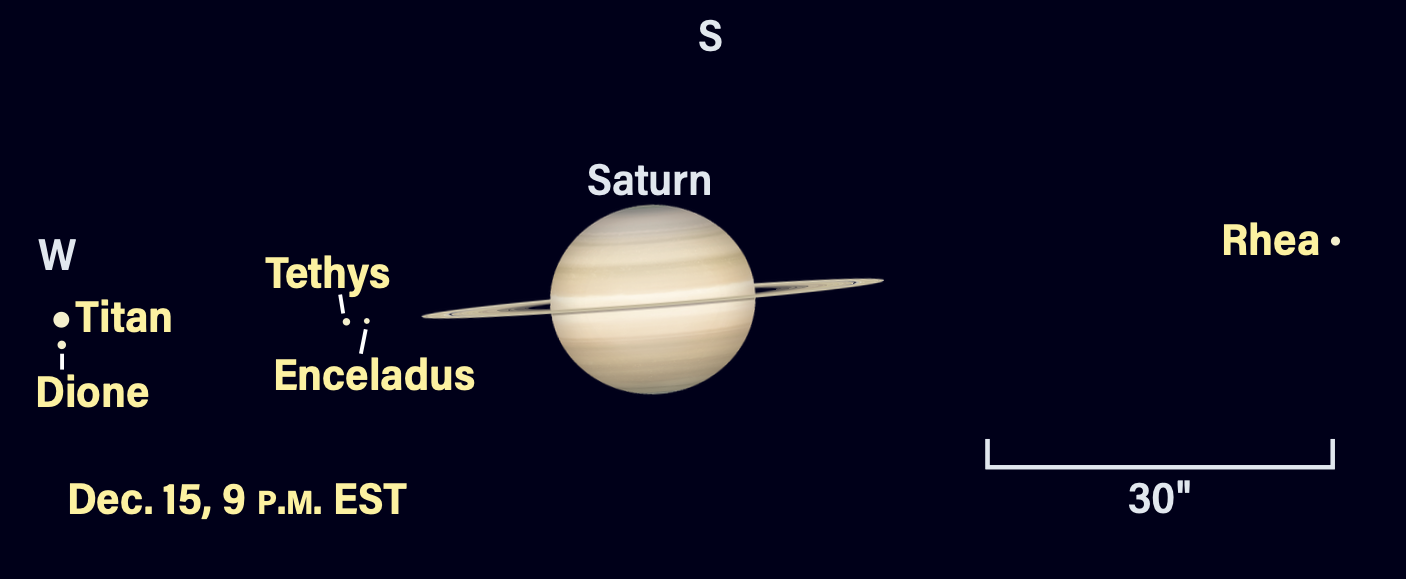
Zoom in on the ringed world with a telescope to spot several of its moons. Brightest is mid-8th-magnitude Titan, located west of the planet. Near Titan and slightly to its northeast early in the evening is 10th-magnitude Dione — this is the pair we’ll want to watch later on. Closer to Saturn on the west is 10th-magnitude Tethys, while similarly bright Rhea is visible alone to Saturn’s east.
Now let’s turn our attention back to Dione and Titan. Early in the evening, Titan is farther from Saturn than Dione. Around 9 P.M. EST, Titan slides to sit just 2” due south of Dione — depending on your optics, you may see the two moons appear to merge. After this, Titan starts to move closer to Saturn — but this configuration is short-lived.
Saturn will set for the eastern half of the country (around local midnight) with Titan slightly east of Dione. But observers in the western U.S. may spot Dione catch up with Titan around 10:35 P.M. PST, when the two moons again stand in a north-south line with Titan just a few scant arcseconds south of Dione. After this, Dione will pull ahead, moving closer to Saturn than Titan as the ringed planet sets for the West Coast.
Sunrise: 7:15 A.M.
Sunset: 4:36 P.M.
Moonrise: 3:16 A.M.
Moonset: 1:33 P.M.
Moon Phase: Waning crescent (13%)
*Times for sunrise, sunset, moonrise, and moonset are given in local time from 40° N 90° W. The Moon’s illumination is given at 10 P.M. local time from the same location.