Credit: Henryk Kowalewski/WikiMedia Commons
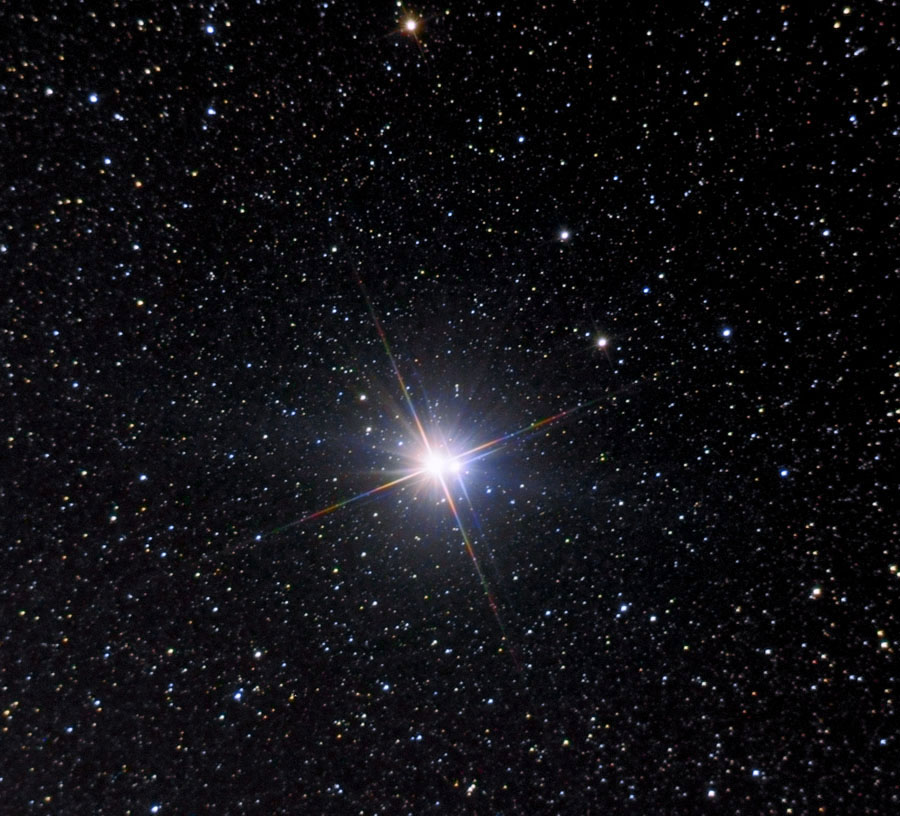
Autumn in the Northern Hemisphere is a great time to hunt galaxies. You’ll find objects ranging from the marvelous Andromeda Galaxy (M31) to Stephan’s Quintet (NGCs 7317, 7318A, 7318B, 7319, and 7320) to NGC 1. But except for a few, like M31, most galaxies are faint and lack detail unless your telescope is large. So, sometime during your observing session, take a break. Point any size telescope at the star Albireo (Beta Cygni), which marks the head of the constellation Cygnus the Swan. Most northern observers consider this the sky’s finest double star.
Astronomers label Albireo’s two components (the stars that make it a double star) Beta1 Cygni and Beta2 Cygni. Beta1shines at magnitude 3.2, while Beta2 is fainter, coming in at magnitude 5.1. The separation between them is 34″, which means that even the smallest telescope will successfully split them. But it’s not their magnitudes or their separation that make these stars a terrific sight: It’s their colors.
Before I describe the colors of these two stars, let me state that no two human eyes see precisely the same hues. That said, most observers ‘‘see’’ Beta1 as golden and Beta2 as sapphire blue. But whether you actually see gold and blue, blue and white, yellow and green, or any number of other combinations, it all adds up to a striking sight in the eyepiece.
A few more things
Both brighter components of Albireo (there are two other stars in the system, but they can’t be seen through amateur telescopes) are truly bright stars. Beta1 is 795 times as bright as our Sun, and Beta2 is 110 times as bright. That makes sense because Albireo lies some 365 light-years away.
Finally, although the first two letters of Albireo are ‘‘al,’’ according to stellar nomenclature historian Richard Hinckley Allen, this star’s name is not Arabian, as are, for example, Aldebaran (Alpha Tauri) and Algol (Beta Persei). He says the now universal title, ‘‘apparently was first applied to the star from a misunderstanding as to the words ab ireo in the description of the constellation in the 1515 edition of [Ptolemy’s] Almagest.’’ The Arabians called Albireo Al Minhar al Dajajah, the Hen’s Beak.
Whatever you call it, I hope you have a clear night soon so you can go out, take a look, and bask in the light of this stellar beauty.