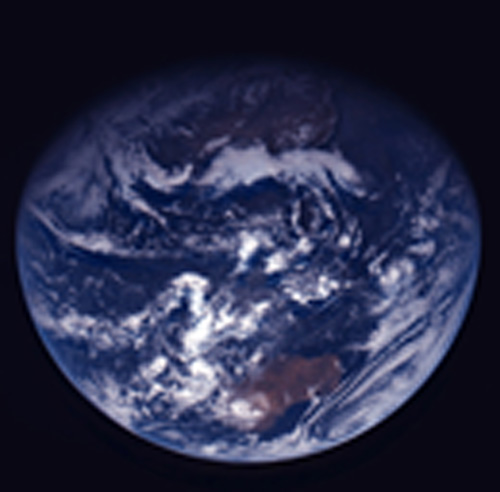
While Earth’s orbit is near-cicular now, it was more elliptical in the past and it will also be so in the future. Credit: NASA/NOAA/GSFC/Suomi NPP/VIIRS/Norman Kuring
As German astronomer Johannes Kepler discovered in the early 1600s, the orbits of Earth and all planets in our solar system are ellipses (slightly elongated near-circles). However, gravitational interactions among the planets cause the ellipticities of the orbits to oscillate periodically by a few percent over millions of years. Currently, Earth’s ellipticity is about 2 percent, meaning it is 3.1 million miles (5 million kilometers) closer to the Sun at the nearest point in its orbit than at the farthest point. But the ellipticity of Earth’s orbit was more than double its current value a few million years ago, and it will be again in a few million years. — Brian Jackson, Carnegie Department of Terrestrial Magnetism, Washington, D.C.