Looking for a sky event this week? Check out our full Sky This Week column.
April 18: Venus moves into Taurus
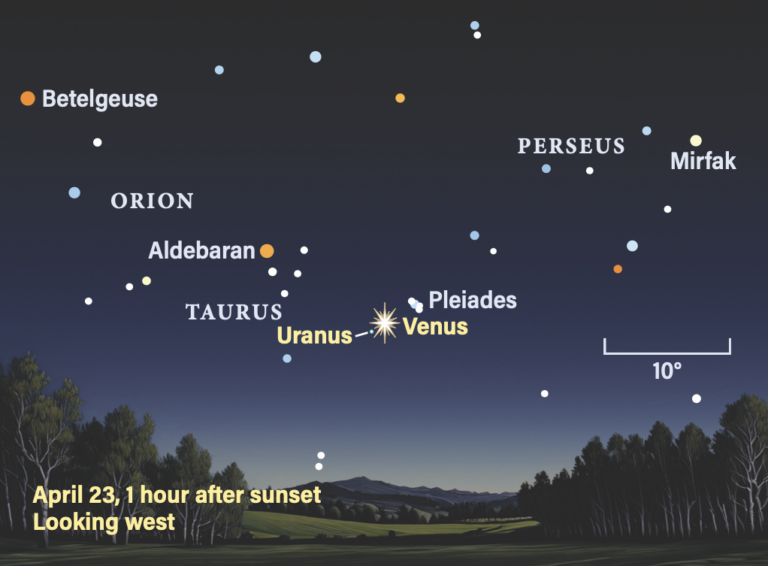
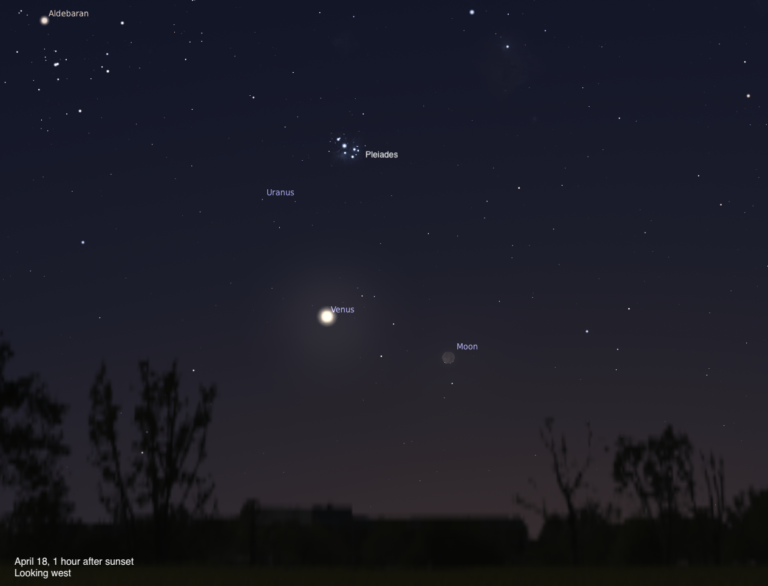
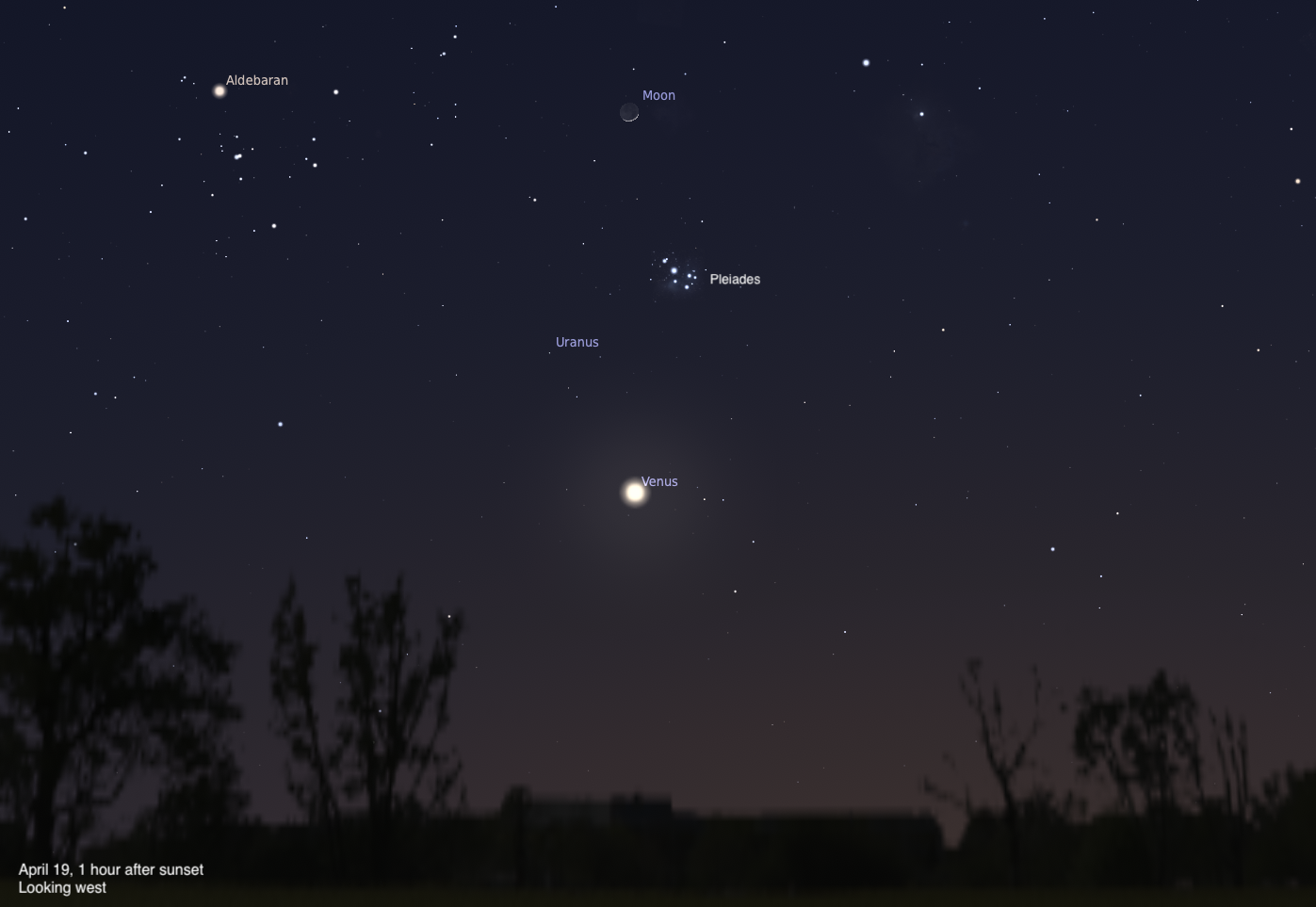
The Moon passes 5° north of Venus at 5 A.M. EDT, then passes 5° north of Uranus at 2 P.M. EDT. By this evening, our satellite is more than 2.5 days old and some 10 percent lit, glowing in the western sky. It is located 5° east of the Pleiades star cluster in Taurus, now standing above it rather than to the cluster’s lower right, as yesterday. Venus still blazes below the cluster, outshining any star in the region by far.
Uranus is now located some 7.2° southwest of the Moon, to our satellite’s lower left. The ice giant is also roughly 4.5° due south of the Pleiades. To spot it, you’ll want to wait until the sky grows fully dark, then skim south of the Pleiades with binoculars or a telescope. Uranus’ tiny, 3”-wide disk glows at magnitude 5.8. Venus will close in on the faint outer solar system world later this week, providing a great guidepost to find it.
Mercury passes 1.8° south of Mars at 8 P.M. EDT; rising shortly before the Sun, these planets are located in the early-morning sky. Keep reading for more details on how to spot them tomorrow morning.
Sunrise: 6:16 A.M.
Sunset: 7:43 P.M.
Moonrise: 7:16 A.M.
Moonset: 11:03 P.M.
Moon Phase: Waxing crescent (10%)
*Times for sunrise, sunset, moonrise, and moonset are given in local time from 40° N 90° W. The Moon’s illumination is given at 10 P.M. local time from the same location.
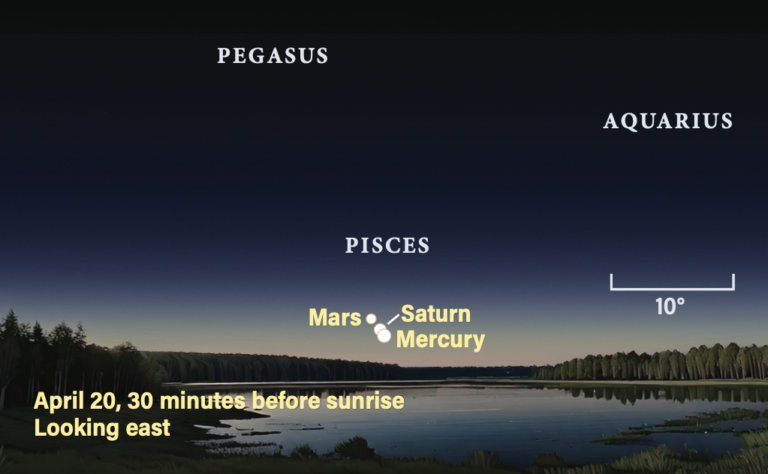
After passing south of Mars late on the 19th, Mercury passes 0.5° south of Saturn at 4 A.M. EDT on April 20. Mars will later pass 1.3° north of Saturn at 2 P.M. EDT.
This trio of planets congregates in the early-morning sky of April 20: Mercury, Mars, and Saturn all lie within a 2°-wide area before sunrise, not to be missed. However, observing them will be a bit challenging, as they currently rise only shortly before the Sun.
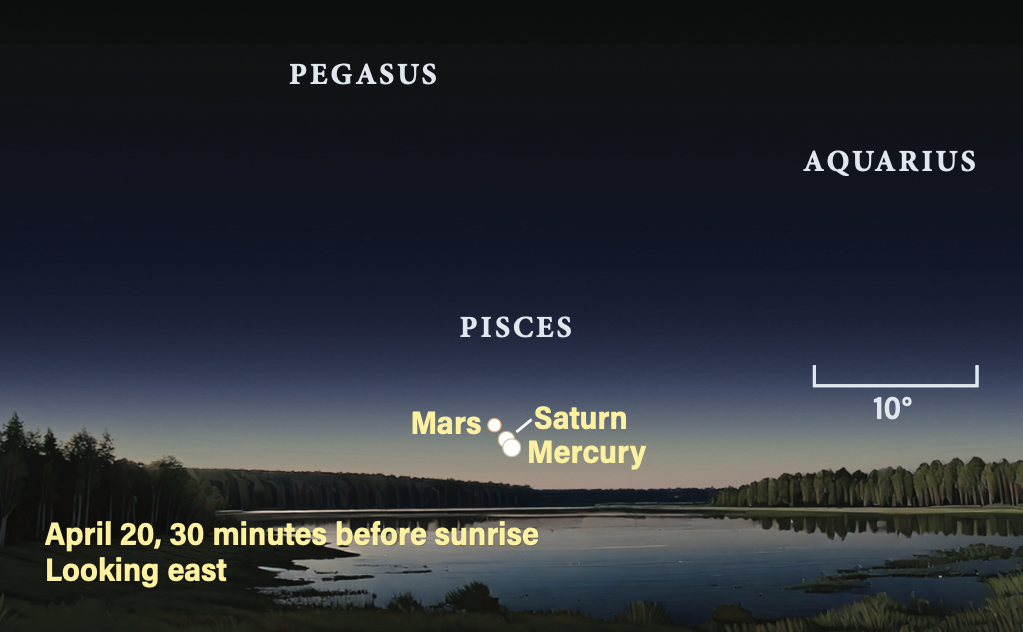
Some 30 minutes before sunrise, the trio is just 2° high in the east. The brightest of the three is Mercury at magnitude –0.2, so look for this world first. Saturn, which is next brightest at magnitude 0.9, is just 28’ north (to the upper left) of Mercury; both are visible in the same field of view with binoculars or a small scope, and you will likely need some form of optical aid to pick up the ringed planet. Mars, the faintest of the three at magnitude 1.2, is located just over a degree north (again, to the upper left) of the Saturn-Mercury pair. Most scopes should still be able to capture all three in the same field.
Remember, as always, to stop your search and put away any optics at least several minutes before sunrise from your location, which may differ from the time given below.