Looking for a sky event this week? Check out our full Sky This Week column.
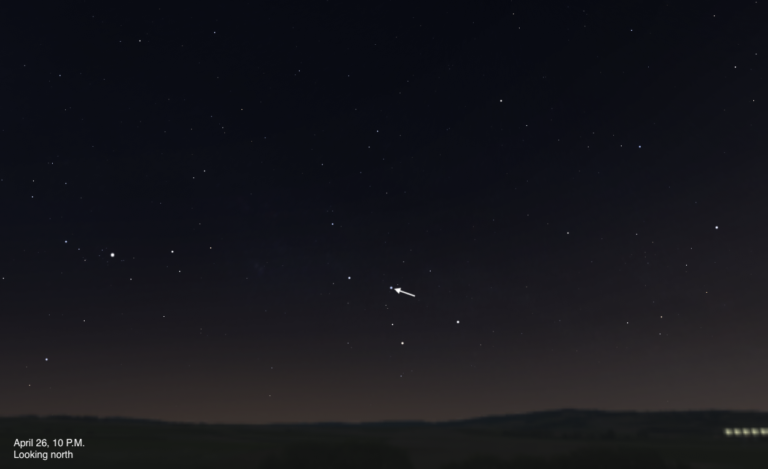
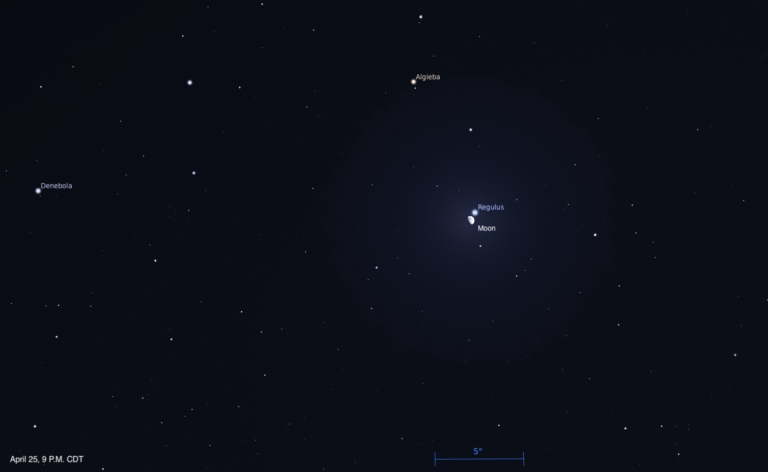
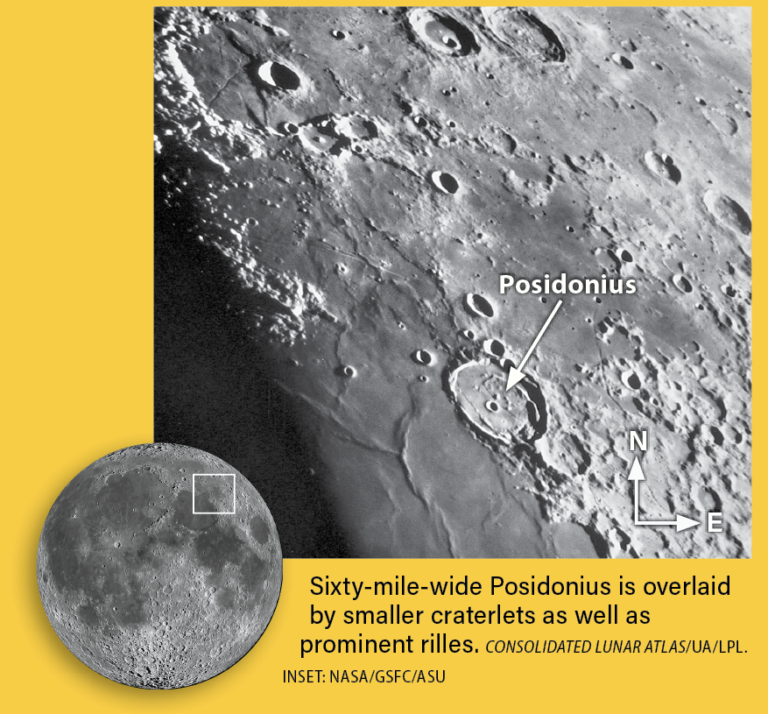
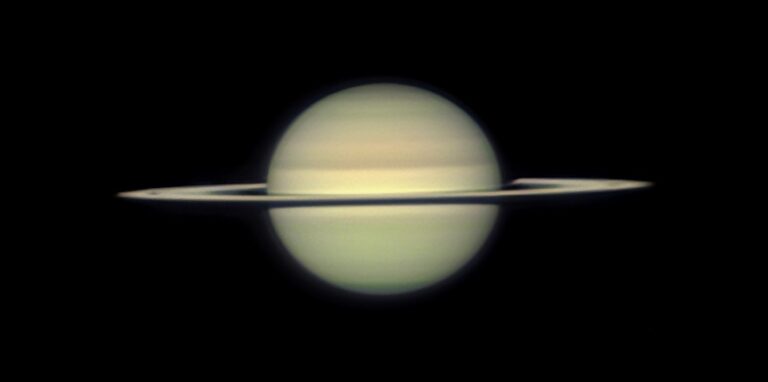
April 26: A look at enigmatic Gamma Cas
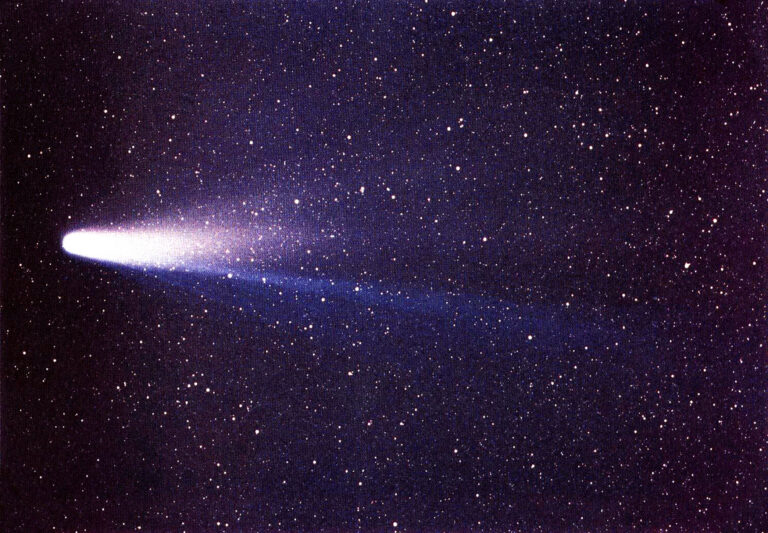
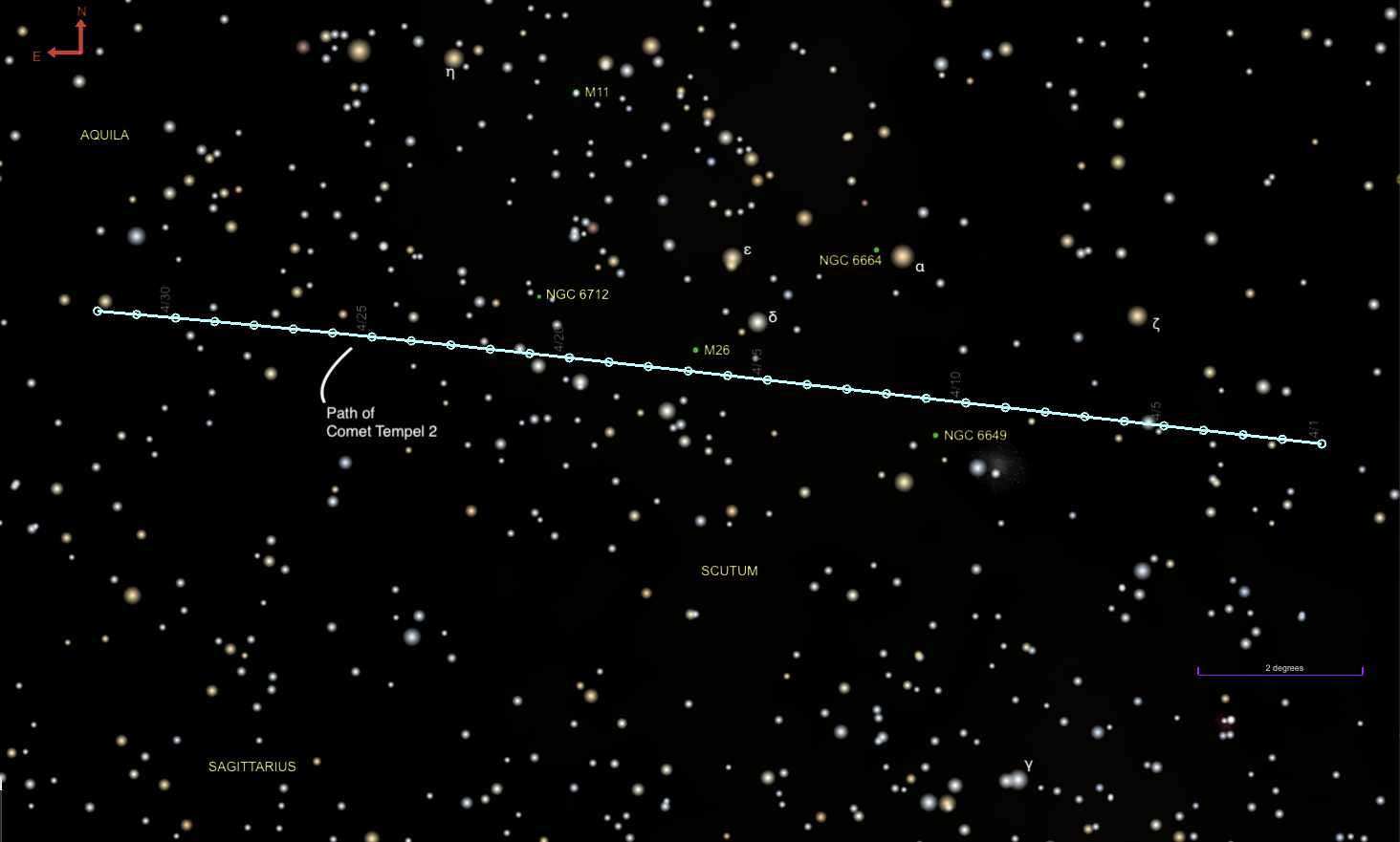
Comet 10P/Tempel, also called Tempel 2, is continuing to brighten in the early-morning sky. Rising around midnight and visible until the sky streaks with dawn, two hours before sunrise on April 27 you’ll find the comet some 35° high in the southeast, near the tail feathers of Aquila the Eagle and not far from globular cluster NGC 6712.
Recently recorded around magnitude 11, Tempel 2 is located just over 4° south of Lambda (λ) Aquilae this morning. The comet is also only 3° from NGC 6712, which lies to Tempel 2’s west. Binoculars may show both fuzzballs in a single field of view, while a telescope will allow you to zoom in on one at a time.
At magnitude 8.2, NGC 6712 will be brighter. It spans roughly 7’ and is a somewhat diffuse cluster with a concentrated core that fizzles into separate stars as you reach the outskirts. Compare its shape, size, and brightness profile to that of the comet. Which one is larger? Which one is brighter in the center, and how do their appearances differ?
Sunrise: 6:05 A.M.
Sunset: 7:51 P.M.
Moonrise: 4:08 P.M.
Moonset: 4:04 A.M.
Moon Phase: Waxing gibbous (88%)
*Times for sunrise, sunset, moonrise, and moonset are given in local time from 40° N 90° W. The Moon’s illumination is given at 10 P.M. local time from the same location.
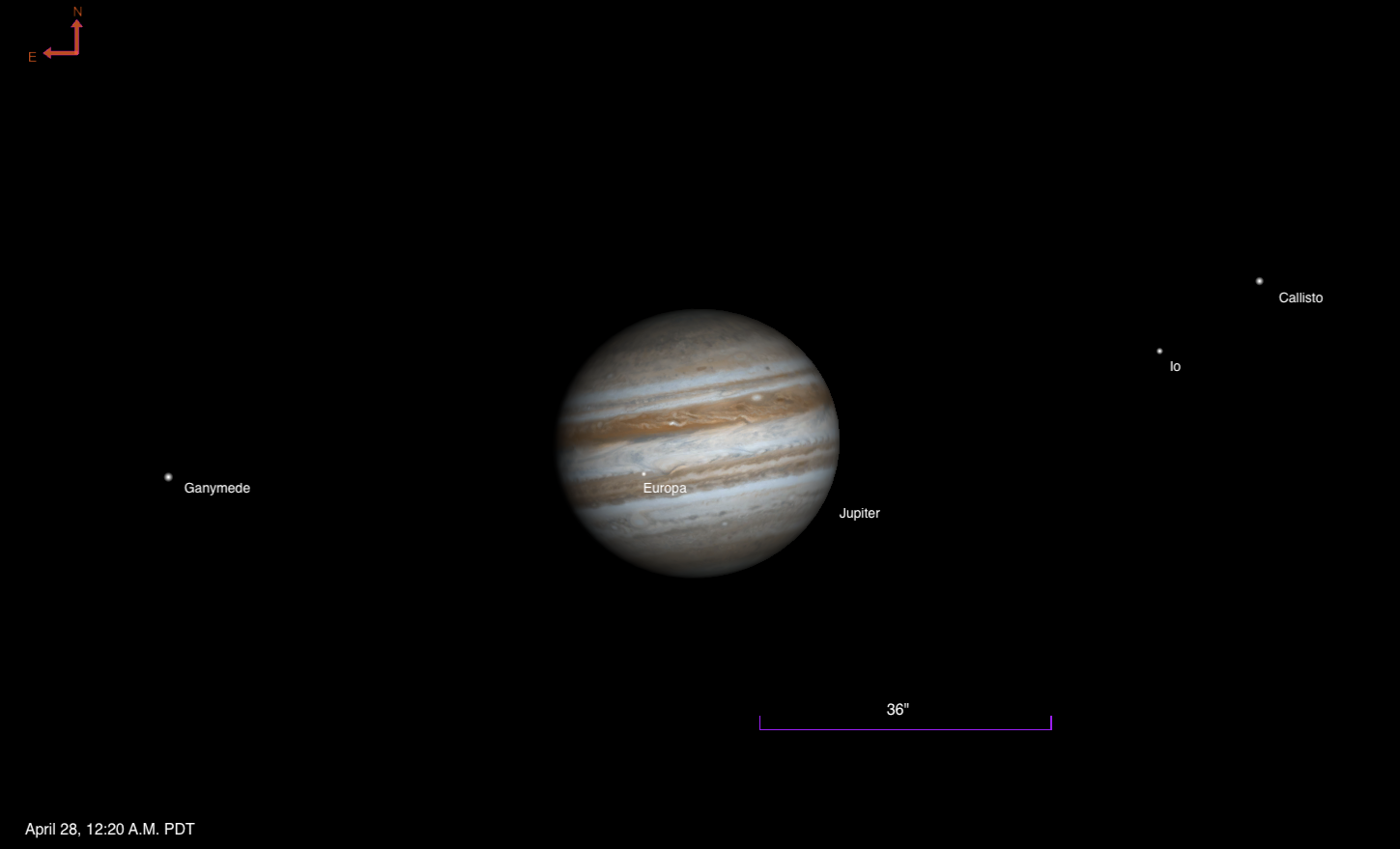
Jupiter’s large moon Ganymede begins passing behind the planet in an occultation late on the 27th. It then travels through the gas giant’s long, dark shadow to finally pop back into view early on April 28 for observers in the western half of the U.S., particularly along the Pacific Coast.
Jupiter is largely visible in the evening and sets around 1:30 A.M. local daylight time. So, you can still catch it this morning in the hour between about midnight and 1 A.M., sinking toward the western horizon in Gemini the Twins. It is the brightest point of light here, outshining even than the constellation’s alpha and beta stars, Castor and Pollux, respectively.
Turn a telescope on the planet and watch as long as you can as it descends into the thicker atmosphere near the horizon. You’ll see two moons to the west — these are Io, which is closer to the planet, and Callisto, which is farther west. East of the planet is Europa. Ganymede is also here, but it is hidden within the dark shadow Jupiter casts into space. The planet will set for most of the U.S. without Ganymede visible, but lucky observers in the far west can catch it reappearing from eclipse at 12:19 A.M. PDT. By then it will be far from the eastern limb, nearly a full arcminute away.
Meanwhile, Europa has begun to transit the planet, crossing the eastern limb around 12:30 A.M. MDT, visible in that time zone as well. Its shadow will follow, but not until after Jupiter sets even for those along the West Coast.