The Artemis 2 mission that flew astronauts Reid Wiseman, Victor Glover, Christina Koch, and Jeremy Hansen around the Moon for the first time in more than 50 years is returning to Earth today.
Following its historic trip around the Moon, Artemis 2 has been headed back toward home. The mission is scheduled to culminate with the Orion crew capsule Integrity‘s splashdown at 8:07 P.M. EDT on Friday, April 10, in the Pacific Ocean near San Diego. But first, the capsule must withstand temperatures of some 3,000 degrees Fahrenheit (1,650 degrees Celsius), traveling at 35 times the speed of sound and subjecting the crew nearly 4 Gs of force during reentry. Throughout it all, the heat shield must hold; after more of the uncrewed Artemis 1’s heat shield burned away than expected during reentry in 2022, NASA engineers have tweaked Artemis 2’s trajectory to reduce wear on the heat shield and keep the crew safe.
After splashdown, helicopter crews from the USS John P. Murtha will retrieve the astronauts for medical evaluation and return them first to California, then finally to NASA’s Johnson Space Center in Houston.
We will begin following the events live starting around 6:30 p.m. EDT, when NASA coverage will begin. To get up to speed on the mission so far, check out our complete guide to Artemis 2 and explore the full mission timeline.
Thank you for joining us to watch Artemis 2 return to Earth. Our splashdown live coverage has ended. Check back at Astronomy.com for additional updates.
Live updates
10:13 P.M. EDT: Mission complete
All four astronauts have left the helicopters for the ship’s medical bay, making the short, one-minute walk under their own power and to applause from those on the flight deck. Throughout the splashdown and wait for pickup, all crew members continually reported feeling good.
Now, as the Sun sets, recovery crews will continue their work to bring Integrity back to the ship.
Artemis 2’s journey has come to a close, signaling a giant leap forward on humanity’s return to the Moon. The four triumphant astronauts, who traveled farther from Earth than anyone ever before, will next fly to NASA’s Johnson Space Center in Houston on Saturday, April 11.
10:08 P.M. EDT: The astronauts remain aboard the helicopters as NASA Administrator Jared Isaacman congratulates them on the flight deck. NASA flight surgeons are also checking the crew’s status before bringing them to the ship’s medical facilities for full evaluations.
9:58 P.M. EDT: The second helicopter, carrying Jeremy Hansen and Reid Wiseman, has landed. All four crew members are now safely aboard the USS John P. Murtha.
9:56 P.M. EDT: The first helicopter carrying two of the Artemis 2 crew, Christina Koch and Victor Glover, has landed aboard the USS John P. Murtha.
9:54 P.M. EDT: Mission commander Reid Wiseman, the final Artemis 2 crew member to leave the front porch, has been brought aboard the recovery helicopter. The astronauts are now headed back to the USS John P. Murtha, where they will be taken to the ship’s medical facilities for evaluation.
Meanwhile, additional recovery crews remain with Integrity to prepare and then tow the craft back to the ship.
9:50 P.M. EDT: The first Artemis 2 crew member is being transferred from the front porch raft to one of two MH-60S Sea Hawk helicopters.
Each helicopter will carry two astronauts, alternating pickups. Helicopters are used to more quickly and easily carry the crew from the capsule to the waiting USS John P. Murtha for evaluation. It’s about a three-minute flight from the capsule’s location to the ship.
9:35 P.M. EDT: Mission commander Reid Wiseman has left Integrity, the last crew member to emerge. All four Artemis 2 crew members are on the front porch in the Sun after spending nearly 10 days in space. Mission Control in Houston has erupted into cheers.
Shortly, the astronauts will be hoisted from the raft into the waiting helicopters for transport back to the USS John P. Murtha.
9:32 P.M. EDT: Two crew members are now enjoying the fresh air on the front porch raft outside the floating Integrity capsule.
9:31 P.M. EDT: The first Artemis 2 crew member has emerged from Integrity with the help of Navy personnel and is now on the front porch raft.
9:24 P.M. EDT: The stabilization collar is fully inflated and the front porch raft that will serve as a temporary staging area for the astronauts as they emerge has also been fully inflated and is now being attached the hatch of Integrity.
9:20 P.M. EDT: The team of Navy divers has set up and is beginning to inflate the stabilization collar ringing the base of the capsule, providing added stability in the water for the astronauts to egress. The front porch raft is also being unfolded and inflated.
9:10 P.M. EDT: The recovery crew reports currents are somewhat hindering the setup of stabilizing floats around the craft, but they are proceeding slowly. Four divers remain inside the capsule with the returned astronauts as others work to set up the stabilization collar to keep the capsule upright in the water.
NASA requires the astronauts to be extracted from the capsule within two hours of splashdown. The agency reports there is still plenty of time to meet this criterion.
8:55 P.M. EDT: Recovery crews have reached Integrity and successfully opened the capsule’s side hatch, exposing the interior to fresh air for the first time since launch. Four recovery personnel will ultimately enter the craft (one for each astronaut) to assess and help them egress.
8:50 P.M. EDT: “A perfect mission”
Speaking from the deck of the USS John P. Murtha moments ago, NASA Administrator Jared Isaacman said of Artemis 2: “I can’t imagine a better crew than the Artemis 2 crew that just completed a perfect mission right now.”
“I just couldn’t be more proud of the entire workforce … It’s a huge moment for everybody. We are back in the business of sending astronauts to the Moon, bringing them back safely, and to set up for a series of more. I mean, this is not a once in a lifetime. … This is just the beginning.”
8:41 P.M. EDT: The official mission duration has now been updated. NASA Flight Dynamics reports splashdown occurred at 8:07:27 P.M. EDT., making the Artemis 2 mission’s final elapsed time 9 days 1 hour 32 minutes 15 seconds.
Integrity is now powered down and the crew reports being in “excellent condition” as they wait for recovery teams to approach.
8:35 P.M. EDT: The spacecraft is now being powered down and the recovery team will soon approach the capsule.
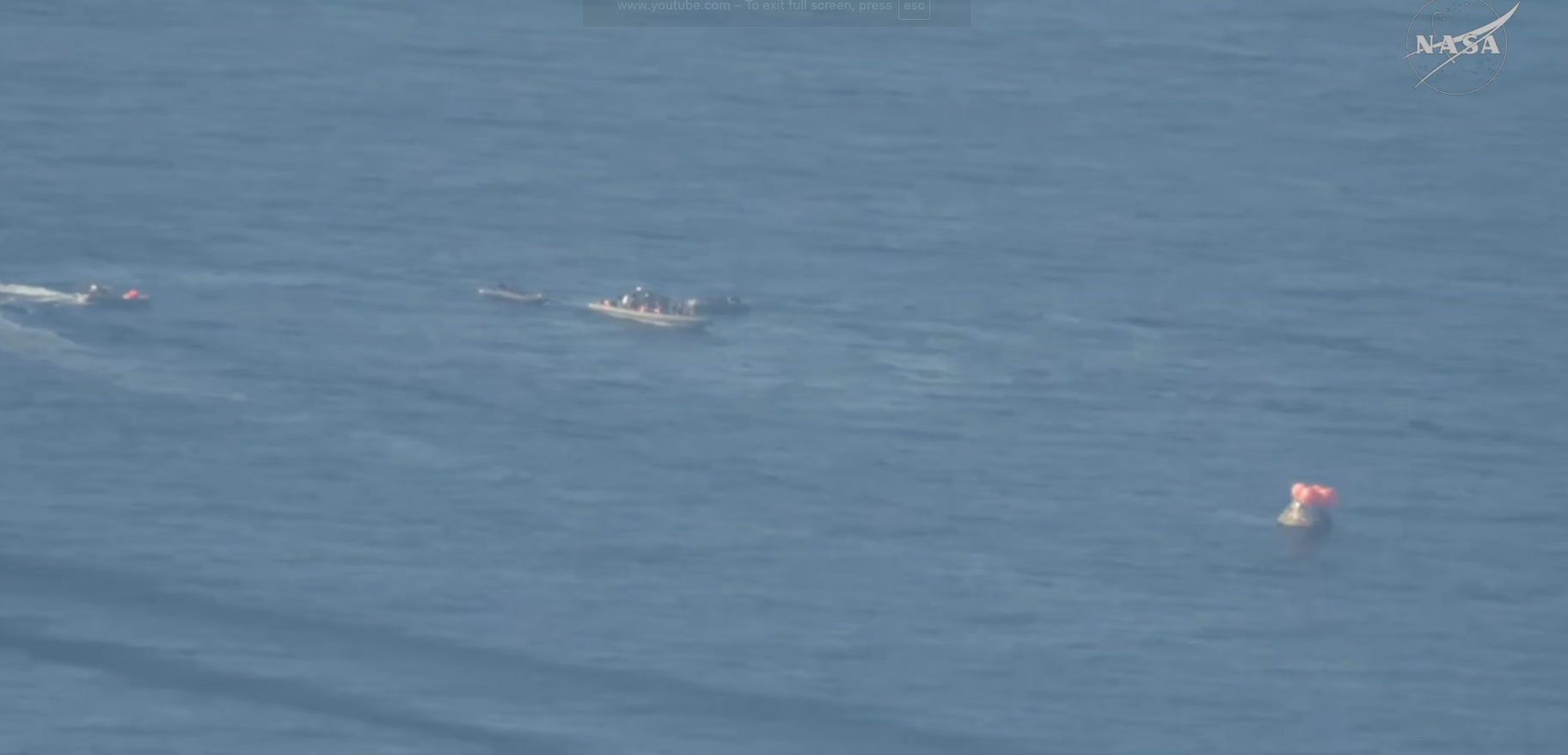
8:21 P.M. EDT: There is some difficulty in establishing communications between recovery crews and Integrity via radio. Although the astronauts report receiving messages from the recovery craft, recovery vessels cannot hear Integrity‘s response. However, recovery crews have begun moving toward the capsule in preparation for attaching a small inflatable raft, called the front porch, to the hatch to allow the astronauts to egress.
8:14 P.M. EDT: Recovery crews from the USS John P. Murtha are now heading for the capsule’s position. These include Navy divers from the Explosive Ordnance Disposal Group 1, as well as two MH-60S Sea Hawk helicopters from San Diego-based Helicopter Sea Combat Squadron 23 “Wildcards.”
There are no toxic gases detected in the area, meaning recovery crews can safely approach. However, they will not do so until the spacecraft is completely powered down, which is expected to take a few more minutes.
8:10 P.M. EDT: Integrity confirms “four green crew members,” meaning all astronauts are in good condition.
The capsule’s main parachutes have been cut and its airbags inflated, ensuring Integrity remains upright to allow the crew to safely exit.
8:07 P.M. EDT: Splashdown!
Integrity has successfully splashed down in the Pacific Ocean, bringing the astronauts’ 694,481-mile (1,117,659 km) spaceflight to an end.
The capsule has landed right-side up; NASA reports “A perfect bull’s-eye splashdown for Integrity and its astronauts.”
8:05 P.M. EDT: Main parachute deployment
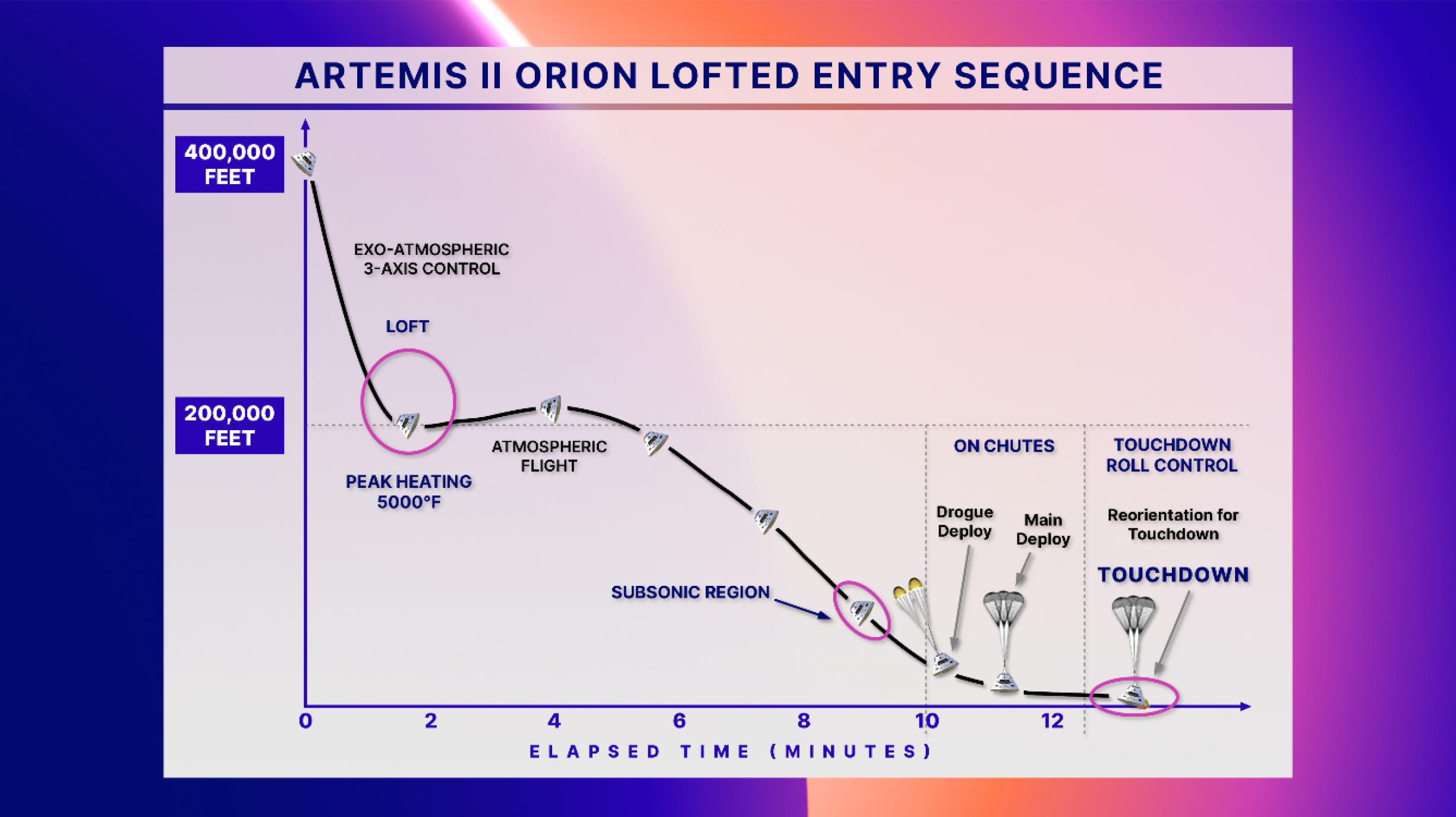
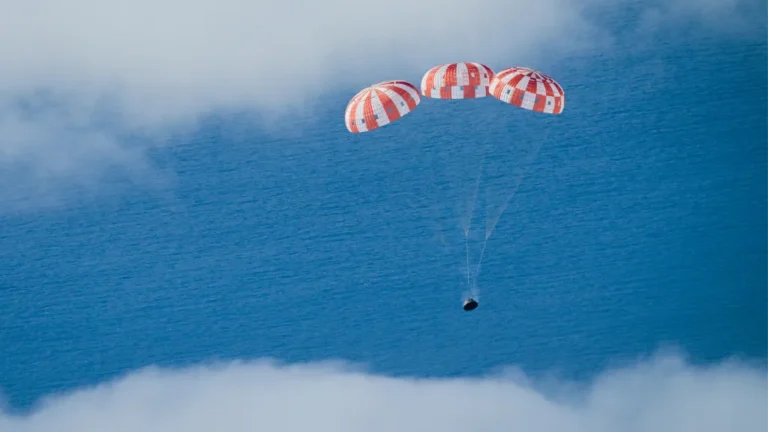
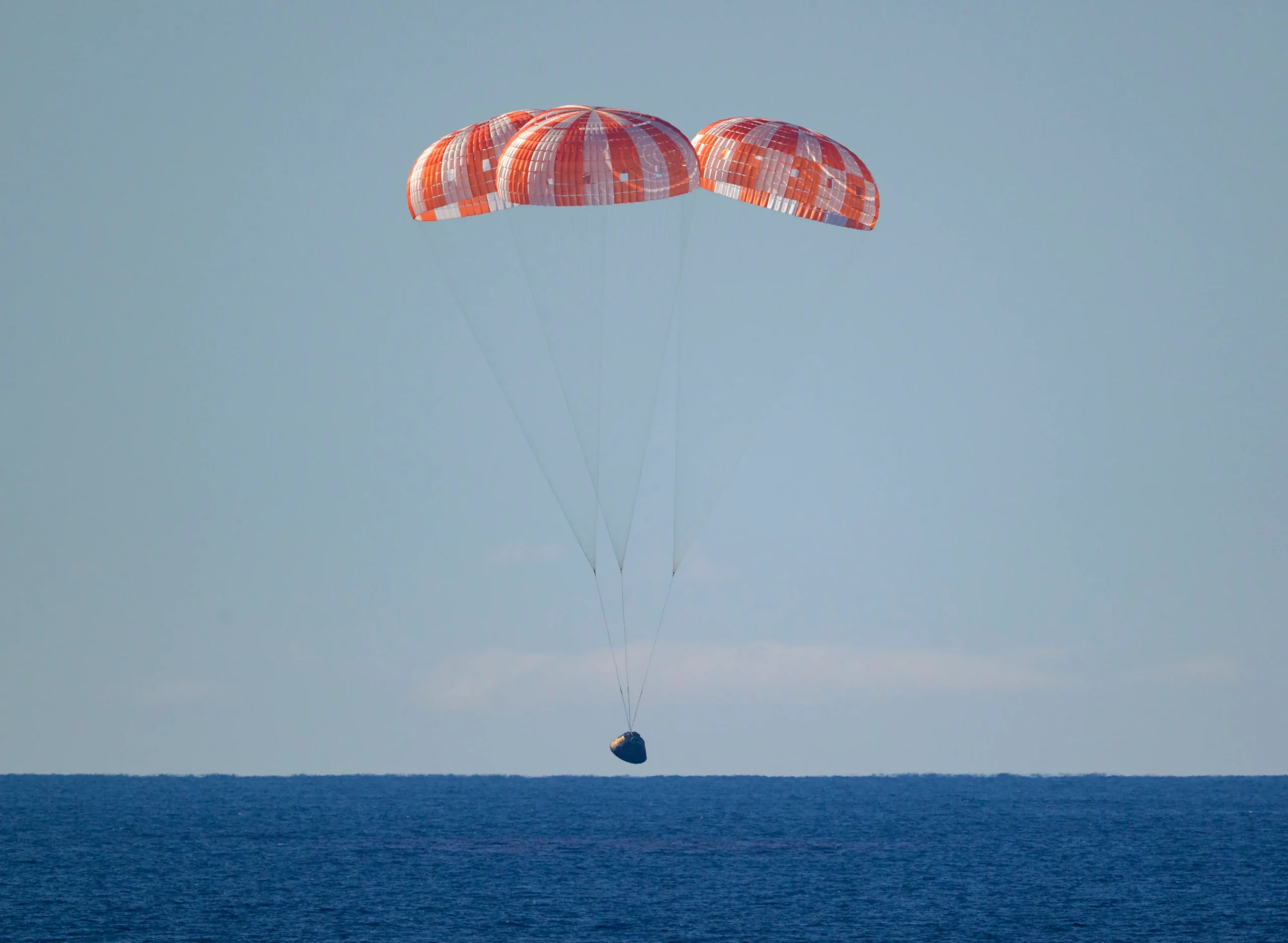
Integrity’s three 116-foot-wide (35 m) main parachutes have deployed at an altitude of 6,000 feet (1,830 m). They will slow the craft from 50 mph (240 km/h) to its final splashdown speed of 17 mph (27 km/h). The craft’s search and recovery beacon has been activated.
“We see three good-looking parachutes,” reports Mission Control.
8:04 P.M. EDT: Drogue parachute deployment
Integrity’s two drogue parachutes have deployed at an altitude of 22,000 feet (6,700 m). These 23-foot (7 m) parachutes stabilize the descending capsule and are designed to reduce its speed from 350 mph (560 km/h) to 150 mph (240 km/h).
8:01 P.M. EDT: “Houston, Integrity, we have you loud and clear.”
Voice communication has been reestablished with Integrity.
7:59 P.M. EDT: Although still in the communications blackout period, NASA reports multiple airborne assets associated with the recovery have visual confirmation of Integrity as it descends.
7:55 P.M. EDT: Integrity is now entering the period of peak heating, reaching temperatures of 4,000 to 5,000 F (2,200 to 2,760 C), traveling at 33,000 feet (10,000 meters) per second).
7:54 P.M. EDT: Integrity reaches Earth’s atmosphere, communications blackout commences
Integrity has reached an altitude of 400,000 feet (121,920 meters), traveling at 25,000 mph (40,000 km/h). The crew is experiencing some 3.9 Gs of force as they encounter our planet’s atmosphere for the first time since launch. Integrity now has 1,701 nautical miles to travel from this entry interface to the point of splashdown and is seconds from hitting hit its peak speed of 24,661 mph (39,690 km/h).
The planned six-minute communications blackout has begun, caused by the buildup of hot plasma around the capsule as it slams down through the atmosphere. The blackout is expected to end at 7:59:55 P.M. EDT.
7:53 P.M. EDT: NASA reports weather at the splashdown site is “go” with one minute until entry interface.
7:47 P.M. EDT: Integrity reports: “Crew and vehicle are configured for entry.”
7:44 P.M. EDT: NASA reports Integrity has completed a roll, moving from southwest to northeast across the Pacific Ocean. Range to touchdown is 4,300 nautical miles with all systems in excellent shape.
7:42 P.M. EDT: Wiseman reports: “We have a great view of the Moon out window 2. Looks a little smaller than yesterday.”
7:38 P.M. EDT: NASA confirms that with the completion of the crew module raise burn, Artemis 2’s reentry trajectory is set and will not be amended further.
7:37 P.M. EDT: Crew module raise burn complete
The Orion capsule has used its own thrusters to perform a 19-second crew module raise burn, putting distance between it and the service module as well as adjusting the orientation and entry angle of the spacecraft. This ensures the heat shield is placed correctly for reentry, where it will need to withstand some 3,000 to 5,000 F (1,650 to 2,760 C).
Artemis 2’s heat shield is the same as that employed on Artemis 1, which showed more ablation and cracking than expected. To reduce risk and ensure the heat shield will hold, mission planners have deliberately changed Artemis 2’s reentry trajectory slightly from that of Artemis 1 to reduce the distance traveled through the atmosphere and the time the shield is heated.
Prior to the burn, Integrity reported seeing the now-separated European Service Module out the spacecraft window, reporting: “It’s a beautiful-looking machine.”
7:34 P.M. EDT: “Good sep on board”
The NASA Orion crew module and ESA European Service Module have separated, allowing the crew capsule to orient its heat shield toward Earth to bear the heat of its reentry.
The 13-foot long (4 m) service module provided much of Artemis 2’s power and thrust throughout the mission, carrying fuel, water, and air for the crew. Its 33 engines provided thrust and maneuverability as the spacecraft flew to, around, and back from the Moon. The service module will reenter the atmosphere separately and burn up over the Pacific Ocean.
7:30 P.M. EDT: The pyrotechnics are now armed for the command and service module separation, scheduled for 7:33 P.M. EDT. From Mission Control: “Your vehicle is in a good config for CMSM sep and go for CM raise.”
7:28 P.M. EDT: A steeper, shorter reentry profile
NASA officials have reiterated the differences between the Artemis 1 reentry profile and the path Artemis 2 will take through the atmosphere. Artemis 1 traveled 3,178 nautical miles from entry to splashdown using a skip entry profile, skipping through the outer atmosphere and back out again like a stone skipping on water. This exposed the heat shield to some 20 minutes of peak heating exposure.
Artemis 2 will come in at a steeper angle designed to protect the heat shield from excessive load. It will travel just 1,071 nautical miles and experience only 14 minutes of heating.
Future Artemis missions will utilize a different design of heat shield and resume the skip entry profile.
7:26 P.M. EDT: NASA reports a good hot fire test in preparation for the upcoming separation of crew and service modules.
7:17 P.M. EDT: Communications handover complete
Mission Control has now handed communications with Integrity from the ground-based radio dishes from the DSN to the TDRS system. These geosynchronous satellites offer better coverage than the DSN and will allow constant communications with the spacecraft.
The spacecraft is now 6,300 miles (10,140 km) from Earth, traveling at 15,260 mph (24,560 km/h).
7:05 P.M. EDT: Wiseman reports “a beautiful sunrise over the west coast of Australia.”
6:49 P.M. EDT: Integrity reports all four astronauts are suited up and will begin final leak checks shortly.
6:44 P.M. EDT: Assistant NASA Recovery Director Paul Sierpinski says following the third and final Return Trajectory Correction Burn this afternoon, Artemis 2 is “Right on the money, right down the middle.”
6:37 P.M. EDT: Splashdown coverage begins
NASA’s live coverage of Artemis 2’s return to Earth has begun. The spacecraft is now 14,600 miles (23,500 km) from Earth, traveling at a speed of 11,400 mph (18,350 km/h).
The crew is in the final stages of their reentry checklist. The next major milestone will come in roughly 40 minutes, when communications between the ground and spacecraft are handed over from the Deep Space Network (DSN) to the Earth-orbiting Telemetry and Data Relay Satellite (TDRS) system.
How to watch
The easiest way to watch is on NASA’s YouTube channel, but you can also stream live coverage starting at 6:30 p.m. EDT on NASA+, Amazon Prime, Apple TV, Netflix, HBO Max, Discovery+, Peacock, and Roku. NASA coverage will continue until the crew is safely out of Orion and aboard the USS John P. Murtha.
What to expect
As Integrity approaches Earth and enters the atmosphere, there will be several key milestones of note.
Following a final major burn of the craft’s thrusters at 2:53 P.M. EDT to set the final return and reentry trajectory, the crew will now eat and finish final preparations to ready their capsule and themselves for reentry. This includes stowing gear and putting on their Orion Crew Survival System suits.
At 7:33 P.M. EDT, the real show begins. This is when the Orion crew capsule will separate from the service module; the latter will fall back to Earth on its own, burning up in our atmosphere. Four minutes later, at 7:37 P.M. EDT, the crew will use Orion’s thrusters in a “raise burn” to ensure the capsule is angled properly for reentry so the heat shield can do its job.
At 7:53 P.M. EDT, the capsule will reach an altitude of 400,000 feet (121,920 meters), coming into contact with Earth’s upper atmosphere while traveling at a speed of nearly 24,000 mph (38,620 km/h). This also begins an expected six-minute radio blackout period.
At 8:03 P.M. EDT, drogue parachutes will deploy when the capsule is some 22,000 feet (6,700 m) high. One minute later, with the craft now at an altitude of 6,000 feet (1,830 m), the three larger main parachutes will deploy at 8:04 P.M. EDT.
Finally, with the craft now traveling just 20 mph (32 km/h), the Orion capsule is expected to splash down in the Pacific Ocean at 8:07 P.M. EDT. Following splashdown, crews currently aboard the USS John P. Murtha will fly out to the capsule to retrieve the astronauts within two hours.