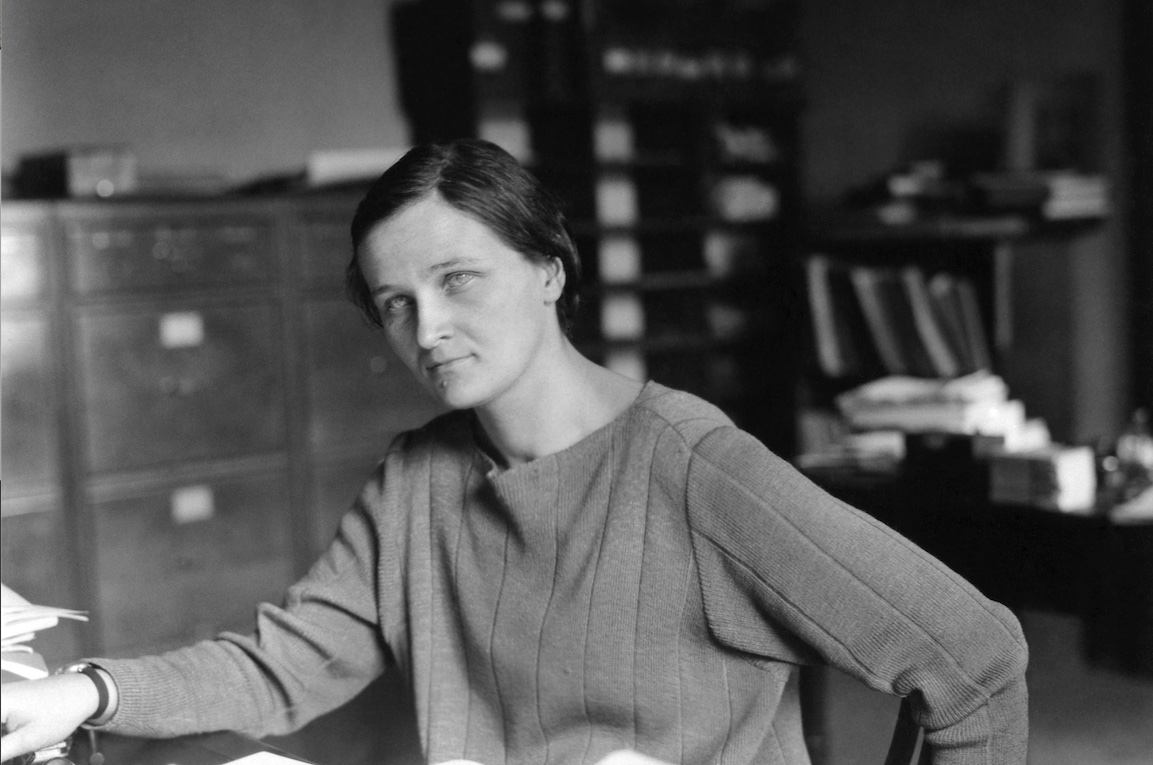
Born May 10, 1900, Cecilia Payne-Gaposchkin was also the first person to discover that stars are primarily made up of hydrogen and helium — a finding that took years to be acknowledged by the scientific community.
Born in Wendover, England, Payne-Gaposchkin was an active student. She attended Cambridge University with an interest in science but was unsure of what to focus on. There, she met astronomer Arthur Eddington, who — after she bombarded him with an onslaught of questions — gave her access to professional astronomical journals. Thus, her career in astronomy began.
Payne-Gaposchkin pursued her advanced degree at Harvard under the guidance of Harlow Shapely, Edward Pickering’s successor. Like Annie Jump Cannon and Henrietta Leavitt, she looked at the spectra of stars, but also took up the study of quantum physics. During these studies, she ultimately confirmed the idea that varying star colors are due to the stars’ temperatures. She also showed that differences in stellar spectra are not due to disparate chemical composition in stars — which was the accepted theory at the time — but due instead to differing temperatures. Thus, stars are all mostly made of the same elements: hydrogen and helium.
In 1925, her doctoral dissertation asserted these findings, which were soon deemed “clearly impossible” by Princeton University Professor Henry Norris Russell. She was forced to downplay her work. Only later did others come to the same conclusion, and astronomers Otto Struve and Velta Zebergs said hers was “the most brilliant Ph.D. thesis ever written in astronomy.”
Despite this hitch in her early career, Payne-Gaposchkin continued to work as Shapley’s assistant, teaching for some time before being officially appointed as a professor in 1956. The same year, she was designated chair of the Harvard astronomy department.