
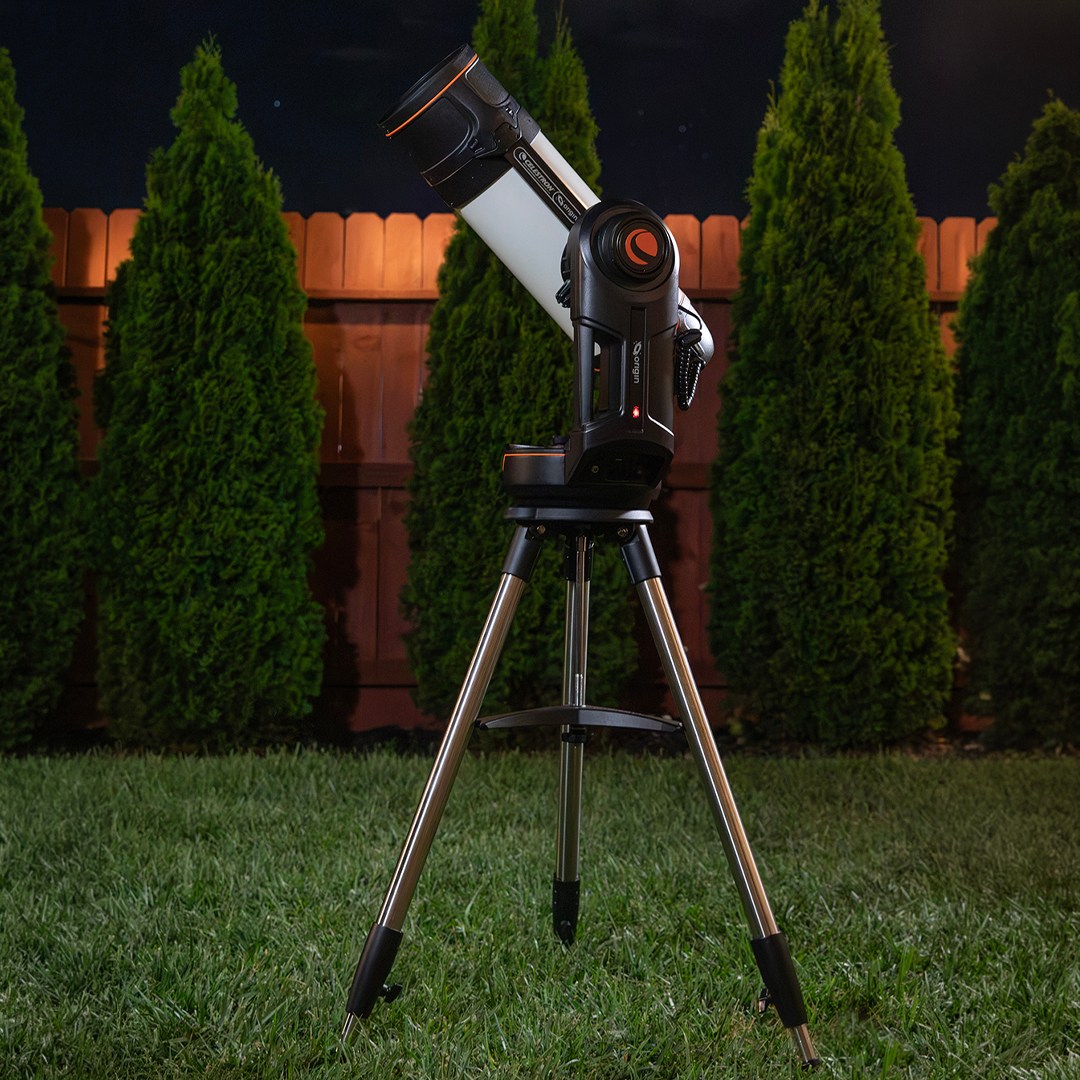
Almost any galaxy or nebula that the Celestron Origin Intelligent Home Observatory can find will fit in its field of view in a single shot. But there is a short list of exceptions.
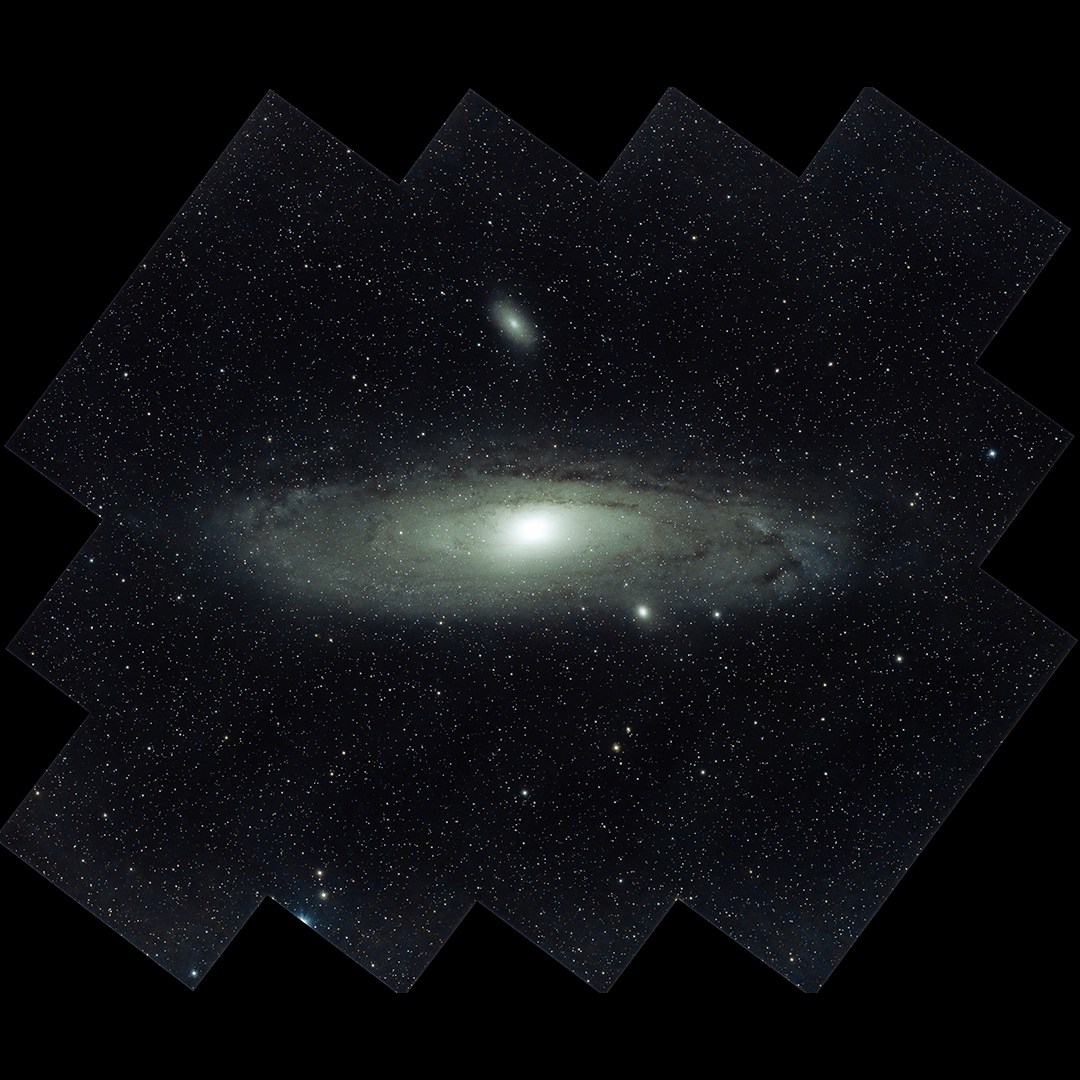
For instance, the Andromeda Galaxy (M31), the nearest major galaxy to our own and a popular first target, stretches about 3° from end to end. And the iconic North America Nebula (NGC 7000), which lies just 2,600 light-years away in Cygnus, spans roughly 2°. Both of these objects spill out of the field of view of the Origin Mark II, which, with its 6-inch (152 mm) f/2.2 Rowe-Ackermann Schmidt Astrograph (RASA) optics, captures a field of 1.32° by 0.75°.
Celestron’s answer is Mosaic Mode, a free update that brings automated mosaic imaging to the Origin smart telescope. In the Origin app, users draw a box around their target. Origin then divides that area into overlapping tiles, slews to each position, captures the data, and stitches the results into a single wide-field image.
Celestron Innovation Specialist Eric Kopit estimates that 90 percent or more of what Origin can see fits within its field of view. “The vast majority of objects” — most galaxies, globular clusters, and planetary nebulae — “are really small,” Kopit says. “But the objects most people want to start with are bigger.”
The ease of imaging with smart telescopes has brought a wave of newcomers into the hobby, he says, and those showpieces are usually what they reach for. Mosaic Mode ensures their reach does not exceed their grasp.
A different kind of night
Mosaic Mode changes the rhythm of an Origin session. The telescope’s standard experience is built around watching an image take shape on your phone, tablet, or smart TV in near-real time. A mosaic is closer to an overnight project. Large targets can take hours, so Kopit says users can set the telescope to turn itself off once it’s done. Users can still watch the tiles come in, but it isn’t a requirement.
Those long capture times also made mosaic image stitching a challenge to bring to life. Each tile is shot at a different point in the night, and conditions can change from one moment to the next. A passing cloud might dim one tile and leave its neighbors untouched.
Targets with a wide range of brightness, like Andromeda, presented their own challenge. “One tile is a bright core, others are faint dust lanes,” Kopit says.
Early versions of the software had trouble blending exposures that were so different, but a recent firmware update reworked the processing. According to Celestron’s release notes, the new version produces fewer visible seams, better preserves faint nebulosity, aligns tiles more accurately, and better rejects frames corrupted by external light sources.
Cleaner data with dithering
Mosaic Mode follows another software addition to Origin’s feature set aimed at users who want to push their images further.
With dithering, the telescope nudges itself slightly between exposures so the target lands on different pixels in each frame. Hot pixels and other sensor defects stay put on the chip, so once the frames are aligned to the stars, those defects end up scattered. Stacking software can then recognize them as outliers and toss them out.
Astrophotography dithering is a technique advanced imagers have relied on for years, and Origin owners had been asking for it.
“We had it on our roadmap, and people wanted it,” Kopit says.
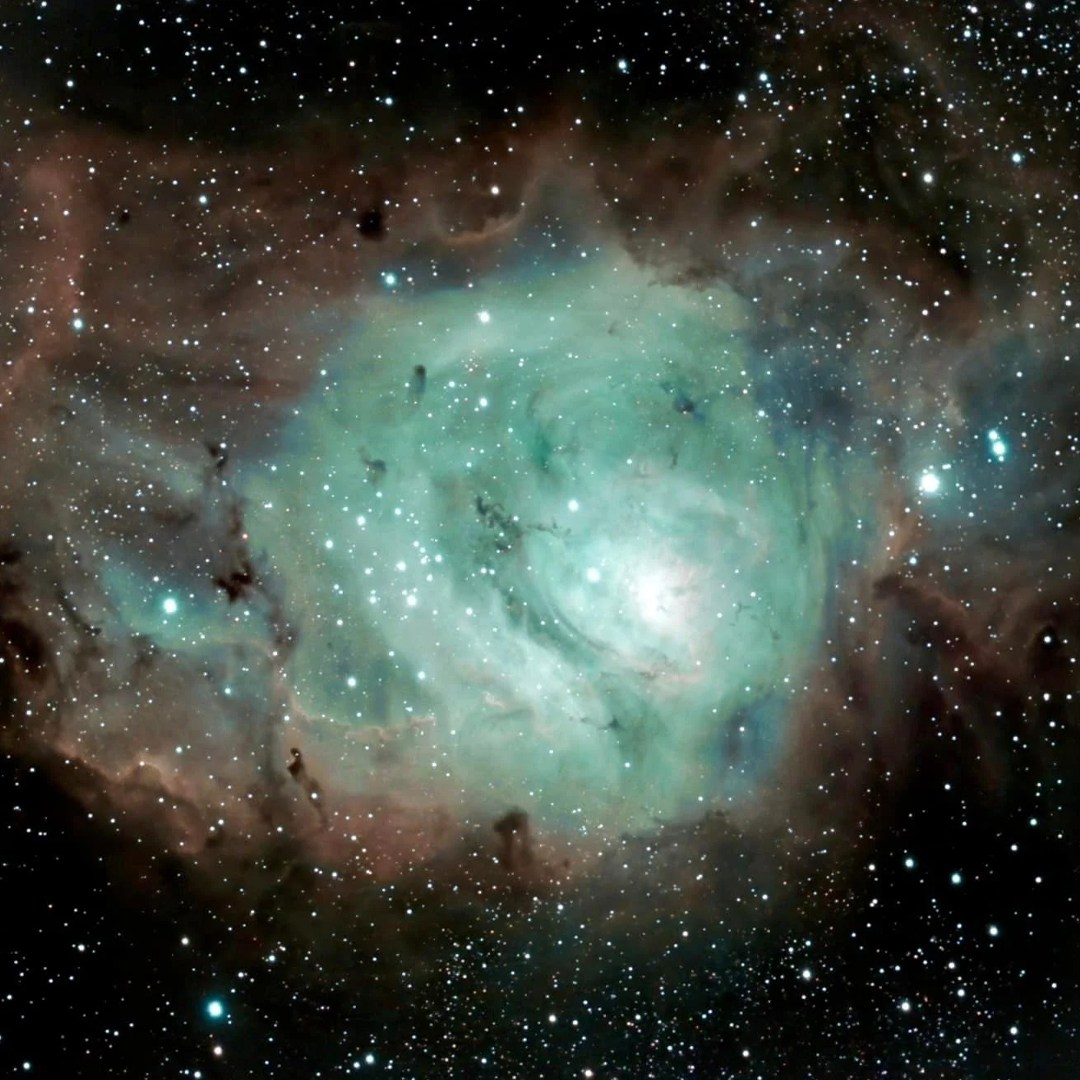
Both Mosaic Mode and dithering work on every Origin, not just the Mark II that Celestron introduced in October 2025. The two generations share the same optics and electronics. The only difference is the camera, which owners can replace.
Camera sensors improve quickly, largely because Sony develops them for other industries. Astronomy gets to borrow the results, meaning a telescope with a fixed camera falls behind rather quickly.
“Modularity was always the vision,” Kopit says. “It can continue to take on new features so that you can keep the rest of the system.”
The Mark II’s camera uses Sony’s IMX678 sensor, an 8.4-megapixel chip with 2.0-micrometer pixels. The original Origin used the 6.4-megapixel IMX178, with 2.4-micrometer pixels.
Those smaller pixels matter more than you might expect on a telescope this fast. At f/2.2, Kopit says, Origin’s resolution is limited more by pixel size than by its 6-inch (152 mm) aperture. With a 335 mm focal length, the Mark II samples the sky at about 1.2″per pixel, compared with about 1.5″ on the original camera.
Sensors with larger pixels used to be commonly preferred in astrophotography for their increased sensitivity, but newer designs have changed that. Kopit sees room for more gains as pixels keep shrinking. First-generation owners can buy the new Origin 678C camera and install it themselves or have Celestron handle the upgrade.
Turning imaging into observing
Celestron first sketched the idea for Origin in 2011, before the technology existed to support it. The original goal wasn’t deep-sky astrophotography, but rather helping people see galaxies and nebulae the way they see the Moon and planets through an eyepiece.
“The idea is to aid the eye,” Kopit says. “For us, it’s turning imaging into a visual experience.”
In practice, that means users experience very little waiting. After the app connects, Origin focuses itself, uses Celestron’s StarSense technology to recognize the sky, and aligns in about a minute. When users tap a target in the SkySafari-powered planetarium view, the telescope begins taking 10-second exposures, stacking each new frame onto the last. Because the fast optics pour so much light onto a sensitive sensor, even the first exposure can reveal detail, and this view rapidly sharpens as the telescope stacks more exposures.
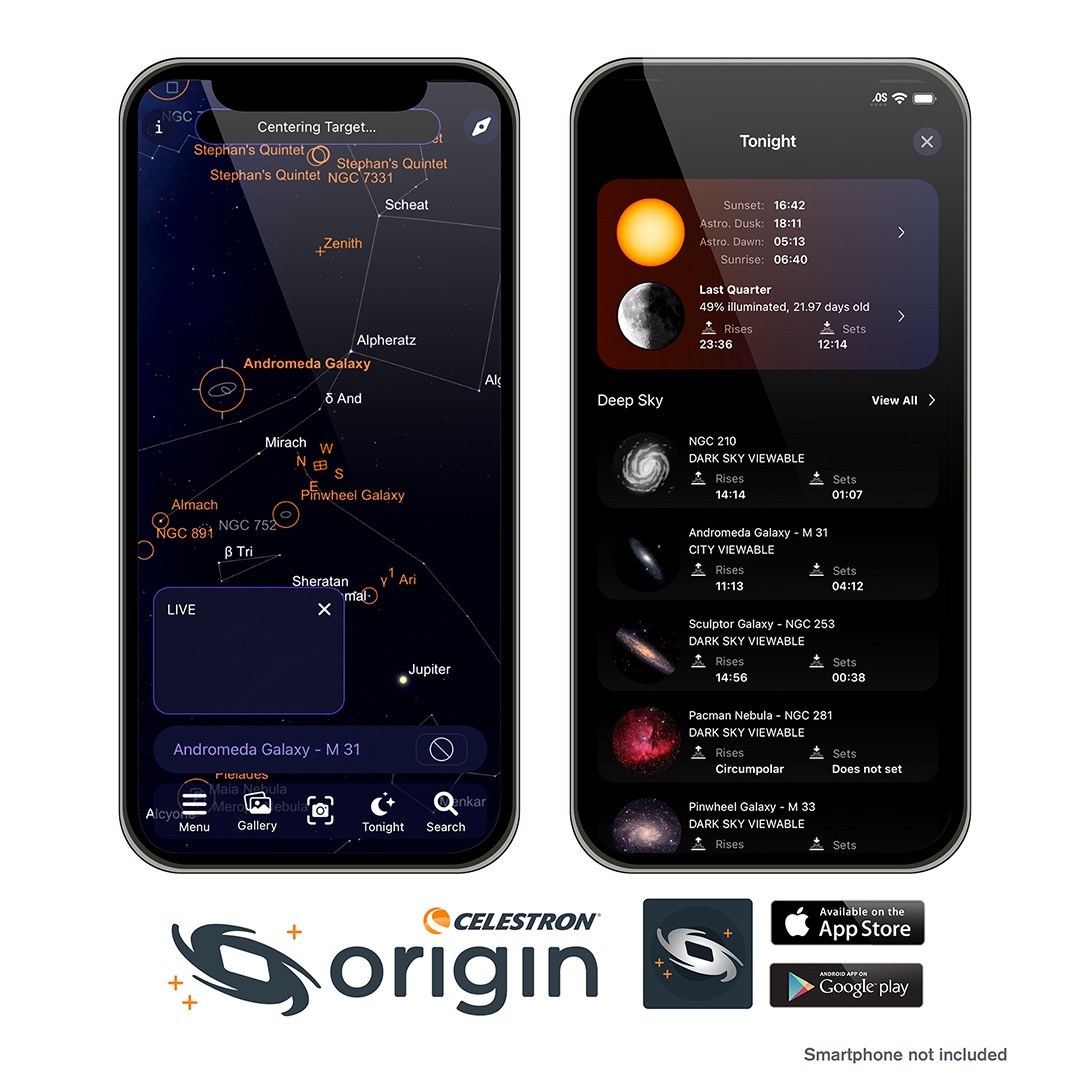
Thanks to this speed, capturing ten or more objects in a night can be a realistic observing plan. The app also offers audio presentations on more than 200 popular targets along the way. When users end the session, the final stacked image saves to the device, acting as a digital souvenir of the night.
Room to grow
The Origin app keeps its core controls up front and tucks advanced settings into deeper menus. A first-time user never has to touch them, which makes Origin an intuitive entry point into astrophotography.
Those venturing deeper into the app will find an option for equatorial mode, which uses an optional wedge to reduce field rotation, along with support for the StarSense Autoguider. This ability for users to choose the depth of their experience speaks to the different kinds of people attracted to Origin.
Celestron always expected Origin would be alluring even to experienced imagers — not just beginners. What surprised the company, however, was how many veteran astrophotographers have made it their primary rig. Many of those buyers already own a full imaging setup, Kopit says, but Origin is far easier to get running on a given night.
Kids sit at the other end of the spectrum. These young users often want to look through a telescope but struggle to see anything in an eyepiece. On a tablet screen, they can see it.
“With kids particularly, it opens up the hobby,” Kopit says.
Mosaic Mode is available now through the app and the latest Origin firmware. Kopit says more features are on the way.