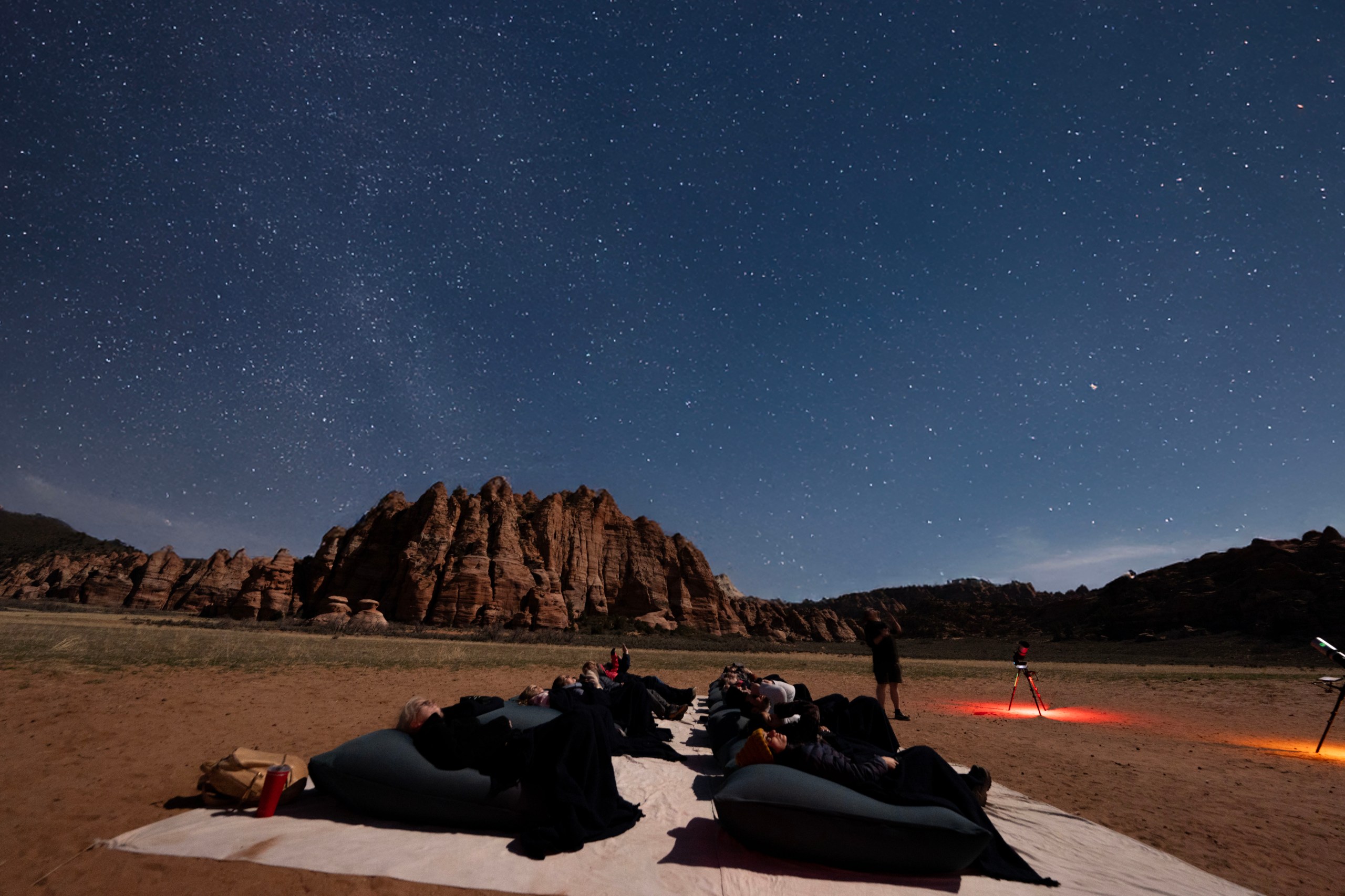

The desert goes quiet before the stars appear. Without engine sounds or ambient glow, you’re left with wind crossing sandstone as the last light drains from the canyon walls. Then the sky opens up.
This is Greater Zion, a region in southwestern Utah where pristine darkness is a destination in its own right. When your eyes fully adapt, you are looking at the Milky Way as our ancestors saw it. You can see the galactic center blazing above the horizon, its dust lanes threading through the brightness like rivers. The Andromeda Galaxy hangs as a visible smudge 2.5 million light-years away, no telescope required.
This quality of sky does not happen by accident.
Greater Zion sits under one of the most accessible dark-sky corridors in the American Southwest. Zion National Park holds an International Dark Sky Park designation from DarkSky International. Springdale, the gateway town adjacent to the park, is a certified International Dark Sky Community, one of a rare few communities worldwide to hold that status alongside a certified park on its doorstep.
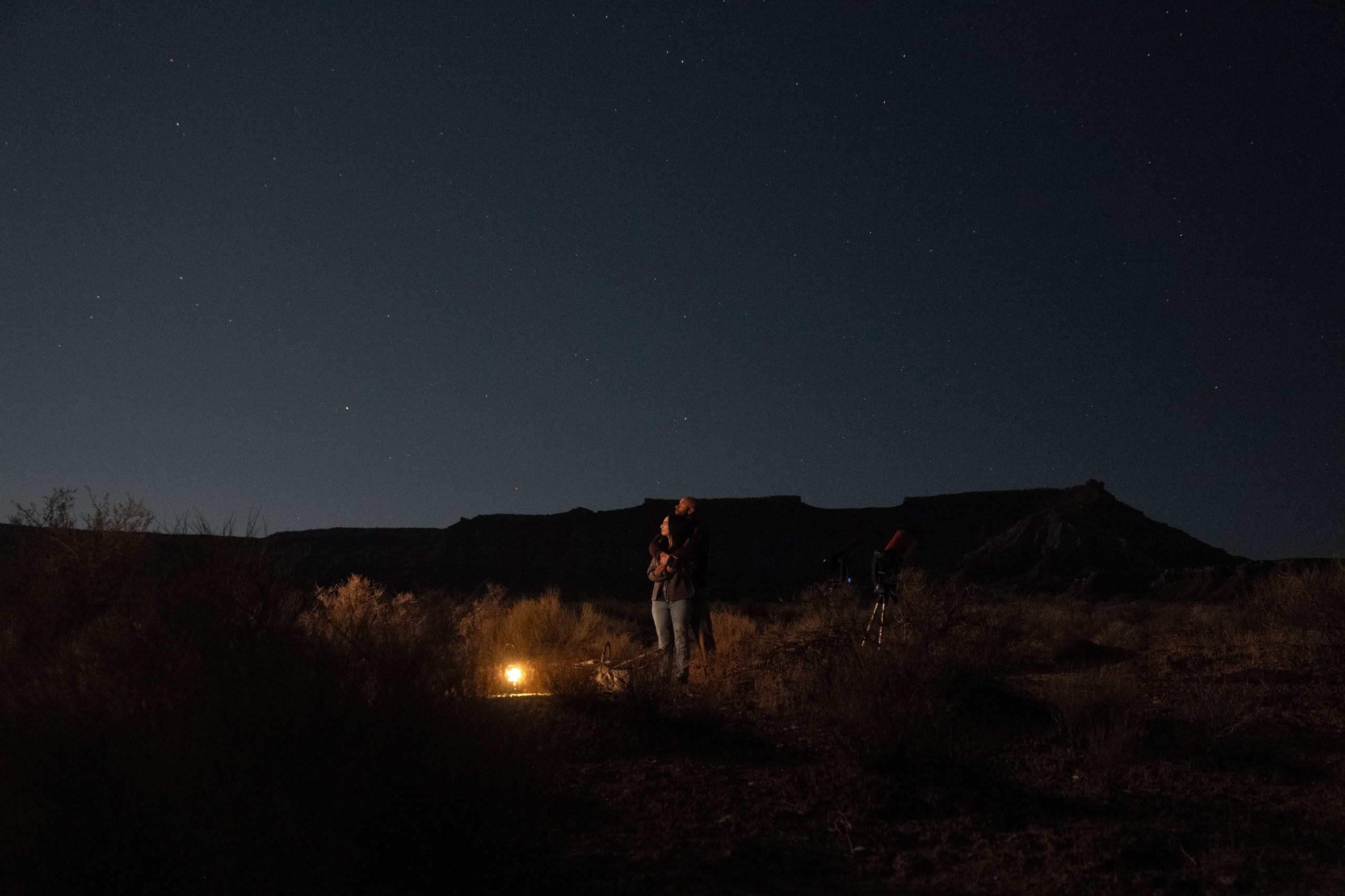
In December 2025, Snow Canyon State Park, just 15 minutes from St. George, Utah, added a third layer: DarkSky International certification as an Urban Night Sky Place, the 10th Utah State Park to earn recognition. Park staff spent years modifying every fixture to achieve 100% compliance with responsible lighting standards, but darkness was achievable even close to populated areas.
Utah leads the world in DarkSky International-certified locations. Kolob Canyons, the remote northwestern section of Zion National Park, rounds out the region’s dark-sky geography with deeper elevation and narrower canyon walls that reward you if you’re willing to venture beyond the main corridor.
The physics behind Greater Zion’s exceptional skies compound in the visitor’s favor. Elevations range from roughly 3,000 feet (900 meters) to over 10,000 feet (3,000 m) throughout the region, pushing observers above the thickest layer of the atmosphere. The desert climate keeps humidity low and air masses stable, reducing the aerosol scatter that washes out faint objects at lower, more humid locations. The stars here appear sharper, and the limiting magnitude for naked-eye visibility regularly exceeds 7.0.
The red-rock geology adds something no purely remote dark-sky site can replicate for astrophotography. The contrast between the Milky Way arching over Zion’s sandstone cliffs and canyon silhouettes produces images that are immediately recognizable as Greater Zion, with a foreground almost as dramatic as the sky.
Reaching this sky requires no specialized equipment and no astronomy background. Greater Zion has built an ecosystem of guided experiences accessible to anyone, from a first-time stargazer to a dedicated observer.
Ranger-led astronomy programs at Zion National Park and Snow Canyon State Park offer free, beginner-friendly evenings connecting the sky to the science and mythology behind it, no equipment needed.
If you want to go deeper, two private outfitters operate guided experiences that have become destination experiences in their own right.
Stargazing Zion conducts its tours from a private dark-sky location near the western boundary of Zion, on Kolob Terrace Road, where the estimated sky quality meter reading reaches 21.70 magnitudes per square arcsecond, which puts the site among the darkest accessible locations in the region. The experience begins with a guided walk through a scale-model solar system, each stop representing a planet and giving guests a visceral sense of the distances involved before the telescopes come out. Guests then settle into zero-gravity reclining pods with blankets and binoculars as guides conduct a laser-guided tour of the constellations, weaving together the science, mythology, and history of the night sky.
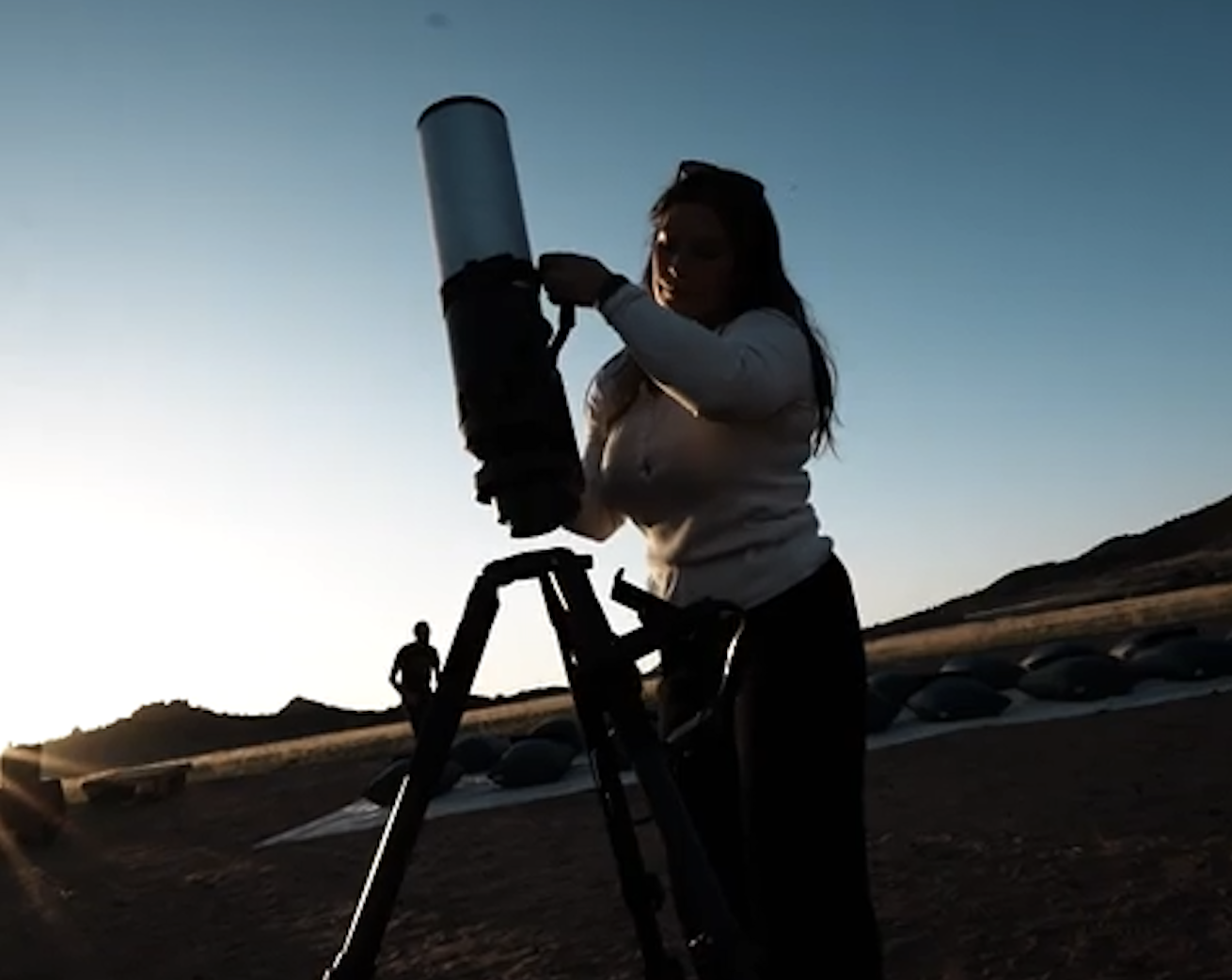
Telescopes, including Celestron, Sky-Watcher, Unistellar eVscope, and Explore Scientific instruments, are pre-programmed and operated with a single keypad button, making high-magnification views of galaxies, nebulae, and clusters accessible to anyone in the group. Tours run approximately two hours.
Dark Skies Astronomy Tours operates nightly from just outside Hurricane, Utah, roughly 45 minutes from Zion. The team, composed of Air Force veterans and space professionals with backgrounds in astronomy education and NASA-affiliated research, structures the experience around a 45-minute laser-guided constellation tour followed by 45 minutes of telescope interaction with an 8-inch optical instrument and three to five digital telescopes. Images captured during the tour are sent to guests the following day. The operation is wheelchair accessible, and Dark Skies Astronomy Tours partners with Black Desert Resort in Hurricane for guests who want guided stargazing built into their lodging.
Both operations keep group sizes intentionally small and provide all necessary equipment and amenities. They even monitor weather conditions daily, notifying guests by early afternoon when conditions warrant a reschedule.
Greater Zion’s dark-sky commitment extends to its lodging landscape. Several glamping properties in the Virgin area (including Open Sky, Wildflower, AutoCamp Zion, and Zion White Bison Resort) offer accommodations designed for guests who want the night sky as part of the stay. Additional dark-sky-oriented properties operate in Hildale, Ivins, and Hurricane. Plan ahead, since tour group sizes are kept small by design, and spots fill quickly.
Approximately 10 million visitors come to Greater Zion each year. Those who stay after dark discover that the region they came to see in daylight is an entirely different place once the canyon walls go black and the stars take over.
One night out here is rarely enough.
Explore guided dark-sky experiences and plan your visit at GreaterZion.com.